ISLAMABAD — May 8, 2026 : Pakistan has officially unveiled the Fatah-3 supersonic cruise missile, introducing a new high-speed precision-strike system into the country’s expanding conventional missile arsenal and significantly extending the capabilities of the Fatah missile family.
The missile was publicly displayed on May 7 under the Pakistan Army Rocket Force Command during a presentation of newly developed indigenous defence systems. The unveiling marks Pakistan’s formal entry into the supersonic cruise missile category with a domestically fielded system designed for both land-attack and anti-ship operations.
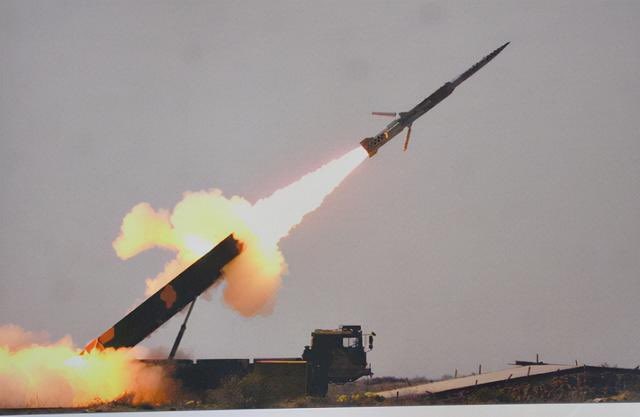
Defence analysts have identified the Fatah-3 as a localized derivative of China’s HD-1 supersonic cruise missile developed by Guangdong Hongda, although Pakistani military authorities have not officially confirmed the design origin. The displayed system featured a road-mobile twin-canister transporter-erector-launcher (TEL), a configuration intended to enhance operational mobility and survivability through rapid deployment and repositioning.
Missile Specifications and Strike Role
According to technical assessments based on the publicly displayed system, the Fatah-3 is capable of reaching speeds between Mach 3 and Mach 4 and has an estimated operational range of approximately 290 to 450 kilometres. The missile reportedly carries a warhead weighing between 240 and 400 kilograms.
The system is designed to perform precision land-attack missions as well as anti-ship strike operations. Analysts state that the missile incorporates terrain-following and sea-skimming flight profiles intended to reduce radar visibility and shorten defensive reaction times during terminal engagement.
The missile is believed to use a ramjet propulsion system supported by a solid rocket booster for initial acceleration after launch. Guidance reportedly combines satellite navigation with terminal seeker systems to improve targeting accuracy during the final phase of flight.
The twin-canister TEL configuration enables the missile system to conduct rapid launch-and-relocation operations, improving survivability against counterbattery fire and pre-emptive strikes during high-intensity conventional engagements.
Expansion of the Fatah Missile Family
The Fatah-3 represents a major expansion of Pakistan’s Fatah missile programme, which previously focused on guided rocket artillery and subsonic cruise missile systems.
Earlier systems in the family included the Fatah-I guided rocket system with a reported range of approximately 140 kilometres and the Fatah-II with an estimated range between 290 and 400 kilometres. Pakistan had also earlier introduced the Fatah-IV, a subsonic land-attack cruise missile reportedly capable of striking targets at ranges of around 750 kilometres.
With the introduction of the Fatah-3, Pakistan has now expanded the series into the supersonic cruise missile category, adding a high-speed precision-strike capability intended for operations against both fixed land targets and moving maritime targets.
Comparison With India’s BrahMos Missile
Regional defence analysts widely regard the Fatah-3 as Pakistan’s direct conventional response to India’s BrahMos supersonic cruise missile programme.
While both systems operate in the supersonic strike category, the Fatah-3 is assessed to be significantly lighter than many BrahMos variants. Current estimates place the Fatah-3 launch weight between approximately 1.2 and 1.5 tonnes, compared to more than 2.5 tonnes for several BrahMos configurations.
Analysts note that the reduced launch weight may simplify transportation and deployment requirements while allowing greater launcher mobility. However, propulsion architecture and terminal flight performance remain key factors in overall missile survivability and operational effectiveness.
Propulsion and Terminal Flight Characteristics
Technical assessments indicate that the Fatah-3 employs a solid-fuel ramjet propulsion system, whereas the BrahMos uses a liquid-fuel ramjet configuration.
Defence technology specialists note that many solid-fuel ramjet-based supersonic cruise missiles face operational limitations related not to peak velocity, but to terminal energy management during the final engagement phase.
According to aerospace analysts, restricted throttling authority, grain regression dynamics and limited combustion modulation can reduce sustained specific excess power during high-G terminal manoeuvres. During engagements against manoeuvring naval targets, these limitations may affect post-turn energy retention and overall endgame agility.
Analysts state that such constraints can result in a comparatively smaller no-escape envelope and may make interception easier under certain layered air-defence conditions despite the missile’s high speed.
In contrast, liquid-fuel ramjet systems such as the BrahMos maintain greater throttle responsiveness and sustained dynamic pressure throughout terminal flight. This enables improved energy recovery during sea-skimming manoeuvres, sharper evasive flight profiles and stronger manoeuvre authority under aggressive lateral loading conditions.
Defence specialists note that missile survivability depends not only on raw velocity, but also on terminal manoeuvrability, seeker stabilization and sustained energy management during the final attack phase.
Chinese HD-1 Connection and System Development
The Chinese HD-1 missile family, which analysts believe formed the baseline for the Fatah-3, was originally developed as a multi-role high-speed strike system capable of conducting both anti-ship and land-attack missions.
The adoption of a solid-fuel propulsion architecture is assessed to simplify storage, transportation and launch preparation compared with older liquid-fuel missile systems. Analysts state that such systems generally require less complex handling procedures and support faster launch readiness during operational deployment.
Pakistan military officials described the Fatah-3 programme as part of broader efforts aimed at strengthening indigenous defence production and improving self-reliance in precision-strike technologies.
The missile was unveiled alongside several other newly developed systems, including a long-range rocket-dispensed mine system. Some defence reports have also indicated the possibility of future air-launched and sea-launched variants of the Fatah-3, although no official confirmation or timeline has been released.
Regional Security Context
The public unveiling took place near the first anniversary of last year’s four-day conflict between India and Pakistan, a confrontation that intensified regional focus on stand-off precision strike systems, survivable launch platforms and integrated air-defence penetration capabilities.
Pakistan has not released detailed official operational data or complete technical specifications for the Fatah-3 beyond the public presentation. Most currently available information is based on visual analysis of the displayed missile system, comparative studies with the Chinese HD-1 design and independent technical assessments by defence analysts.
The introduction of the Fatah-3 adds a new supersonic precision-strike capability to Pakistan’s conventional missile inventory and reflects the continuing expansion of long-range strike systems across South Asia. Additional details regarding operational integration, deployment status and future variants are expected in the coming months.
——— End of Article ———