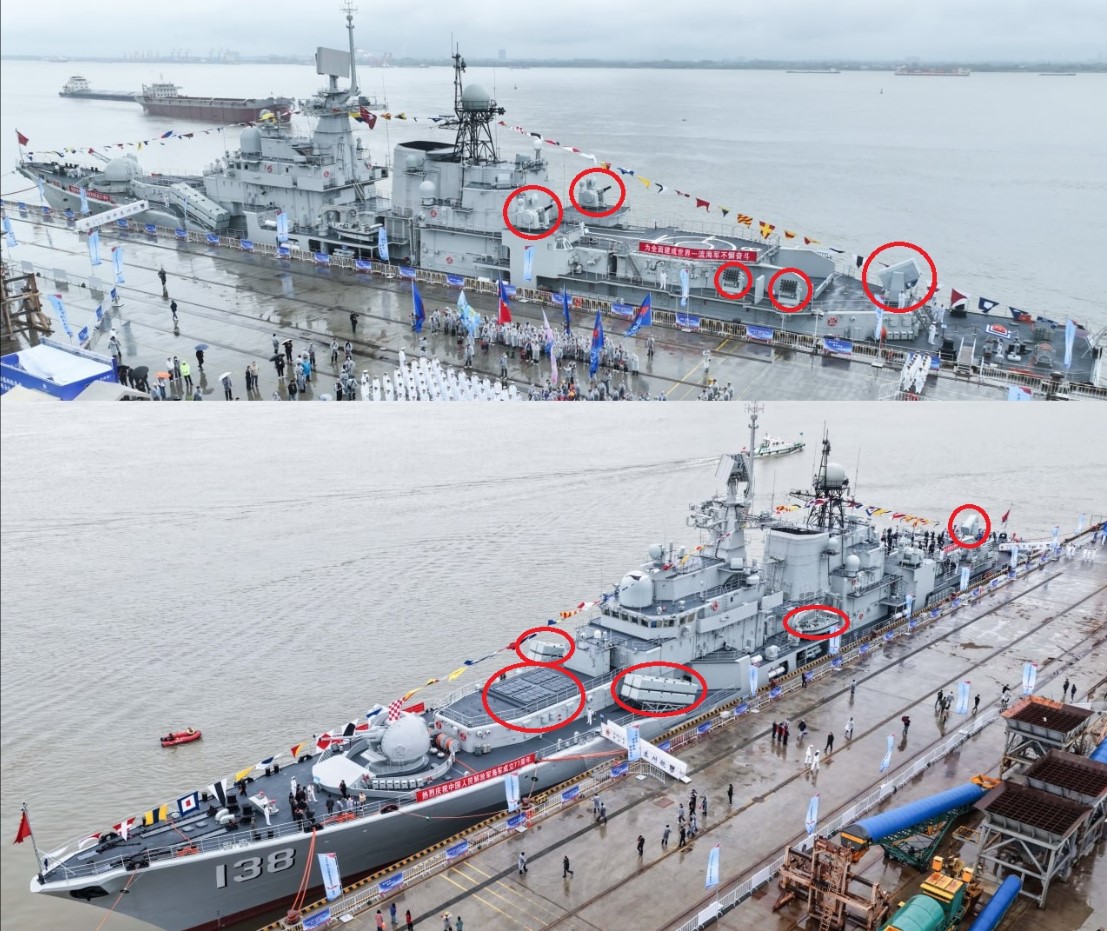
BEIJING — April 25, 2026 : During the 77th anniversary of the People's Liberation Army Navy (PLAN) on April 23, 2026 , the Type 956EM destroyer Taizhou (Hull 138) was placed on public display, coinciding with the announcement that the navy has completed a comprehensive mid-life modernization of the vessel, according to newly released official imagery and exhibition photographs. The upgrade represents a full-scale transition from legacy Russian-origin systems to standardized, domestically developed Chinese combat technologies.
The Taizhou, the third of four Sovremenny-class destroyers procured from Russia, was originally laid down at the Severnaya Verf shipyard in Saint Petersburg in 2002 and commissioned into PLAN service on December 28, 2005. Assigned to the Eastern Theater Command Navy, the vessel was built to the improved Project 956EM standard. Its modernization forms part of a broader PLAN program initiated around 2014 to extend the operational lifespan of imported hulls while aligning them with contemporary fleet requirements.
Replacement of Russian-Origin Weapon Systems
The refit has resulted in the near-total removal of the destroyer’s original Russian-supplied weapons and defensive suites. The most significant change involves the replacement of the 3M80E Moskit (SS-N-22 Sunburn) anti-ship missile system. The earlier configuration of two quadruple launchers has been removed and replaced with two quadruple launchers for the Chinese YJ-12 supersonic anti-ship missile. The YJ-12 provides improved engagement range, higher terminal speed, and enhanced targeting capability.
In the area of air defence, the legacy Shtil system, which relied on a single-arm beam launcher, has been fully dismantled. It has been replaced with the Chinese HHQ-16 medium-range surface-to-air missile system, deployed through the H/AJK-16 vertical launch system. The installation consists of 48 vertical launch cells capable of firing both HHQ-16 surface-to-air missiles and Yu-8 anti-submarine rockets. This transition introduces a modern, multi-role launch capability consistent with other PLAN surface combatants.
Modern Close-In Defence and Anti-Submarine Systems
Close-in defence capabilities have also been upgraded. The original Kashtan combined gun-and-missile CIWS mounts have been removed and replaced with two Type 1130 (H/PJ-11) 11-barrel rotary close-in weapon systems. These systems provide higher rates of fire and improved interception performance against incoming missiles and aerial threats. Additionally, a 24-cell HQ-10A short-range air defence system has been installed, enhancing layered air defence coverage.
Anti-submarine warfare systems have been modernized through the replacement of the original Russian torpedo tubes with Chinese 324 mm triple torpedo launchers. The ship is also equipped with Yu-8 anti-submarine missiles deployable from the vertical launch system, extending its engagement envelope against underwater threats.
To improve survivability, the vessel has been fitted with four 24-tube launchers for the H/RJZ-726-4A decoy system. This provides enhanced electronic countermeasure and soft-kill defence capabilities against anti-ship missiles.
Retained Gun System and Structural Configuration
Despite the extensive overhaul, the forward-mounted 130 mm AK-130 twin naval gun—one of the defining features of the Sovremenny-class—has been retained. This preserves the ship’s capability for naval gunfire support and surface engagement. The aft AK-130 gun, which was never included in the Project 956EM design due to the extension of the helicopter flight deck, remains absent in the upgraded configuration.
Sensors, Electronics, and Fleet Integration
All radar systems, fire-control equipment, and onboard electronics have been replaced with Chinese-produced equivalents. These upgrades are intended to improve interoperability with other PLAN assets, particularly modern platforms such as the Type 052D destroyers and Type 054A frigates. The integration of standardized combat systems allows the Taizhou to operate more effectively within network-centric naval operations.
Modernization Timeline and Program Context
The PLAN’s Sovremenny-class modernization program began with the earlier Project 956E ships, Hangzhou (Hull 136) and Fuzhou, which completed their upgrades between 2015 and 2019. The two improved Project 956EM vessels, including Taizhou, followed in subsequent phases.
Taizhou entered its refit period around early 2022 at a Chinese shipyard. It reappeared in late 2025 with its upgraded configuration, and official imagery released in November 2025 confirmed the completion of the modernization work. The fourth ship in the class, Ningbo (Hull 139), is expected to undergo a similar upgrade in the near future.
Operational Implications
With the installation of vertical launch systems, modern air defence layers, and upgraded anti-ship and anti-submarine capabilities, the Taizhou now aligns with current PLAN operational standards. The modernization enhances its strike range, defensive coverage, and overall combat effectiveness.
The refit underscores China’s capacity to sustain and extensively modify foreign-built naval platforms using indigenous technologies. It also reflects a broader strategy to maintain fleet size and capability by upgrading existing vessels alongside the introduction of new-generation warships.
——— End of Article ———