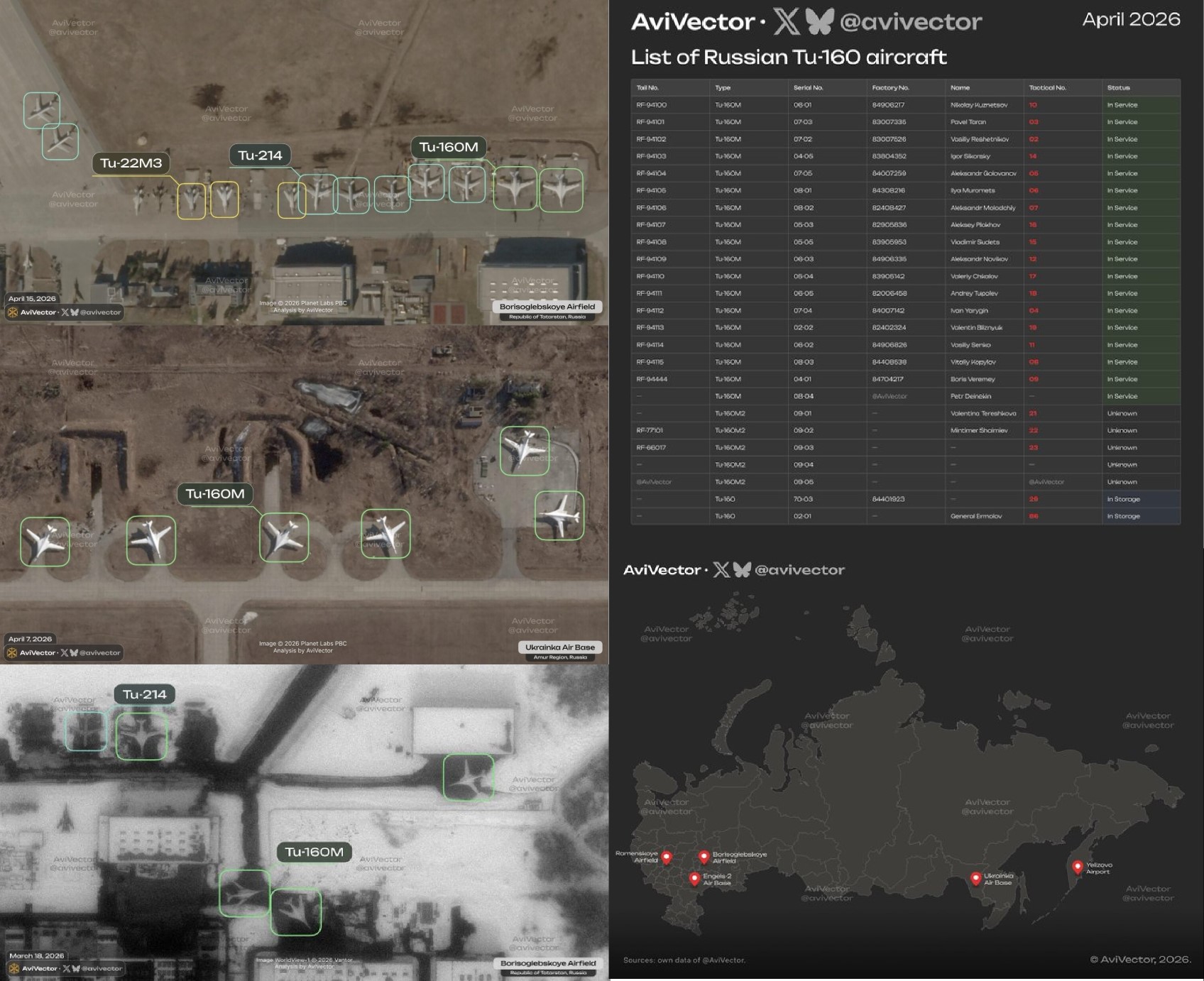
MOSCOW / AMUR OBLAST — April 17, 2026 : Recent open-source intelligence and registry data indicate that only a limited portion of Russia’s modernized strategic bomber fleet is currently being used in combat operations against Ukraine. According to analysis conducted by monitoring group AviVector, just seven out of the 18 Tu-160M “Blackjack” aircraft in service with the Russian Aerospace Forces are actively participating in strike missions.
The remaining two-thirds of the fleet are not engaged in frontline operations and are instead assigned to testing, pilot training, scheduled maintenance, modernization programs, or remain under production.
Fleet Composition and Operational Availability
Registry data confirms that Russia maintains a total inventory of 18 Tu-160M aircraft as of April 2026. Of these, only seven are considered operational for combat use. Two additional aircraft are currently held in storage, with analysts assessing that at least one of them has likely been decommissioned and is being used as a source of spare parts to sustain the operational fleet.
In parallel, five newly built Tu-160M2 bombers have been identified. However, their operational or combat-ready status remains unclear based on currently available information.
A significant number of aircraft—estimated between seven and nine Tu-160M and Tu-160M2 units—are located at the Kazan Aircraft Production Association (KAPO). These aircraft are undergoing modernization, assembly, or testing as part of Russia’s ongoing effort to sustain and expand its strategic aviation capability.
Basing and Deployment Structure
Following a Ukrainian strike on Belaya Air Base in June 2025, attributed to the Security Service of Ukraine, Russia reorganized the basing of its strategic bomber fleet. The Tu-160M aircraft are now primarily deployed at Ukrainka Air Base in the Amur region.
The relocation to Ukrainka reflects a strategic decision to position high-value assets farther from densely populated areas and major transport routes, thereby reducing vulnerability to potential long-range attacks or sabotage.
Operational patterns indicate that Tu-160M bombers typically depart from Ukrainka Air Base and transit to Engels-2 Air Base in the Saratov region. At Engels-2, the aircraft are equipped with cruise missiles, including the Kh-101. After completing strike missions, the bombers either return to Ukrainka Air Base or remain temporarily at Engels-2.
Current Distribution of Aircraft
Satellite imagery and registry analysis as of April 16, 2026, provide the following distribution of Tu-160M aircraft across multiple locations:
- Ukrainka Air Base — 6 aircraft
- Engels-2 Air Base — 2 aircraft
- Ramenskoye Airport — 3 aircraft
- Borisoglebskoye Airfield — 2 aircraft
- Yelizovo Airport — 1 aircraft
Additionally, in March 2026, Tu-22M3, Tu-95, and Tu-160 aircraft were observed at Ramenskoye airfield near Moscow. Construction activity at the site indicates ongoing development of new hangars intended to support strategic aviation assets.
Industrial Activity and Production Developments
Satellite imagery dated March 18, 2026, shows two Tu-160M aircraft being moved into a newly constructed production workshop at KAPO. The facility has been under development since 2020 and is part of broader efforts to enhance manufacturing and modernization capacity.
Imagery from April 15, 2026, further indicates that two Tu-160M aircraft remain positioned outdoors at the Kazan facility. As of April 16, 2026, these aircraft were still located in open areas, suggesting they may be awaiting final assembly, testing, or transfer.
Recent deliveries of Tu-160M aircraft to the Russian Aerospace Forces were reported in late 2025 and early 2026, reflecting continued, though limited, production and upgrade efforts.
Technical and Operational Considerations
Available reporting suggests that the limited number of combat-ready aircraft may also be influenced by technical and reliability factors. The Tu-160M platform is based on a Cold War-era airframe, and sustained operational use has increased pressure on critical components.
In a documented incident on September 3, 2025, during a large-scale strike operation, two Tu-160 aircraft experienced failures. One aircraft, identified as “Ivan Yarygin” (tail number 04), encountered a malfunction in its missile launch mechanism. Another aircraft, “Aleksey Plokhov” (tail number 16), aborted its mission after sustaining cockpit damage caused by a lightning strike.
These incidents, combined with maintenance demands and modernization requirements, contribute to reduced operational availability across the fleet.
Infrastructure Expansion
Despite current limitations in active deployment, infrastructure development for strategic aviation continues. Construction of large-scale hangars at Ramenskoye airfield is ongoing, indicating efforts to improve storage conditions and reduce environmental exposure for aircraft.
Recent satellite imagery from both Kazan and Ukrainka shows multiple Tu-160M bombers parked in open areas, highlighting existing constraints in covered storage capacity. The expansion of hangar infrastructure is expected to support long-term fleet preservation and operational readiness.
No official statement from the Russian Ministry of Defence has been released regarding the specific figures outlined in the AviVector analysis.
——— End of Article ———