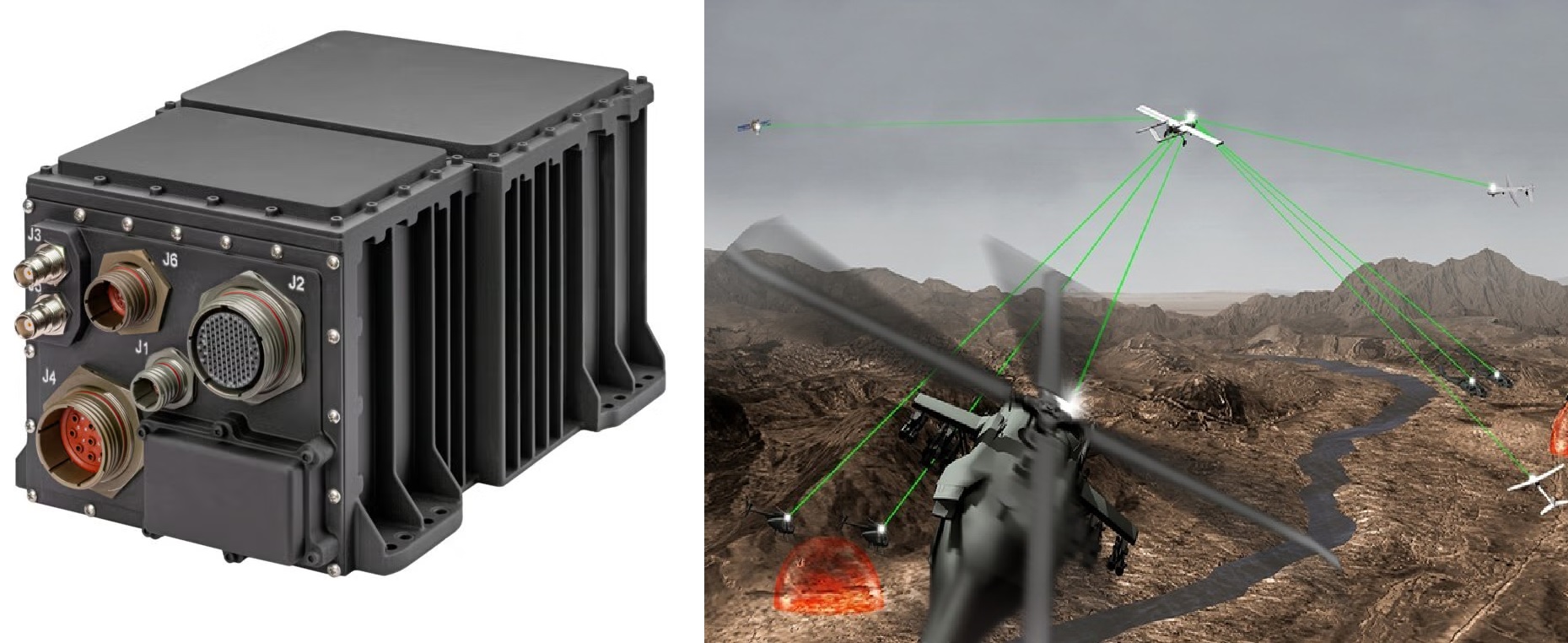
Woodland Hills, California — April 18, 2026 : Northrop Grumman Corporation has delivered the first production unit of its Embedded Global Positioning System/Inertial Navigation System-Modernized (EGI-M), also designated as the LN-351. The airborne navigation system is designed to provide accurate positioning, navigation and timing (PNT) data for military platforms operating in contested and GPS-denied environments, marking a transition of the program toward full-scale production.
The EGI-M is intended to support global military operations by maintaining navigational accuracy in conditions where satellite signals may be degraded, jammed or denied. The system integrates GPS and inertial navigation technologies into a unified hardware and software architecture, enabling continuous navigation performance across a range of operational scenarios.
System Design and Navigation Function
The system combines Global Positioning System (GPS) inputs with an Inertial Navigation System (INS). While GPS relies on external satellite signals for positioning and timing, the INS uses internal sensors, including accelerometers and gyroscopes, to calculate position, velocity and orientation independently of external inputs. This dual-architecture allows seamless transition to inertial navigation when GPS signals are unavailable or compromised.
The EGI-M incorporates a tightly coupled GPS/INS configuration derived from the earlier LN-251 system, with the addition of modern fiber optic gyro technology. The system is designed as a fully integrated, digital, non-dithered navigation unit that minimizes self-induced acceleration and velocity noise. It provides free inertial performance in the range of 0.4 to 2.0 nautical miles per hour and features low angle random walk characteristics to improve stabilization and targeting accuracy.
Resilient PNT and Anti-Jam Capabilities
According to Northrop Grumman, the EGI-M delivers resilient and trusted navigation through military-code PNT capabilities. It includes Blended Navigation Assurance (BNA), a feature that cross-checks navigation data to ensure GPS information remains accurate and secure under electronic attack conditions.
The system is equipped with a 24-channel All-In-View Military GPS User Equipment (MGUE) receiver capable of tracking M-code, P(Y)-code and coarse/acquisition (C/A) signals. It also integrates anti-jam subsystems featuring beam-steering and nulling technologies to counter interference and maintain signal integrity in contested electromagnetic environments.
Open Architecture and Integration Flexibility
The EGI-M is built on a flexible, open systems architecture that enables operators to host third-party PNT applications without requiring direct manufacturer involvement. This approach allows integration with additional sensors and supports tracking of non-GPS satellite signals, enhancing adaptability to evolving operational requirements.
The system provides four independent navigation solutions: blended INS/GPS, INS-only, GPS-only and Blended Navigation Assurance. It supports geo-location for sensor targeting, transfer alignment of remote sensors and stabilization functions for advanced mission systems, including Synthetic Aperture Radar (SAR), Active Electronically Scanned Array (AESA) radars and Electro-Optical/Infrared (EO/IR) sensors.
Interface options include RS-422, ARINC-429, MIL-STD-1553B and Ethernet, with provisions for future integration of fiber-optic and high-speed SerDes connections.
Testing, Standards and Program Timeline
Northrop Grumman stated that the EGI-M has undergone extensive hardware and software testing to meet military performance standards. The system also complies with DO-178C and DO-254 standards, supporting interoperability with civil aviation systems while meeting military requirements.
The program was developed under an engineering and manufacturing development contract awarded by the U.S. Air Force. The system completed its critical design review in 2020. A prototype conducted its first flight test in May 2023 aboard a testbed aircraft, where it demonstrated performance comparable to the LN-251 while incorporating M-code capabilities.
Initial Platforms and Deployment Scope
Initial integration platforms for the EGI-M include the U.S. Navy’s E-2D Advanced Hawkeye and the U.S. Air Force’s F-22 Raptor. Additional fixed-wing and rotary-wing aircraft across the Department of Defense, as well as allied military forces, have selected the system as a future navigation solution.
The system is produced at Northrop Grumman facilities and is intended for use on platforms requiring precise PNT data for navigation, pointing, stabilization and flight control functions.
Official Statements
Ryan Arrington, vice president of navigation and cockpit systems at Northrop Grumman, stated that the company continues to deliver navigation systems designed for operational reliability and adaptability. He said the EGI-M enhances operational effectiveness and is built to address current and future threat environments.
Lt. Col. Chris Grover of the U.S. Air Force said the system provides military assets with the capability to operate with required precision and timing in contested environments.
Ongoing Development
Northrop Grumman indicated that it continues to develop positioning, navigation and timing technologies across multiple domains, including air, land, sea, underwater and space. The company stated that its systems are designed to ensure reliable navigation performance in environments affected by electronic warfare and signal disruption.
——— End of Article ———