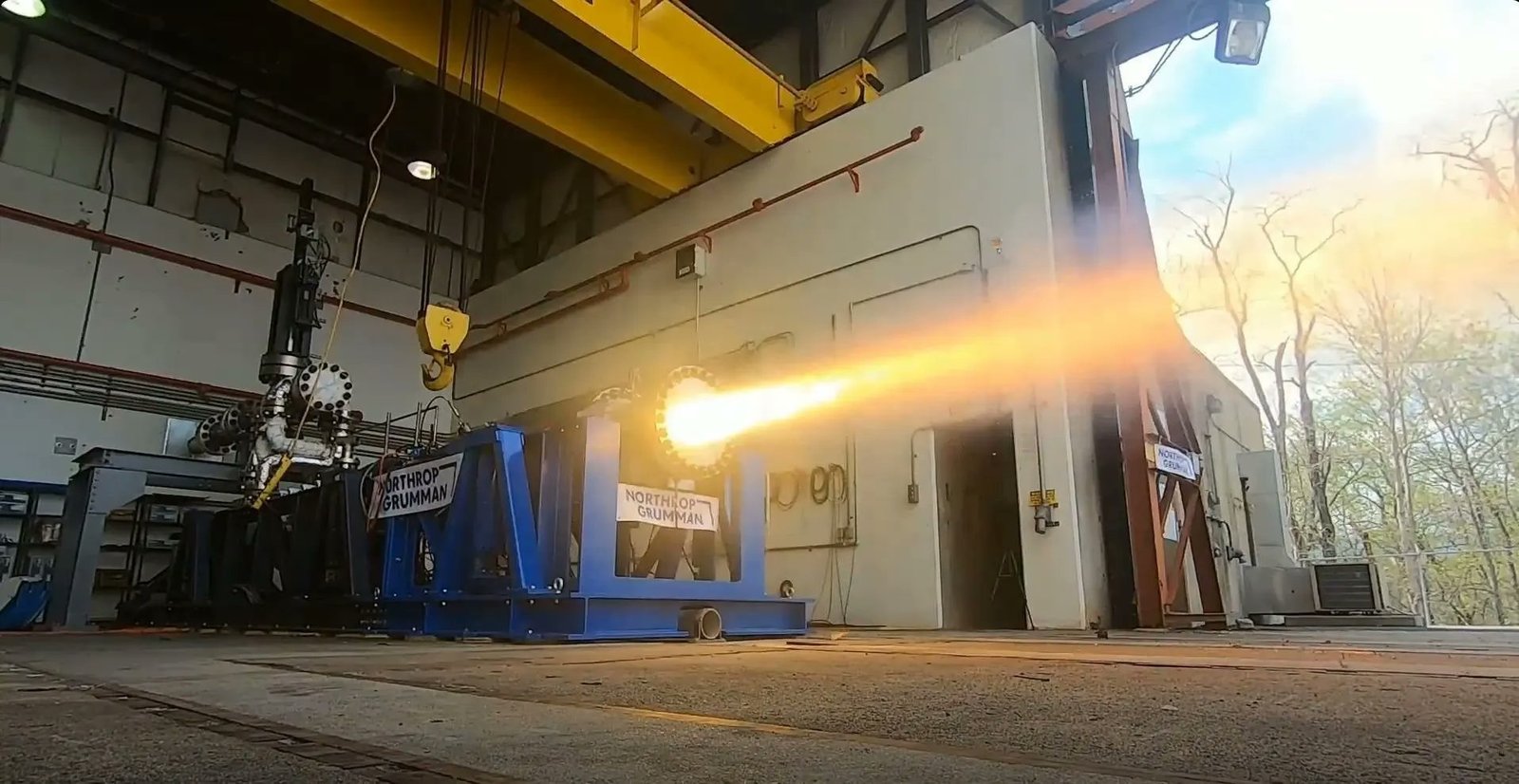
PALMDALE, California — April 18, 2026 : Northrop Grumman announced on April 17, 2026, that its YFQ-48A Talon Blue autonomous combat aircraft has successfully completed its first engine run, marking a key development milestone in the prototype’s progression toward flight testing. The event was carried out in coordination with Pratt & Whitney and the United States Air Force.
The company confirmed the development in a brief statement, noting: “YFQ-48A Talon Blue started its engine for the first time today, a significant advancement achieved with Pratt & Whitney and the United States Air Force.” No further details regarding the exact test location, timeline specifics, or subsequent testing schedule were disclosed.
Propulsion Integration Milestone
The first engine run represents a transition point from a structurally complete airframe to an operational propulsion-integrated system. This stage enables engineers to validate the interaction between the engine, fuel systems, onboard electronics, and the aircraft structure under real ground conditions. Such testing is required before proceeding to taxi trials and eventual flight testing.
The propulsion system for the YFQ-48A is supplied by Pratt & Whitney, an RTX business, and is based on the PW500 family of commercial turbofan engines. Originally developed for business jet applications, the engine has been adapted to meet the operational requirements of the Collaborative Combat Aircraft (CCA) program.
According to Pratt & Whitney, the PW500 family has accumulated more than 24.5 million flight hours. The company conducted an extensive internal test program to simulate mission-specific conditions associated with autonomous combat aircraft operations. These evaluations resulted in measured performance across thrust, operational range, and system reliability parameters. The company also self-funded validation and capability improvements as part of the integration effort.
Peter Sommerkorn, Vice President of Military Development Programs at Pratt & Whitney, stated that the use of a commercial baseline engine enabled faster development timelines while maintaining cost and performance targets. He added that the integration process combined an in-service engine platform with targeted enhancements aligned to CCA mission requirements.
Role in the Collaborative Combat Aircraft Program
The YFQ-48A Talon Blue is Northrop Grumman’s prototype submission for the U.S. Air Force’s Collaborative Combat Aircraft program, a priority modernization effort focused on developing autonomous, uncrewed platforms designed to operate alongside crewed fighter aircraft.
The CCA concept emphasizes the deployment of cost-effective, semi-autonomous aircraft capable of executing missions such as intelligence, surveillance, electronic warfare, and forward strike operations. These systems are intended to expand operational capacity while reducing risk to human pilots.
The YFQ-48A is designed to integrate with existing and future fighter platforms, including the F-35 Lightning II, F-22 Raptor, F-15EX Eagle II, and the planned Next Generation Air Dominance (NGAD) fighter.
The aircraft received its Mission Design Series designation from the U.S. Air Force on December 22, 2025. The “Y” prefix indicates a prototype status, while the “FQ” designation identifies it as an uncrewed fighter-category platform developed specifically for the CCA program.
Aircraft Design and Development
The Talon Blue is developed under Northrop Grumman’s Project Talon portfolio, previously referred to as Project Lotus, in collaboration with its subsidiary Scaled Composites. The design incorporates lessons learned from the company’s earlier, unsuccessful bid for CCA Increment 1.
Compared to previous concepts, the YFQ-48A is smaller, less complex, and optimized for cost and manufacturability. The aircraft features approximately 50 percent fewer parts and is around 1,000 pounds lighter than earlier designs. These changes are intended to support a production process that is up to 30 percent faster through the use of modular construction methods and composite materials.
The airframe configuration includes a long, slender fuselage, swept lambda wings, a V-tail arrangement, and a dorsal air intake positioned above the fuselage. The aircraft is powered by a small turbofan engine. Its landing gear configuration includes widely spaced main gear that retract into the wings, supporting ground handling and structural efficiency.
Program Status and Next Steps
The prototype aircraft, registered as N444LX, is currently undergoing ground-based trials as part of a broader test campaign leading up to its first flight, which is projected to occur in 2026. The YFQ-48A is positioned as a candidate for the next phase of the CCA competition, referred to as Increment 2.
Northrop Grumman’s Project Talon portfolio focuses on delivering modular, scalable, and cost-effective autonomous aircraft systems. The program prioritizes rapid development cycles and mission-ready autonomy, combining software and hardware advancements to accelerate deployment timelines.
The Collaborative Combat Aircraft program remains one of the U.S. Air Force’s central modernization initiatives. It aims to field advanced, affordable autonomous aircraft capable of operating in contested environments alongside crewed platforms. Progress on milestones such as the first engine run contributes to the evaluation of industrial performance, integration maturity, and overall program risk among competing industry participants.
——— End of Article ———