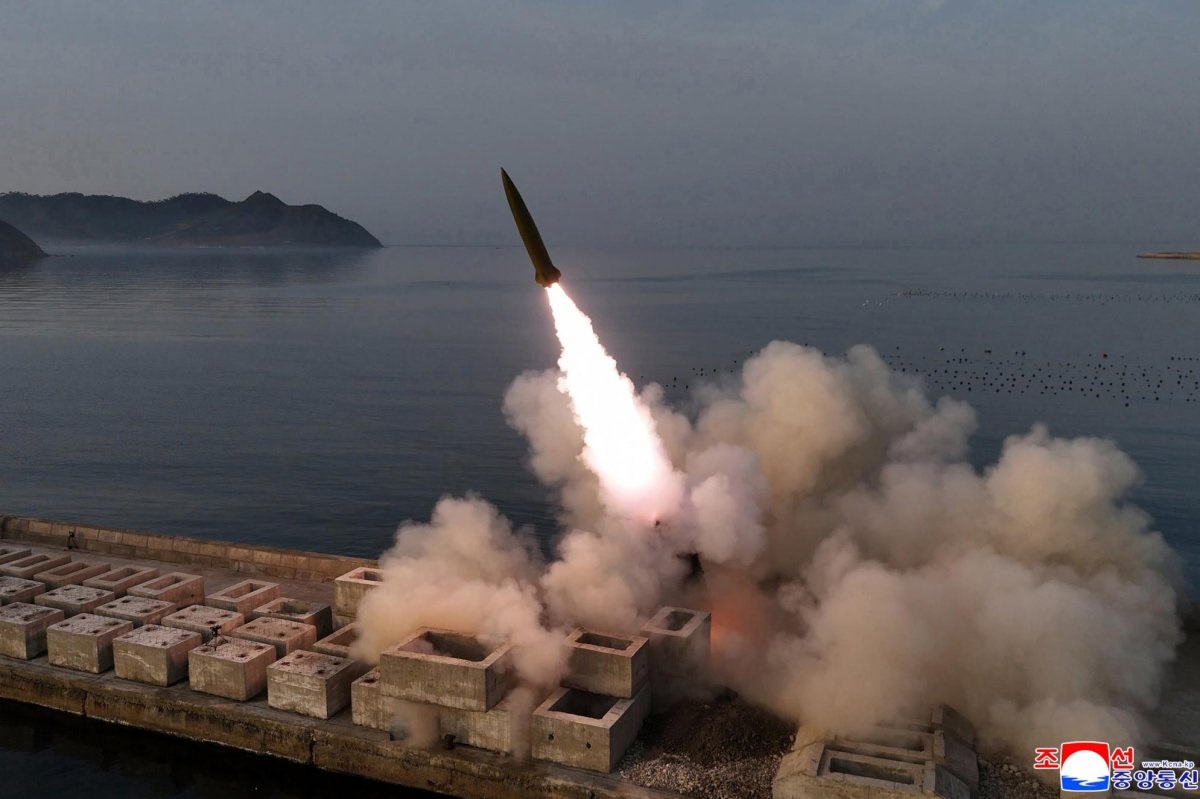
SEOUL, — April 20, 2026 : North Korea conducted a test of tactical ballistic missiles equipped with cluster bomb warheads and fragmentation mine warheads on April 19, according to the state-run Korean Central News Agency (KCNA). The launches were also detected by South Korea’s military earlier the same day.
Test Details and Missile Specifications
The test involved five upgraded short-range Hwasong-11 Ra (also referred to as Hwasongpho-11 Ra) surface-to-surface tactical ballistic missiles. The missiles were launched from the Sinpo area on North Korea’s eastern coast at approximately 6:10 a.m. local time, according to South Korea’s Joint Chiefs of Staff.
All five missiles struck a designated target island located 136 kilometers from the launch site. The barrage covered an area of approximately 130,000 square meters, equivalent to around 12.5 to 13 hectares, achieving what KCNA described as very high-density saturation of the target zone.
The Hwasong-11 series is a short-range ballistic missile system designed for low-altitude flight profiles. South Korean military authorities noted that the Sinpo launch location raises the possibility of submarine-linked operations, although no additional confirmation was provided.
Warhead Characteristics and Test Objective
According to KCNA, the primary objective of the test was to verify the characteristics and operational effectiveness of cluster bomb warheads and fragmentation mine warheads integrated into tactical ballistic missiles.
Cluster warheads disperse multiple submunitions over a wide area, while fragmentation mine warheads are designed to maximize area denial and fragmentation effects. The test specifically assessed both the power and coverage density of these payloads.
KCNA reported that the missile strike achieved dense coverage across the target area, indicating enhanced capability for wide-area impact using short-range delivery systems.
Leadership Oversight and Remarks
North Korean leader Kim Jong Un personally oversaw the test. He was accompanied by his daughter, Kim Ju Ae, according to images released by KCNA.
Following the test, KCNA stated that Kim Jong Un expressed satisfaction with the results. He noted that the development of cluster bomb warheads contributes to improving both high-density strike capability against specific target areas and precision strike effectiveness.
Comparison with Earlier April Test
The April 19 launch marks the second test involving cluster munitions by North Korea in April 2026.
Earlier in the month, North Korea conducted a test of a Hwasong-11 Ka missile equipped with a cluster bomb warhead. That test demonstrated coverage of approximately 6.5 to 7 hectares, significantly smaller than the 12.5 to 13 hectares coverage reported in the latest test.
The comparison indicates an increase in area saturation capability between the two tests conducted in April.
Detection and Regional Monitoring
South Korea’s military reported detecting multiple short-range ballistic missile launches from the Sinpo area, tracking them toward the East Sea (Sea of Japan). The missiles traveled approximately 136 to 140 kilometers.
Following the detection, South Korean authorities maintained a combined defense posture with the United States. The South Korean presidential office convened an emergency security meeting to review the situation.
Japan also monitored the launches as part of regional missile tracking activities.
Strategic Context
The integration of cluster warheads and fragmentation mine warheads into North Korea’s short-range ballistic missile systems reflects ongoing modifications to its tactical strike capabilities.
The 136-kilometer range demonstrated in the test places key regional targets within reach if launched from forward positions, including areas near the Korean Peninsula’s Demilitarized Zone.
North Korea is not a signatory to the 2008 Convention on Cluster Munitions, which prohibits the use, production, transfer, and stockpiling of cluster weapons. South Korea and the United States are also not signatories to the treaty.
KCNA published photographs of the April 19 test but did not release additional technical specifications beyond details related to warhead performance and coverage area.
——— End of Article ———