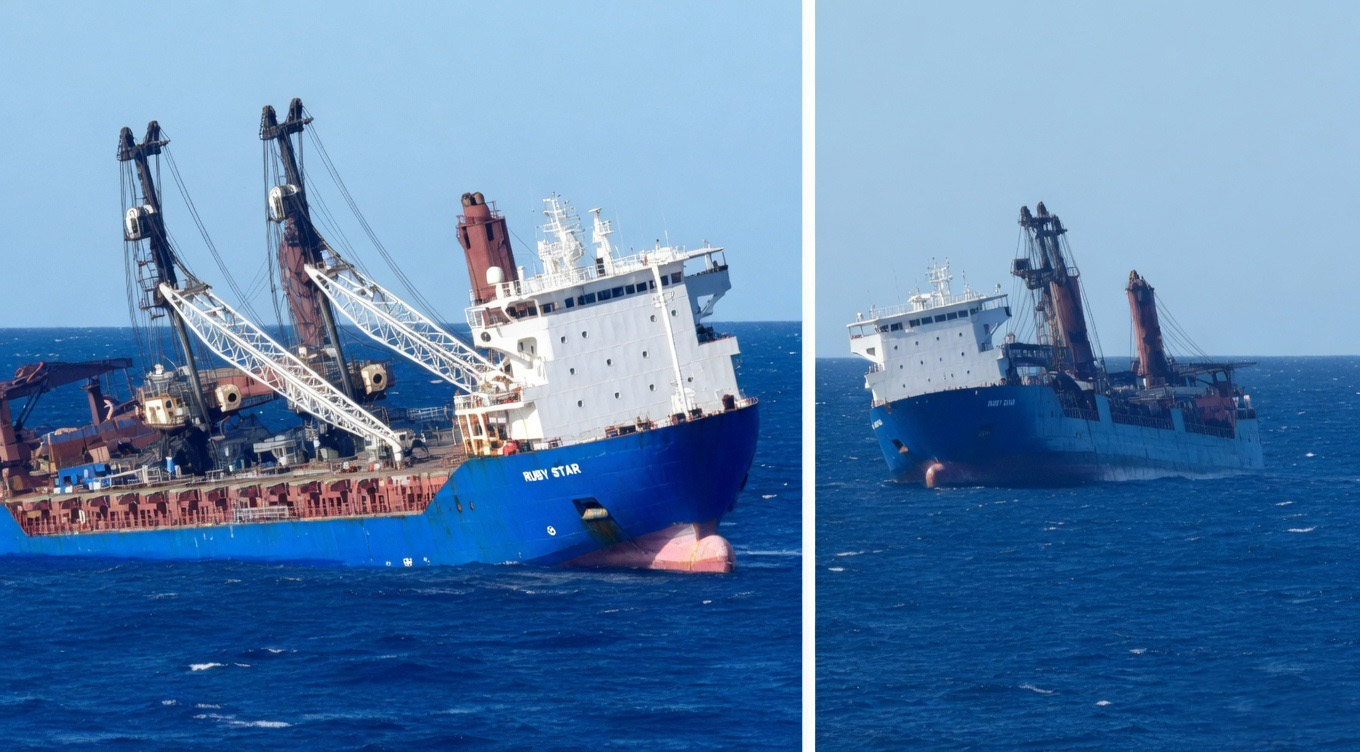
WASHINGTON — May 12, 2026 : A CNN investigation published on May 12, 2026, citing Spanish investigative documents and intelligence sources, has raised the possibility that a NATO member state may have been involved in the sinking of the Russian cargo vessel Ursa Major in the Mediterranean Sea in December 2024. The vessel was reportedly transporting sensitive nuclear reactor components potentially intended for North Korea.
The Ursa Major, a heavy-lift cargo ship operated by Oboronlogistika, a company linked to the Russian Defense Ministry and under Western sanctions, departed from the Baltic ports of Ust-Luga and St. Petersburg in early December 2024. Official shipping records listed Vladivostok as the vessel’s destination, but Spanish investigators later concluded that the ship may have been secretly rerouted to the North Korean port of Rason.
According to testimony provided by the ship’s captain, Igor Anisimov, the cargo included components for two nuclear reactors similar to those used aboard submarines, specifically housings associated with VM-4SG pressurized water reactors. Spanish investigators also identified 129 empty shipping containers and two large Liebherr deck cranes aboard the vessel, which analysts believe were intended to support unloading operations at ports lacking advanced cargo infrastructure.
Satellite imagery reviewed during the investigation reportedly showed two large undeclared containers positioned on the stern of the vessel that were not included in the official cargo manifest. Spanish officials also questioned why the cargo was being transported by sea when rail transport across Russia to the Far East remained available.
Incident in the Mediterranean
On December 23, 2024, while operating approximately 60 miles southeast of Cartagena, Spain, in international waters between Spain and Algeria, the Ursa Major reported multiple explosions near its engine room on the starboard side. The vessel transmitted a distress call at 11:53 a.m. UTC and rapidly began taking on water.
Spanish maritime rescue services evacuated 14 crew members from the vessel, while two engineers were reported missing and later presumed dead. Salvage vessel Salvamar Draco and other Spanish rescue assets participated in the operation, with a Spanish military vessel arriving in the area shortly afterward.
Spanish investigators later documented a 50-by-50-centimeter breach in the hull with metal plating bent inward and fragments of shrapnel scattered across the deck. According to sources familiar with the investigation cited by CNN, the damage pattern was consistent with an external explosive impact rather than an internal mechanical failure.
Possible Use of Supercavitating Torpedo
Investigators reportedly considered the possibility that the vessel had been struck by a supercavitating torpedo, potentially of the Barracuda class. These high-speed torpedoes use gas bubble technology to reduce underwater drag and enable extremely rapid underwater movement.
According to the investigation, only a limited number of countries — including the United States, several NATO member states, Russia, China, and Iran — are known to possess such weapons systems.
At the time of the incident, the Ursa Major was reportedly being escorted by Russian military vessels, including the Ivan Gren and the Aleksandr Otrakovsky. Following the rescue operation, the Ivan Gren ordered nearby civilian vessels to remain clear of the area and requested custody of the rescued Russian crew members.
Hours later, the Ivan Gren fired red flares over the area. Shortly afterward, four additional underwater explosions were recorded by the Spanish National Seismic Network, which confirmed seismic activity matching the time and location of the incident. By 11:10 p.m. local time, the Ursa Major had sunk to the seabed at a depth of approximately 2,500 meters.
Russian and Western Activity After the Sinking
Oboronlogistika later described the incident as a “targeted terrorist attack,” stating that the vessel experienced three explosions before sinking. The Russian Foreign Ministry confirmed the loss of the ship but released limited additional information.
Approximately one week after the sinking, the Russian research vessel Yantar arrived at the wreck site and remained in the area for five days. Western intelligence agencies have previously identified the Yantar as a vessel associated with underwater surveillance and espionage operations.
During the Yantar’s presence near the wreck, four additional underwater explosions were reportedly detected. Analysts cited by CNN suggested that Russian personnel may have been attempting either to recover or destroy sensitive cargo remaining on the seabed.
The investigation also stated that United States Air Force WC-135R “Constant Phoenix” aircraft conducted at least two overflights of the wreck site during the following year. The WC-135R platform is specifically designed to collect atmospheric samples and detect radioactive particles associated with nuclear activity.
Official Responses
The Spanish government publicly addressed the incident in February 2025 after pressure from opposition lawmakers, confirming the captain’s testimony regarding the reactor-related cargo while stating that authorities could not confirm whether nuclear fuel was aboard the vessel.
Spanish officials also stated that recovery of the ship’s voyage data recorder from the wreck site remains technically difficult because of the depth of approximately 2,500 meters and the operational risks involved.
No confirmed radioactive contamination has been reported in the area.
The Pentagon, along with the British and Russian defense ministries, has declined to comment publicly on allegations regarding possible NATO involvement in the sinking.
No country has formally claimed responsibility for the incident, and the wreck of the Ursa Major remains on the Mediterranean seabed in international waters.
——— End of Article ———