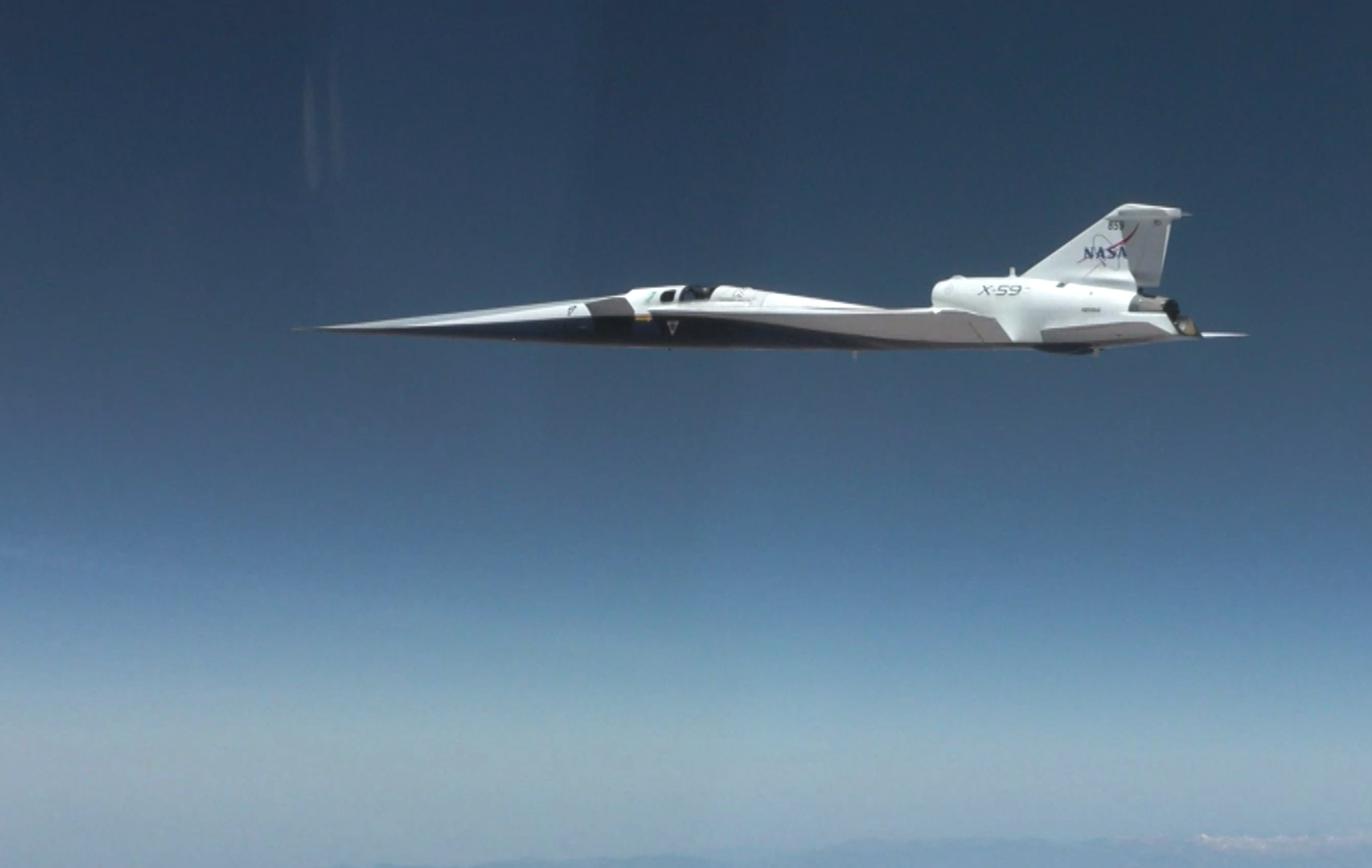
EDWARDS AIR FORCE BASE, California — June 06, 2026 : NASA’s X-59 quiet supersonic research aircraft has successfully reached supersonic speeds for the first time, marking a major milestone in the agency’s Quesst mission and moving the program into the next phase of flight testing aimed at demonstrating quieter supersonic travel over land.
The milestone flight took place on June 5 from Edwards Air Force Base in California, where NASA test pilot Jim “Clue” Less flew the experimental aircraft for 81 minutes. During the mission, the X-59 climbed to an altitude of approximately 43,400 feet and reached a top speed of Mach 1.1, or about 713 mph (1,147 km/h), successfully crossing the speed of sound for the first time.
The achievement marks the completion of the aircraft’s initial subsonic flight-testing phase and the beginning of more demanding supersonic evaluations. NASA officials said the flight was focused on assessing the aircraft’s handling characteristics, stability, and system performance at supersonic speeds.
For the test, the X-59 was accompanied by a NASA F-15 chase aircraft. The sonic booms generated by the F-15 were intentionally used to mask any acoustic signatures from the X-59, as the objective of this flight was not to measure noise levels but to verify aircraft performance during supersonic operations.
Developed under NASA’s Quesst mission and built by Lockheed Martin Skunk Works, the X-59 is designed to address one of the biggest challenges associated with supersonic flight: the loud sonic boom produced when aircraft exceed the speed of sound. Traditional supersonic aircraft, including the retired Concorde, generated powerful shockwaves that created disruptive booms on the ground, leading regulators to prohibit commercial supersonic flights over land in many countries.
The X-59 has been specifically engineered to reduce this effect. Instead of producing a loud sonic boom, the aircraft is designed to generate a significantly quieter “sonic thump” that NASA estimates will be about 75 perceived decibels, roughly comparable to the sound of a car door closing.
Several design features contribute to this capability. The aircraft’s most distinctive feature is its nearly 38-foot-long, needle-shaped nose, which helps separate shockwaves generated during flight and prevents them from merging into a single powerful boom. The X-59 also uses a top-mounted General Electric F414-GE-100 engine producing approximately 22,000 pounds of thrust. Positioning the engine on top of the fuselage helps direct engine noise upward and away from the ground.
In addition, the aircraft’s swept wings and carefully shaped underbody are designed to minimize the formation of additional shockwaves. Because the extended nose blocks the pilot’s forward view, the X-59 does not have a traditional forward-facing cockpit window. Instead, pilots rely on an advanced eXternal Vision System (XVS), which uses high-resolution cameras and displays to provide a real-time forward view.
The X-59 measures approximately 99.7 feet (30.4 meters) in length and has a wingspan of 29.5 feet (9 meters). The aircraft first flew on October 28, 2025, and has since completed a series of subsonic flight tests, including wheels-up operations and envelope expansion flights reaching speeds close to Mach 0.95.
With the first supersonic flight completed, NASA plans to continue expanding the aircraft’s flight envelope. Future tests will gradually increase operating speeds toward the X-59’s planned cruise condition of Mach 1.4, or approximately 925 mph, at an altitude of 55,000 feet. Additional testing is expected to evaluate performance at speeds approaching Mach 1.6 and altitudes up to 60,000 feet.
Once flight performance and safety requirements are fully validated, the program will move into acoustic testing and community overflight operations. During this phase, NASA will fly the X-59 over selected communities across the United States and collect public feedback regarding the aircraft’s quieter sonic signature.
The data gathered from those flights will be shared with the Federal Aviation Administration (FAA) and international aviation regulators. NASA hopes the results will support the development of new noise standards for supersonic aircraft and potentially lead to revisions of regulations that have restricted commercial supersonic flight over land since the 1970s.
The Quesst mission is intended to provide the technical and acoustic data needed to support future generations of commercial supersonic aircraft, with the goal of enabling faster air travel while reducing the noise impacts that limited earlier supersonic passenger operations.
——— End of Article ———