Defense News - In
the dark hours of Monday, a powerful 6.2 magnitude earthquake struck
the mountainous province of Gansu in China, sending shockwaves through
the neighboring Qinghai region. The seismic event, occurring around
midnight local time (16:00 GMT), has already resulted in over 700
reported injuries in the frigid conditions, and the death toll is feared
to rise.
Chinese President Xi Jinping has swiftly mobilized
thousands of rescue personnel to the affected area, known for its
challenging terrain and being among the country most economically
disadvantaged and ethnically diverse regions. This earthquake marks
China deadliest since 2014 when a devastating quake claimed the lives of
more than 600 people in the southwestern Yunnan province.
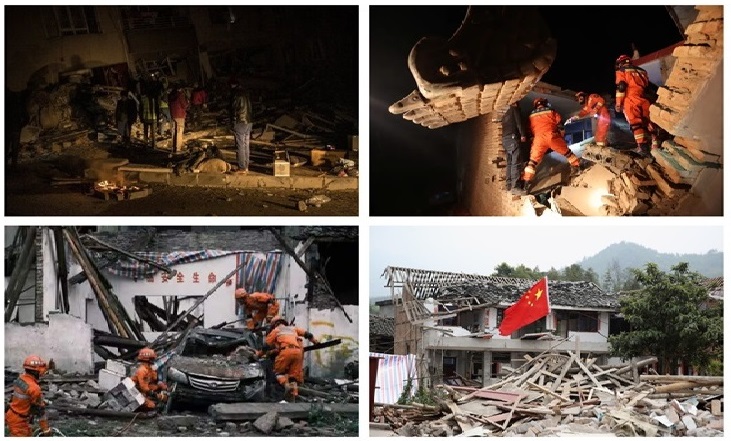
Images
broadcasted on state TV and shared across social media platforms reveal
the extensive damage caused by the quake. Entire villages appear split,
and buildings lie in ruins, reflecting the force of the tremors. In the
aftermath, displaced residents are seen huddled around makeshift fires
in hastily arranged evacuation camps, battling temperatures as low as
-13°C (8.7°F).
Survivors recount harrowing experiences, likening
the tremors to being "tossed by surging waves." In the chaotic moments
following the quake, families rushed out of their homes, seeking safety.
"I woke my family up, and we rushed down all 16 floors in one breath,"
recounted a man identified as Mr. Qin by Chinese media.
The
worst-hit region is Jishishan county in Gansu province, where local
officials report that more than 5,000 buildings have been damaged.
Mudslides triggered by the quake have affected numerous structures, and
landslides have damaged dozens of roads. A director of the Gansu rescue
team attributes the widespread damage to poor building quality,
highlighting the prevalence of old clay structures in many villages.
Gansu,
situated between the Tibetan and Loess plateaus and bordering Mongolia,
is known for its remote and impoverished status. The epicenter of the
quake lies in Linxia Hui Autonomous Prefecture, home to various Chinese
Muslim groups, including the Hui, Bonan, Dongxiang, and Salar people.
While
Chinese authorities report a magnitude of 6.2 on the Richter scale, the
US Geological Survey (USGS) records a slightly lower magnitude of 5.9
with a depth of 10km (6 miles). A series of aftershocks have been
reported in the area.
Adding to the challenges, a 5.5 magnitude
quake struck Xinjiang, the province west of Gansu, on Tuesday.
Fortunately, there are no immediate reports of casualties, but the
seismic activity has disrupted power and water supplies across the
region, hampering ongoing rescue efforts.
With sub-zero
temperatures prevailing, rescue teams face a race against time to locate
and aid survivors. Wang Yi, chief commander of China largest
non-governmental humanitarian organization, the Blue Sky Rescue Team,
emphasizes the urgency of the situation. "It is too cold to bear... its
-15°C [here]," he states, expressing concerns that the casualty count
is likely to rise as rescue operations intensify.
President Xi
Jinping has issued directives for all-out efforts in search and rescue
operations, prompt medical treatment for the injured, and the
minimization of casualties. The earthquake underscores China
vulnerability to seismic events due to its location where several
tectonic plates, including the Eurasian, Indian, and Pacific plates,
converge. The nation has a history of earthquakes, with the 2010 quake
in Yushu and the devastating 2008 earthquake in Sichuan being stark
reminders of the potential for widespread destruction.
——— End of Article ———