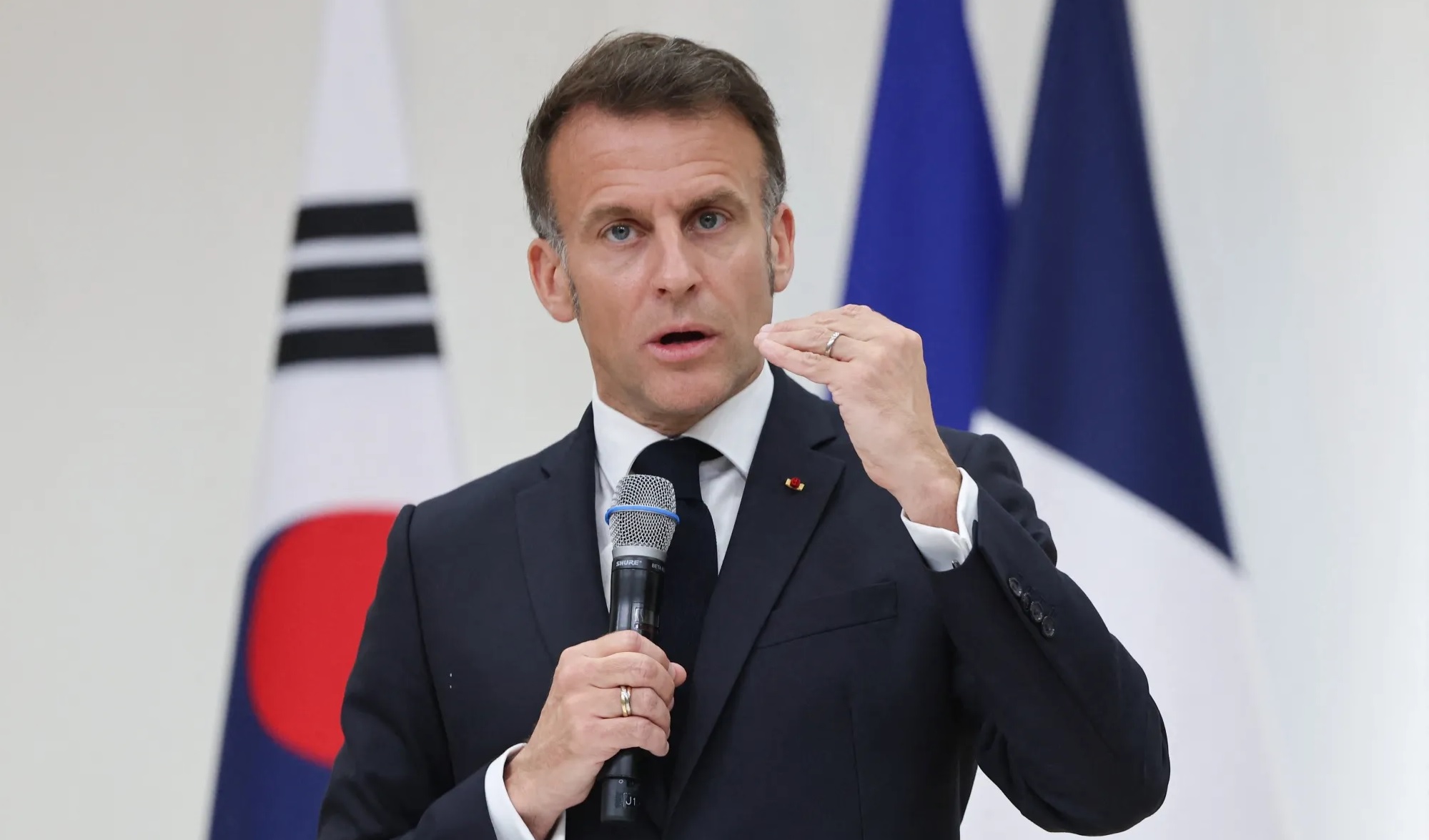
ATHENS — April 25, 2026 : Emmanuel Macron has called on European leaders to accelerate efforts to protect the continent’s industrial base, identifying China’s state-backed manufacturing expansion and shifting United States strategic priorities as dual pressures shaping Europe’s economic future.
The remarks were delivered during high-level talks in Athens with Kyriakos Mitsotakis, where the French president outlined concerns that Europe has underestimated the scale and speed of industrial competition emerging from China.
Chinese Industrial Expansion and European Impact
Macron stated that China’s industrial model—characterized by large-scale production capacity and state-supported exports—has become a central challenge for Europe’s “industrial sovereignty” agenda. He pointed specifically to sectors such as automotive manufacturing and machine tools, where European producers are facing sustained competitive pressure.
“One of the main challenges of the European industry today, if we want to deliver this sovereignty agenda, is about China,” Macron said, adding that Chinese competition is “literally killing a large part of the European industry” while policymakers have been “too slow” to respond.
He described what he termed a “landslide approach” by Chinese manufacturers, referring to rapid gains in global market share across industrial sectors. As an example, Macron cited Germany’s manufacturing downturn, noting that approximately 250,000 industrial jobs were lost in the country last year. Broader data indicates that Germany has lost nearly 250,000 industrial jobs since 2019 amid a prolonged contraction in its manufacturing base.
France, Macron noted, has been less affected in these specific sectors, though he attributed this to earlier phases of deindustrialization rather than current resilience.
Machine Tool Sector and Trade Imbalance
Recent trade data underscores the structural shift highlighted by Macron. In 2025, China surpassed Germany as the world’s largest exporter of machine tools, increasing exports by 13 percent to €8.6 billion. In contrast, German machine tool exports declined by 10 percent to €7 billion over the same period.
China now accounts for approximately 37 percent of global machine tool production, consolidating its position in a sector that underpins advanced manufacturing. The shift has contributed to a widening imbalance in trade between Europe and China.
The European Union’s goods trade deficit with China exceeded €300 billion in 2025, driven by high import volumes across sectors including electric vehicles and industrial components. European policymakers have responded with a combination of anti-subsidy investigations, tariffs on Chinese electric vehicles, and discussions on minimum pricing mechanisms and safeguard measures aimed at restoring competitive balance.
“De-risking” Strategy and Industrial Policy
Macron reiterated that Europe should pursue a strategy of “de-risking” rather than full economic decoupling from China. Speaking earlier at the World Economic Forum in January 2026, he stated that Chinese investment in Europe remains welcome, particularly where it includes technology transfer and contributes to economic growth.
However, he emphasized that such engagement must be conditioned on fair competition, arguing against the import of subsidized products that do not align with European regulatory standards. He also called for stronger industrial policy tools, including “European preference” in public procurement and targeted incentives to support domestic manufacturing capacity.
Reassessment of U.S. Strategic Priorities
In parallel with concerns about China, Macron urged European leaders to adopt a long-term perspective on United States policy. He argued that Washington’s strategic orientation has, for more than a decade, prioritized domestic economic interests and competition with China over transatlantic considerations.
“We have to be lucid on the US strategy… This is not just Trump’s character or behavior,” Macron said. “The United States, I would say, for now 15 years, decided the number one issue is America — America first. The second priority is China.”
He added that U.S. global strategies “don’t put European interests at the center,” reflecting a structural shift rather than a temporary policy direction tied to any single administration.
European Strategic Autonomy Debate
Macron’s comments are consistent with his longstanding advocacy for greater European strategic autonomy across defense, energy, and critical technologies. During the Athens discussions, he also noted that the geopolitical positioning of major powers—including the United States, China, and Russia—is increasingly exerting pressure on European interests.
Within the European Union, policymakers are continuing to debate measures aimed at strengthening industrial resilience. These include proposals for joint borrowing to finance strategic investments, expanded “Buy European” provisions, and coordinated responses to external subsidies.
Macron has argued that timely and coordinated action will be necessary if Europe is to maintain competitiveness in key industries and reduce structural dependencies in the coming years.
——— End of Article ———