WASHINGTON, — April 22, 2026 : Lockheed Martin has presented a new ship-integrated counter-unmanned aerial system (C-UAS) configuration featuring its JAGM Quad Launcher (JQL) mounted on a scale model of an Arleigh Burke-class destroyer during the Navy League Sea-Air-Space 2026 exposition held from April 20 to April 22 in Washington, D.C.
System Display and Configuration
The company displayed the JQL installed on the aft section of the destroyer’s superstructure, illustrating a compact, modular launcher footprint intended for integration on existing surface combatants. The configuration demonstrates potential deployment on large warships without requiring significant structural modification.
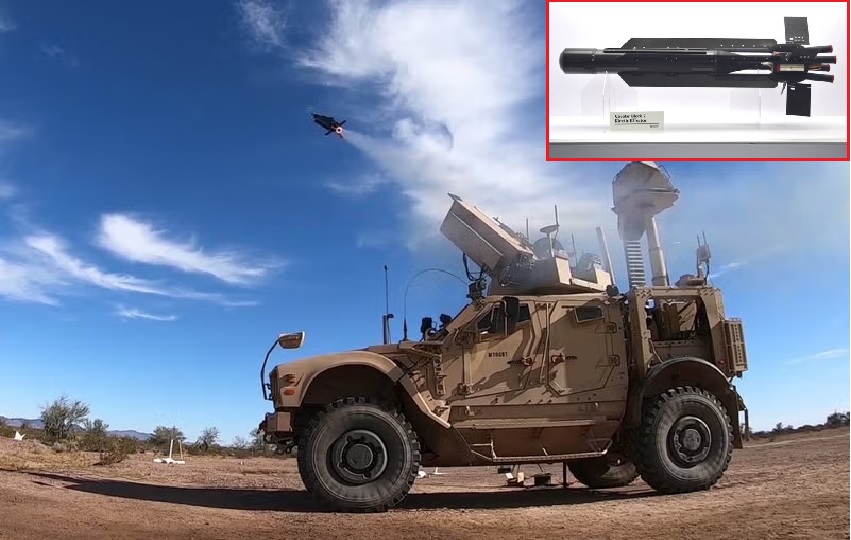
The JQL, pronounced “Jackal,” is a four-cell launcher designed to employ the in-service AGM-179 Joint Air-to-Ground Missile (JAGM) for maritime defensive roles. The system is positioned as a layered defense capability against unmanned aerial systems (UAS), unmanned surface vehicles (USVs), and other short-range air threats.
Launcher Architecture and Design
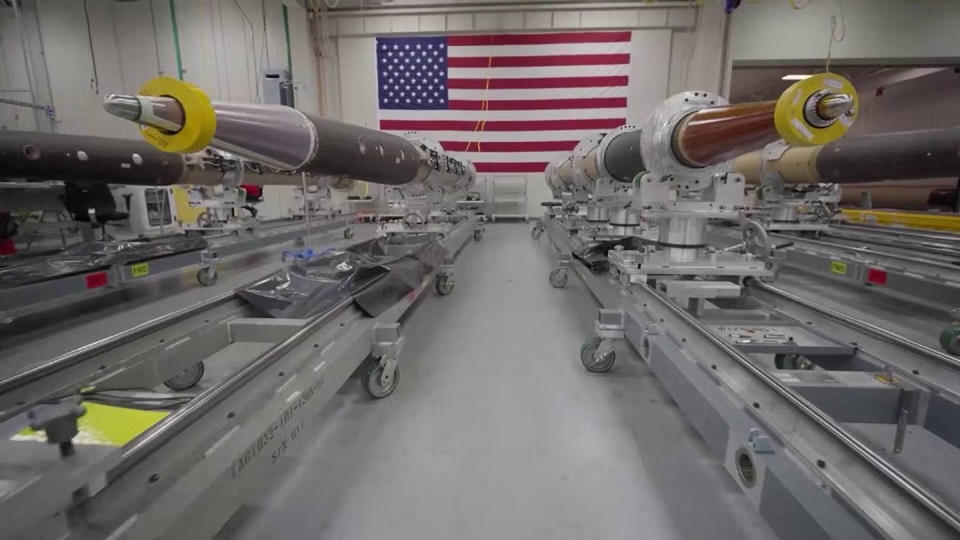
The JQL consists of four independent modular composite canisters, each housing a single JAGM missile. The system is derived from the existing M299 launcher and incorporates technologies adapted from the Mk 41 Vertical Launching System (VLS), which is widely deployed across U.S. Navy surface combatants.
The launcher integrates the qualified Launcher Electronics Assembly (LEA) from the M299 system and introduces a Launcher Management Assembly (LMA) based on VLS open-architecture electronics and software. This configuration enables compatibility with both local and remote weapon control systems through wired or wireless interfaces. It also supports incremental software upgrades and the integration of new sensors without requiring hardware modifications.
A pivot fixture allows missiles to be launched at both angled and vertical orientations. The system includes a self-contained gas management solution, incorporating a plenum and uptake assembly to safely vent missile exhaust gases during vertical launch operations. Naval variants include a metallic hatch for below-deck missile protection and an exhaust cover designed to prevent ingestion of seawater. The system has been marinized for sustained operation in harsh maritime environments.
Missile Characteristics and Engagement Modes
The AGM-179 JAGM used by the launcher features a dual-mode seeker combining semi-active laser (SAL) guidance and millimeter-wave (MMW) Doppler radar. The SAL mode enables precision engagement of laser-designated targets, while the MMW radar provides fire-and-forget capability, allowing target detection and tracking in adverse weather and low-visibility conditions.
The missile supports both lock-on-before-launch and lock-on-after-launch (LOAL) engagement modes, using targeting data provided by the host platform or external sensors. It is powered by a solid rocket motor and equipped with a multi-purpose warhead consisting of a shaped charge within a fragmenting casing.
Standard operational range is approximately 8 kilometers, with an extended medium-range variant reaching up to 16 kilometers. The JAGM replaces the out-of-production Longbow Hellfire variant and remains in full-rate production.
Operational Integration and Reload Capability
A primary feature of the JQL is its ability to be reloaded at sea. Each canister cell operates independently, allowing individual missiles to be fired and reloaded within minutes. Due to the relatively low weight of the JAGM—approximately 100 pounds (around 50 kilograms)—naval crews can manually transport and reload the missiles using standard shipboard handling systems without requiring heavy port infrastructure.
The system supports both above-deck and below-deck installations on surface combatants, including destroyers, frigates, corvettes, and patrol vessels. It is also compatible with Littoral Combat Ships through existing surface-to-surface missile modules or direct deck mounting. A ground-based variant is available for vehicle integration, incorporating the same gas management system for safe vertical exhaust.
The open-architecture design allows integration with existing combat management systems, enabling rapid engagement cycles and compatibility with evolving sensor networks.
Vertical Launch Capability and Test Validation
The JQL supports vertical launch at a 90-degree angle, providing a full 360-degree engagement envelope without requiring a forward-facing launch corridor. This reduces the need for ship maneuvering and enables deployment in constrained deck spaces.
This capability was validated during a live-fire demonstration conducted on January 15, 2026, at Naval Air Weapons Station China Lake. In that test, a JQL mounted on a Richard Childress Racing Mothership 6×6 vehicle executed a vertical launch using the missile’s MMW Doppler radar mode to successfully neutralize an unmanned aerial target.
An earlier test conducted in 2025 at Yuma Proving Ground demonstrated a 45-degree angled launch, achieving a direct hit on a stationary target with telemetry collected from ignition through impact.
Cost Considerations and Role in Layered Defense
Lockheed Martin has positioned the JQL and JAGM combination as a lower cost-per-engagement option compared to long-range interceptors such as SM-6 or RAM Block 2 missiles. With an estimated unit cost of approximately $212,000 per JAGM, the system is intended to address medium-tier threats, including drones and loitering munitions, while preserving higher-value interceptors for more complex engagements.
The vertical launch capability and modular design allow deployment across multiple domains, including naval, ground, and expeditionary platforms. The system has also been demonstrated on a Richard Childress Racing 6×6 vehicle and is planned for further integration with unmanned surface platforms such as Saildrone.
Development Status
Lockheed Martin officials stated that the JQL remains in development and testing, with additional live-fire demonstrations planned to further validate its adaptability across platforms. The system’s compatibility with existing JAGM inventory, established logistics chains, and standard handling procedures is intended to support streamlined adoption by naval forces.
The display at Sea-Air-Space 2026 reflects ongoing efforts to expand counter-UAS capabilities for surface combatants in response to increasing use of unmanned systems in maritime operational environments.
——— End of Article ———