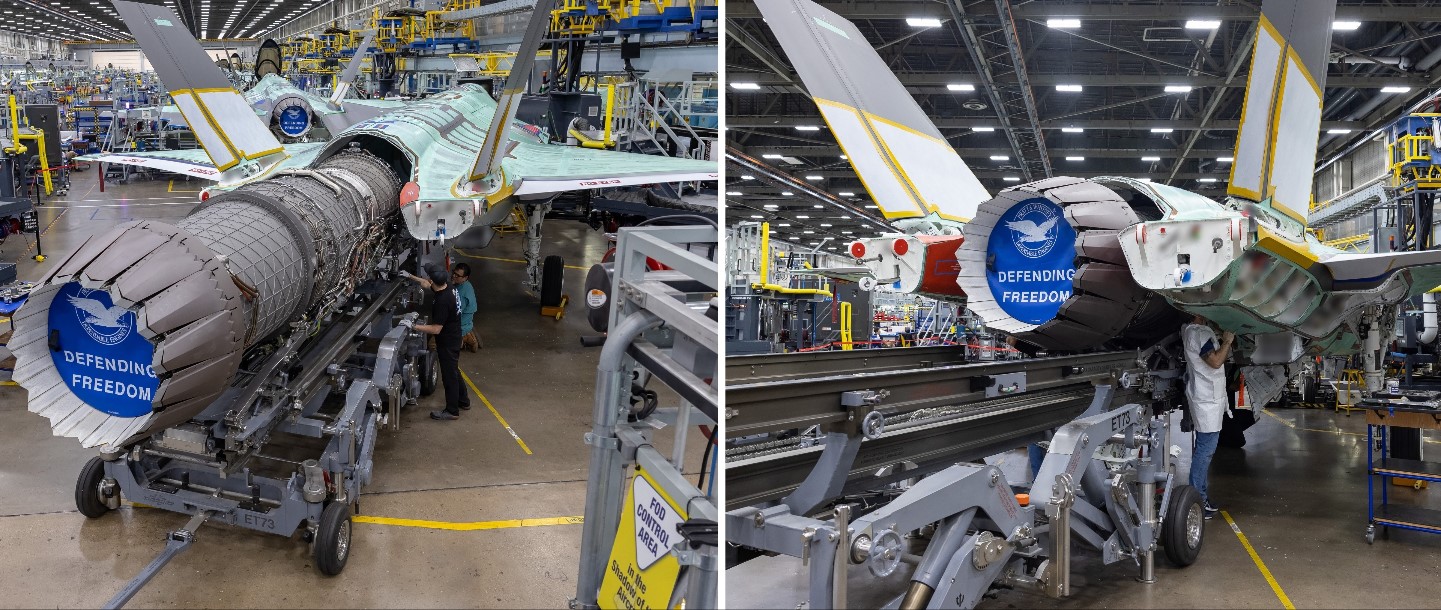
FORT WORTH, TEXAS — June 04, 2026 : Lockheed Martin has completed the installation of the Pratt & Whitney F135 engine on Germany’s first F-35A Lightning II, marking a major production milestone as the aircraft moves closer to delivery to the German Air Force (Luftwaffe).
The aircraft, designated MG-01, recently underwent engine installation at Lockheed Martin’s production facility in Fort Worth, Texas, after successfully progressing through key stages of structural assembly. The development represents an important step in Germany’s effort to modernize its air force and replace part of its aging Panavia Tornado fleet.
Engine Installation Marks Transition to Final Assembly
Before the engine was installed, the aircraft’s major structural sections—including the forward, center, and aft fuselage components, as well as the wings—were joined using advanced laser-guided alignment systems. Following the installation of the landing gear and completion of structural assembly, the aircraft became capable of supporting its own weight, allowing technicians to begin final integration work.
Assembly teams are now focused on installing the remaining systems, including the cockpit canopy, control surfaces, avionics, sensors, and other onboard equipment required before testing can begin.
Once systems integration is completed, the aircraft will enter the finishing phase, where it will receive its exterior paint scheme and the specialized radar-absorbing stealth coating that forms a critical part of the F-35A’s low-observable design.
Germany’s F-35 Acquisition Program
Germany officially joined the F-35 program in December 2022, placing an order for 35 F-35A conventional takeoff and landing aircraft. The procurement package, valued at approximately €10 billion, includes the aircraft, engines, mission systems, spare parts, logistics support, training, and armament.
The acquisition is intended primarily to replace a portion of the Luftwaffe’s aging Tornado fleet, particularly aircraft assigned to NATO’s nuclear-sharing mission involving U.S.-owned B61-12 tactical nuclear bombs.
A key reason behind Germany’s selection of the F-35A was its ability to perform the nuclear-sharing role currently carried out by the Tornado. In addition, the aircraft offers a range of fifth-generation capabilities, including stealth technology, sensor fusion, advanced situational awareness, and secure data-sharing capabilities that enhance interoperability with allied forces.
Eight Aircraft Currently in Production
Production of Germany’s F-35 fleet began with major assembly activities at Lockheed Martin’s facility in Marietta, Georgia, in December 2024. The first aircraft, MG-01, entered final assembly in Fort Worth in March 2026.
According to Lockheed Martin, eight German F-35As are currently in various stages of production, reflecting continued progress across the broader acquisition program.
Testing and Delivery Timeline
Following completion of final assembly, MG-01 will undergo a series of critical activities, including systems verification, avionics and sensor evaluations, ground testing, and pre-delivery flight testing. The aircraft is also expected to participate in an official rollout ceremony later in 2026.
Deliveries of the first German F-35As are scheduled to begin in 2026. However, the initial batch of eight aircraft will not immediately deploy to Europe.
Instead, they will be delivered to Ebbing Air National Guard Base in Fort Smith, Arkansas, where German pilots and maintenance personnel will undergo extensive training as the Luftwaffe prepares to transition to the new fighter platform.
Path to Operational Service
The aircraft are expected to begin arriving in Germany from 2027, with permanent basing planned primarily at Büchel Air Base. The Luftwaffe is targeting initial operational capability in 2028, while deliveries of all 35 aircraft are expected to continue through the latter part of the decade.
The introduction of the F-35A will significantly enhance Germany’s ability to operate alongside NATO allies already flying the aircraft, including the Netherlands, Norway, Belgium, Finland, and Poland.
In parallel, German defense company Rheinmetall is expanding its role in the program through a new fuselage production facility in Weeze, Germany, which is expected to support future F-35 manufacturing for Germany and other international customers.
Program Remains on Schedule
The successful installation of the Pratt & Whitney F135 engine on MG-01 represents one of the final major assembly milestones before testing and delivery. With eight aircraft already progressing through production, the achievement keeps Germany’s F-35 modernization program on track as the Luftwaffe prepares to introduce its first fifth-generation fighter aircraft into operational service.
——— End of Article ———