WASHINGTON, D.C., — April 22, 2026 : Leidos, through its naval architecture subsidiary Gibbs & Cox, presented updated details of its Mobile Defense/Depot Platform (MODEP) and associated Vertical Launch System (VLS) “Speed Reloader” concept during the Sea Air Space 2026 exhibition held in National Harbor, Maryland from April 20 to 22.
The MODEP concept outlines the conversion of surplus commercial semi-submersible offshore oil and gas rigs into relocatable maritime platforms designed to support U.S. Navy operations. These platforms are intended to function as afloat forward staging bases, combining resupply, re-arming, maintenance, and missile defense roles without requiring new hull construction within the naval shipbuilding industrial base.
Concept Overview and Operational Role
According to Leidos, MODEP is designed to address logistical constraints associated with sustaining surface combatants in forward operating areas, particularly across the Indo-Pacific region. The concept leverages the structural stability, deck space, and payload capacity of existing offshore energy infrastructure to provide a mobile alternative to fixed land-based facilities.
The semi-submersible platforms feature a height of approximately 45 to 90 meters above the waterline, enabling elevated placement of radar and sensor systems for enhanced surveillance and missile defense coverage. Their design supports operations in high sea states, including wave heights of up to 60 feet, while maintaining a shallow and variable draft. This allows navigation through constrained waterways such as Pacific atolls and operations in sheltered harbors.
The platform is self-propelled, with cruising speeds ranging from 5 to 9 mph (8 to 14 km/h), or approximately 8 to 11 knots following pontoon modifications. At lower speeds, the platform can cover about 200 nautical miles per day. Its unrefueled range is between 4,000 and 4,600 miles (6,400 to 7,400 kilometers), supported by a fuel capacity of approximately 2.3 million gallons (8.7 million liters). The system is designed for extended independent operations exceeding 12 months, with an endurance interval of up to 150 days between resupply.
The platform supports a payload capacity of approximately 8,000 metric tonnes and generates an additional 6 to 20 megawatts of electrical power to sustain onboard systems, maintenance facilities, and mission equipment.
VLS “Speed Reloader” System
A central focus of the 2026 presentation was the “Speed Reloader,” a structural and mechanical system designed to enable rapid reloading of VLS cells at sea. Current U.S. Navy procedures typically require 40 to 60 minutes to reload a single VLS cell, often necessitating a return to port.
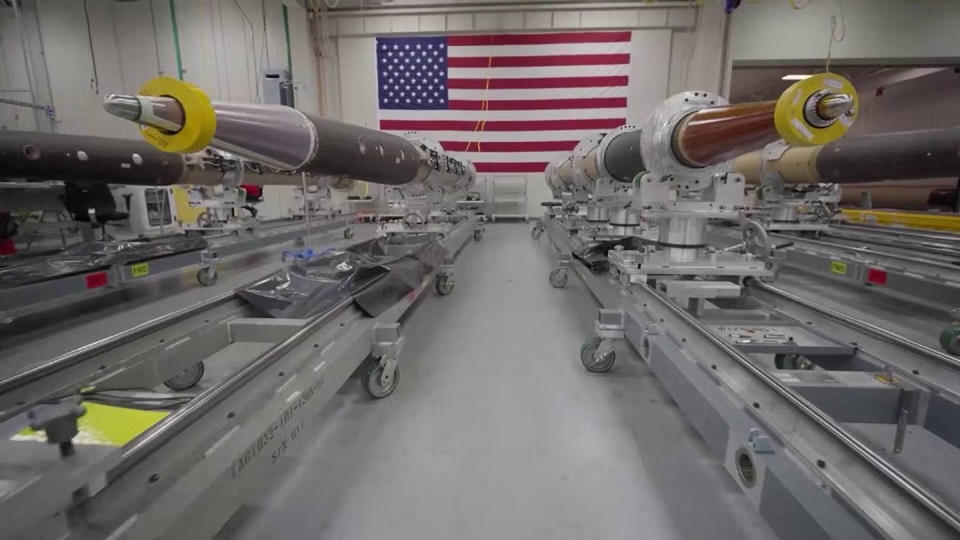
The Speed Reloader introduces a frame-based mechanism integrated with MODEP storage magazines. The system lifts multiple missile canisters simultaneously and transfers them to a receiving warship using two heavy-duty gantry cranes standard on semi-submersible rigs, each capable of lifting up to 100 tonnes.
The mechanism allows simultaneous extraction of expended canisters and insertion of new ones. Under Sea State 4 conditions, it can reload six to eight VLS cells within the same time normally required for a single-cell reload. The system operates alongside existing Navy reloading concepts but increases throughput while maintaining open-ocean operability.
Depot Configuration and Logistics Capacity
In its depot configuration, MODEP functions as a re-arming and logistics hub. The platform incorporates 16 magazines capable of storing between 384 and 446 VLS canisters, depending on storage orientation. This capacity is sufficient to fully replenish the missile inventories of approximately 4.5 Arleigh Burke-class destroyer vessels, each equipped with 96 VLS cells.
The depot variant also supports refueling operations using established offshore oil and gas transfer systems, as well as maintenance and repair facilities for both surface ships and submarines. The semi-submersible design enables ballast adjustments to improve stability during reloading or to reduce draft for navigation.
Defense Configuration and Missile Capacity
MODEP’s defense-oriented variant is configured for air and ballistic missile defense missions. The platform can accommodate between 128 and 256 VLS cells, or alternatively up to 100 large missile launchers sized for future hypersonic weapons consistent with DDG(X) requirements. This represents approximately five times the missile capacity of a single Arleigh Burke-class destroyer.
Earlier iterations of the concept proposed up to 512 VLS cells; however, the design has since been refined to balance capacity with operational and structural considerations. The elevated structure provides an advantageous position for radar and sensor integration, supporting extended detection and engagement ranges.
Leidos estimates that a ballistic missile defense configuration based on a converted rig would cost approximately 10 percent of an equivalent new land-based system.
Additional Mission Variants
Beyond resupply and missile defense roles, MODEP has been developed with multiple mission configurations. These include a submarine tender variant aligned with the U.S. Navy’s AS(X) Submarine Tender Recapitalization Program, featuring sheltered internal docking areas for repair and refit operations.
Other proposed configurations include a hospital ship and an unmanned systems hub. The unmanned systems variant is designed to deploy and support unmanned surface and underwater vehicles, incorporating onboard additive manufacturing capabilities to produce and repair drone components while deployed.
The platform’s modular design allows multiple mission sets—such as logistics, reloading, maintenance, and unmanned operations—to be integrated on a single unit.
Industrial and Strategic Context
Leidos and Gibbs & Cox have identified between 10 and 12 surplus semi-submersible rigs as suitable candidates for conversion. Acquisition of these platforms represents a relatively small portion of total program cost, with conversion timelines estimated at approximately 24 months.
The concept aligns with broader trends in distributed maritime operations and the repurposing of aging offshore energy infrastructure. Thousands of oil and gas platforms worldwide are expected to be decommissioned in the coming decades, creating a potential pool of assets for conversion into military support platforms.
By utilizing the commercial offshore industrial base, the MODEP approach avoids additional strain on naval shipyards while providing a scalable solution for forward logistics, missile defense, and multi-role maritime operations.
Leidos officials stated that the concept remains under development, with ongoing engineering analysis focused on platform modifications, system integration, and operational validation. The Sea Air Space 2026 presentation outlined potential configurations and performance parameters for future consideration by the U.S. Navy.
——— End of Article ———