LONDON, — April 15, 2026 : Iran’s Islamic Revolutionary Guard Corps (IRGC) secretly acquired operational control of a Chinese-built reconnaissance satellite in late 2024 and used it to monitor United States military installations across the Middle East, according to a report published by the Financial Times on April 15, 2026, citing leaked Iranian military documents.
The documents describe how the IRGC Aerospace Force utilized the satellite, designated TEE-01B, to collect pre-strike and post-strike intelligence during regional military activity, including drone and missile operations conducted in March 2026.
Acquisition Agreement and Satellite Deployment
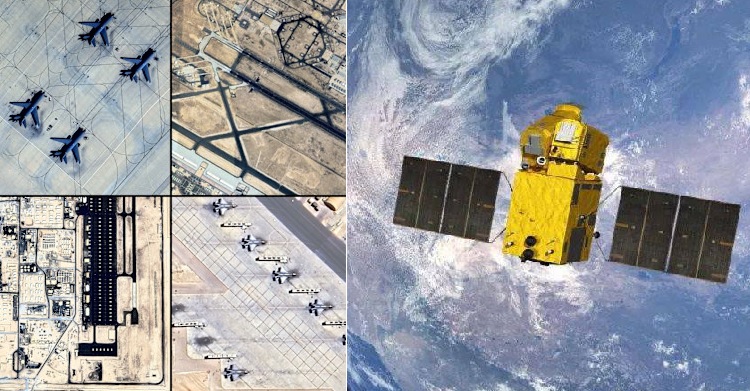
The satellite, also known as Earth Eye 1 or Diqiu Zhiyan-1, was manufactured and launched by Chinese commercial space firm Earth Eye Co. (Mumei Xingkong Keji) on June 6, 2024. It operates in a low Earth sun-synchronous orbit and is equipped with high-resolution panchromatic imaging capable of capturing ground features at an estimated resolution of approximately 0.5 meters.
According to the leaked materials, the IRGC Aerospace Force finalized an agreement in September 2024 to assume control of the satellite under an “in-orbit delivery” model after it reached orbit. The agreement, signed by a brigadier general within the IRGC Aerospace Force, was valued at approximately RMB250 million (around $36.6 million). The contract, denominated in renminbi, covered the satellite platform, launch services, technical support, data infrastructure, and associated operational services provided by a foreign counterparty.
The arrangement allowed Iran to bypass domestic satellite development timelines by acquiring a fully operational system already deployed in orbit.
Ground Infrastructure and Operational Control
As part of the agreement, Iranian operators were granted access to a global network of commercial ground stations managed by Beijing-based satellite services provider Emposat. The company provided the software and infrastructure required for telemetry, tracking, command transmission, and imagery reception.
The ground station network, spanning regions including Asia and Latin America, enabled IRGC personnel to control the satellite remotely and task it for specific imaging operations worldwide.
Surveillance of U.S. and Allied Installations
Leaked documents reviewed by the Financial Times include time-stamped coordinate lists, orbital tracking data, and satellite imagery indicating that the IRGC directed TEE-01B to observe multiple strategic locations associated with U.S. and allied forces.
In March 2026, the satellite conducted repeated imaging passes over several sites:
Prince Sultan Air Base (Saudi Arabia) was imaged on March 13, 14, and 15. On March 14, U.S. President Donald Trump confirmed that American refueling aircraft stationed at the base had sustained damage from projectile strikes.
Muwaffaq Salti Air Base (Jordan) was monitored before and after IRGC-claimed attacks in the region.
Areas surrounding the U.S. Fifth Fleet headquarters (Manama, Bahrain) were tracked during the same period.
Erbil International Airport (Iraq) was observed alongside nearby strategic facilities amid regional drone and missile activity.
Additional locations identified in the documents include Camp Buehring and Ali Al Salem Air Base (Kuwait), Camp Lemonnier (Djibouti), and Duqm International Airport (Oman).
The satellite’s imaging capability allowed identification of aircraft, vehicles, and infrastructure changes, providing a level of detail comparable to commercially available Western satellite systems.
Role in Strike Planning and Assessment
The documents indicate that imagery collected by TEE-01B was used by Iranian military planners for both targeting and post-strike evaluation. The satellite enabled independent verification of damage following operations, reducing reliance on external or civilian data sources.
Analysts cited in the report noted that the 0.5-meter resolution represented a significant improvement over Iran’s domestically operated Noor-3 satellite, which has an estimated resolution of approximately 5 meters.
Chinese Entities and Commercial Model
Earth Eye Co. describes its “in-orbit delivery” model as a commercial service in which satellites launched from China are transferred to international customers after reaching orbit. The company has publicly stated that TEE-01B was intended for civilian applications, including agriculture monitoring, ocean observation, emergency response, natural resource management, and urban transportation planning.
Iran is a participant in China’s Belt and Road Initiative, which provides a broader framework for economic and technological cooperation between the two countries.
Neither Earth Eye Co. nor Emposat has issued a public response to the allegations regarding the satellite’s operational use by the IRGC.
Diplomatic Responses and Denials
The report has contributed to increased diplomatic tension between Washington and Beijing. The White House, Central Intelligence Agency (CIA), and Pentagon have not issued formal statements specifically addressing the leaked documents.
U.S. President Donald Trump has previously warned of potential economic consequences for countries providing military support to Iran. In recent remarks, he threatened to impose tariffs of up to 50 percent on China if evidence emerges confirming the transfer of military-related systems to Tehran.
Chinese officials have rejected the allegations. Foreign Ministry spokesperson Lin Jian stated that claims of Chinese support for Iran’s military activities are “purely fabricated” and warned that China would respond with countermeasures if new tariffs are imposed.
The Chinese Embassy in Washington also described the reports as speculative and characterized them as disinformation.
Verification Status
The Financial Times and Reuters reported that they were unable to independently verify the authenticity of the leaked Iranian military documents. No official confirmation has been provided by U.S. intelligence agencies or other government bodies regarding the operational use of the satellite as described in the report.
The IRGC Aerospace Force, which oversees Iran’s missile, drone, and space programs, is identified in the documents as the primary operator of the TEE-01B system rather than Iran’s civilian space agency.
——— End of Article ———