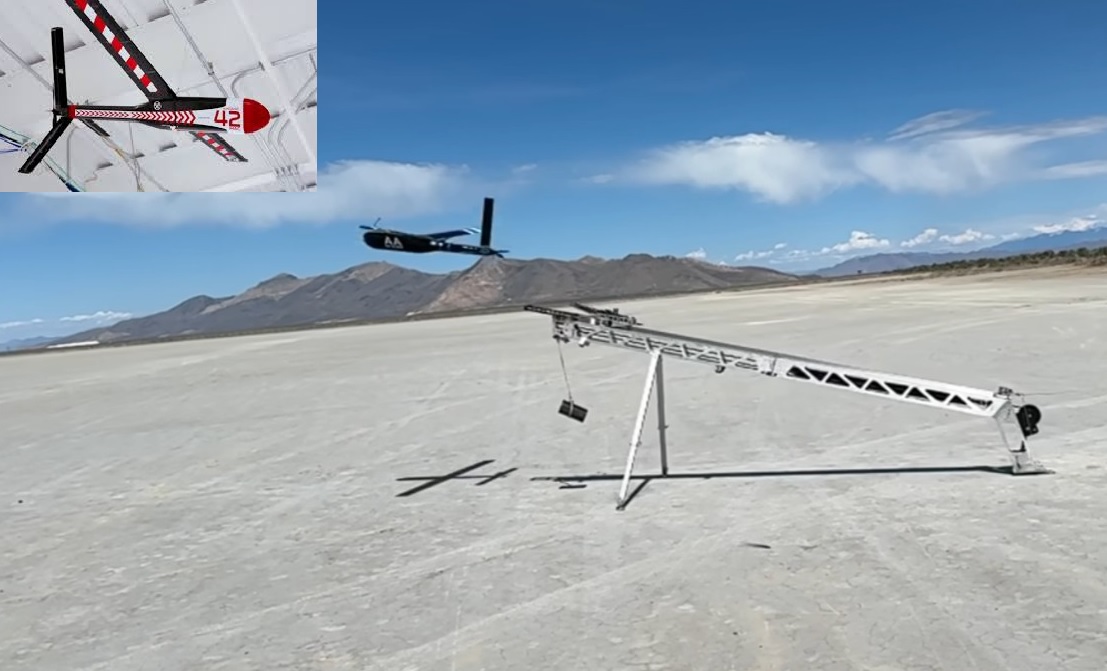
LAYTON, Utah — May 2, 2026 : KIHOMAC founder and chief executive officer Ki Ho Kang has released flight test footage of the company’s Agami fixed-wing unmanned aerial vehicle, outlining performance data and production goals tied to its internally developed Project Liberty program.
The Agami platform has been designed to demonstrate that military-grade unmanned aerial systems can be produced at scale without the manufacturing constraints that have affected several U.S. drone programs in recent years. The initiative focuses on reducing production time while maintaining operational flexibility.
Platform Design and Manufacturing Approach
The Agami has a gross takeoff weight of 20 pounds (9 kilograms) and is capable of carrying more than 5 pounds (2.2 kilograms) of payload. Its airframe, including fuselage and wings, is constructed from carbon fiber materials.
A central feature of the system is its open architecture design, described by the company as a “Bring Your Own Payload” configuration. This allows operators to integrate sensors, communication systems, or mission-specific effectors without requiring structural redesign of the aircraft.
Under Project Liberty’s production model, KIHOMAC states that each airframe can be manufactured in under one hour. The company contrasts this with additively manufactured drones, which can require up to 100 hours per unit. The accelerated production timeline is intended to address high attrition rates observed in recent operational environments.
Flight Testing and Performance Metrics
Flight data released alongside the footage provides detailed performance benchmarks for the Agami system. On a single battery pack, the drone demonstrated an endurance of approximately one hour, covering more than 60 miles.
With a dual-battery configuration, the platform achieved nearly 90 minutes of flight time over a distance of about 90 miles during testing conducted on what was described as a “very turn-intensive range.” The company indicated that a standard flight profile with fewer turns would likely extend both endurance and range.
The Agami uses a catapult launch system, eliminating the requirement for a runway and enabling deployment in areas with limited infrastructure.
Operational Context and Project Liberty Objectives
Project Liberty has been developed with reference to recent operational trends, particularly the high-volume use of drones in the Ukraine conflict. According to the company, these conditions have demonstrated that manufacturing capacity—rather than technical complexity—has become a primary limiting factor in sustained drone operations.
KIHOMAC’s approach prioritizes rapid, repeatable production of airframes to support continuous deployment requirements. The company positions the Agami as a system designed for scalability, where replacement and replenishment cycles can be maintained without extended delays.
Deloitte Investment and Production Expansion in Utah
In October 2025, Deloitte announced a direct investment in KIHOMAC to expand drone manufacturing capabilities in Utah. The financial terms of the investment were not disclosed.
The partnership is focused on increasing domestic production capacity for unmanned systems intended for U.S. government agencies, commercial customers, and other organizations. Expansion efforts include scaling manufacturing operations and strengthening supply chain resilience.
Oniel Cross, who leads hybrid cloud and edge infrastructure within Deloitte’s Government and Public Services division, stated that the investment supports the development of domestic production capacity for technologies considered important to national security and economic competitiveness.
Ki Ho Kang said the collaboration enables faster scaling of production and delivery of unmanned systems while contributing to local economic activity through job creation and facility expansion.
Company Background and Manufacturing Footprint
KIHOMAC, founded in 2003, is a veteran-owned small business employing more than 350 personnel with multiple operational facilities across the United States. The company provides systems engineering, reverse manufacturing, custom fabrication, and sustainment services for the U.S. Department of Defense and commercial clients.
The Utah expansion is intended to support increased production output for the Agami platform as well as other unmanned systems under development.
Applications and Market Positioning
The Agami platform is designed for multiple mission profiles, including infrastructure inspection, emergency response, and defense and security operations. Its modular payload architecture allows a single airframe to be reconfigured for different operational requirements.
The program aligns with broader U.S. policy efforts to reduce dependence on foreign-manufactured drone components and to strengthen domestic supply chains. By focusing on rapid manufacturing and modular integration, KIHOMAC positions Project Liberty and the Agami system within ongoing efforts to expand secure, scalable unmanned system production in the United States.
The company indicated that the Agami platform represents one component of a wider portfolio of scalable unmanned technologies being developed in coordination with its production expansion initiatives and partnership with Deloitte.
——— End of Article ———