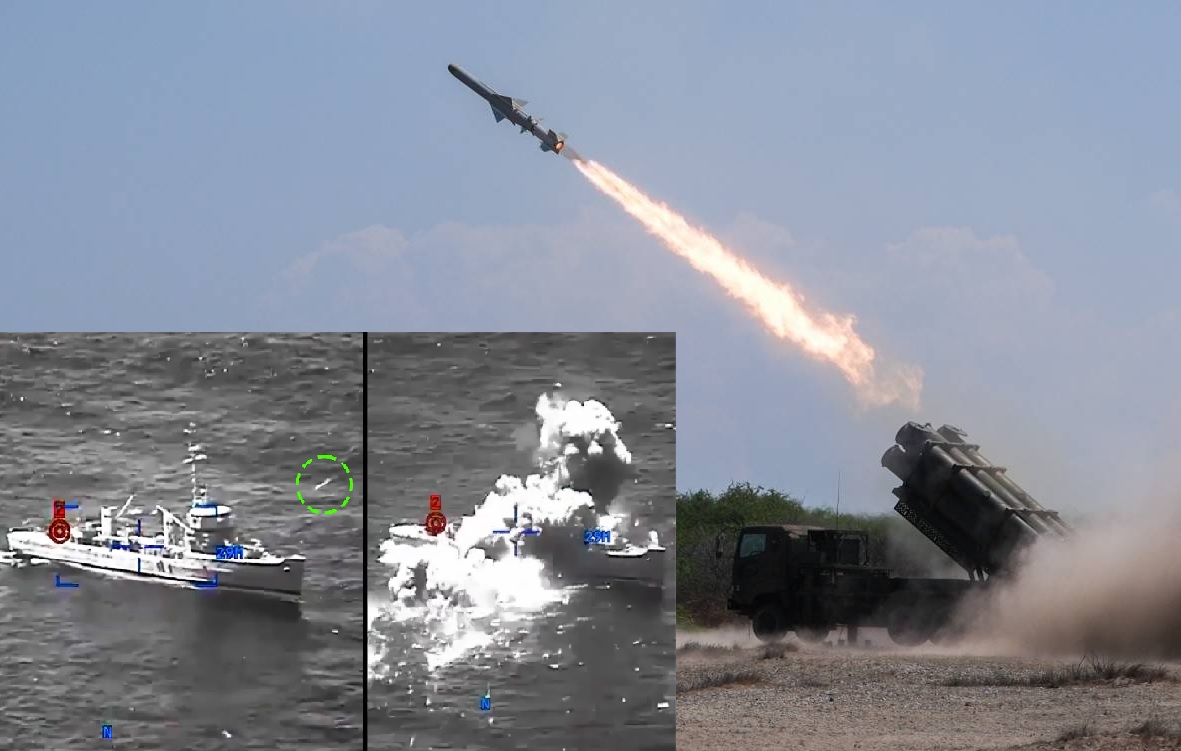
PAOAY, Philippines — May 7, 2026 : Japanese Ground Self-Defense Force (JGSDF) personnel fired two Type 88 surface-to-ship missiles during a multinational maritime strike exercise under Exercise Balikatan 2026, sinking a decommissioned Philippine Navy vessel in the South China Sea, referred to by the Philippines as the West Philippine Sea.
The live-fire event took place on May 6 from the sand dunes at Culili Point near Laoag City in Ilocos Norte province in northwestern Luzon. The missiles were launched from a single JGSDF 6×6 coastal defense launcher vehicle and struck the target vessel positioned approximately 75 kilometers offshore. Military officials confirmed the target was hit around six minutes after launch and subsequently sank.
The target vessel was the former BRP Quezon (PS-70), an Auk-class minesweeper originally built for the United States Navy during World War II. The vessel was transferred to the Philippine Navy in 1967 and later served as a patrol corvette for more than five decades before being decommissioned in 2021.
The maritime strike formed one of the capstone activities of Exercise Balikatan 2026, which ran from April 20 to May 8. The exercise involved approximately 17,000 military personnel from seven participating nations: the Philippines, the United States, Japan, Australia, Canada, France, and New Zealand. The 2026 edition marked the first active participation of Japanese combat troops in Balikatan and the first deployment of Japanese combat forces onto Philippine territory since the end of World War II.
Japanese participation in the exercise was enabled through the Japan-Philippines Reciprocal Access Agreement (RAA), ratified on September 11, 2025. Japan deployed approximately 1,400 troops across the broader exercise, while 70 JGSDF personnel were directly involved in the missile firing operation at Culili Point.
Before the Japanese missile launch, a United States Army High Mobility Artillery Rocket System (HIMARS) launcher fired a Guided Multiple Launch Rocket System (GMLRS) munition at the ex-BRP Quezon. Additional simulated engagements were also conducted using a Philippine Navy C-Star anti-ship missile system and a United States Marine Corps Navy/Marine Expeditionary Ship Interdiction System (NMESIS).
The NMESIS platform, deployed by the Hawaii-based 3rd Marine Littoral Regiment, was present in the Philippines for the first time during the exercise. The system consists of an unmanned Joint Light Tactical Vehicle (JLTV) carrying two Kongsberg Naval Strike Missiles. Although it did not fire live ordnance during the event, the system participated in the broader maritime strike scenario.
Exercise planners integrated the maritime strike into a wider operational framework focused on coastal defense, interoperability, and maritime denial operations in the Luzon Strait. Two days before the missile firing, American, Canadian, and Philippine forces conducted a separate counter-landing live-fire exercise designed to repel a simulated amphibious assault.
Additional activities during Balikatan included maritime key terrain seizure drills on remote islands in the Luzon Strait. Systems such as HIMARS and NMESIS were transported into forward operating areas using landing craft and C-130J Hercules aircraft to rehearse rapid deployment and area denial operations across strategic maritime chokepoints.
Defense analysts consider the Luzon Strait a critical corridor linking the South China Sea to the Pacific Ocean. The exercise scenario emphasized maintaining operational control of the strait and improving allied coordination across the First Island Chain.
The JGSDF employed the Mitsubishi Heavy Industries-built Type 88 anti-ship missile system during the exercise. The system, which has remained in Japanese service for more than 35 years, uses a six-tube launcher mounted on a 6×6 chassis. The missile measures 5.08 meters in length, carries a 225-kilogram high-explosive warhead, travels at high subsonic speed, and has an operational range of approximately 180 kilometers.
Japan is currently transitioning from the Type 88 system to the newer Type 12 surface-to-ship missile, which features extended range and updated targeting and guidance systems.
The Balikatan firing represented the first operational live use of the Type 88 missile system by Japan outside its national territory and the first JGSDF missile launch conducted from Philippine soil.
Philippine Defense Secretary Gilberto Teodoro Jr. and Japanese Defense Minister Shinjiro Koizumi attended the live-fire event at Culili Point.
Following the exercise, Teodoro stated that the activity demonstrated future interoperability potential between Philippine and Japanese forces. He said the exercise involved extensive coordination in planning, force organization, and resource management before the final missile engagement phase.
One day before the maritime strike, Teodoro and Koizumi met in Manila and signed a joint statement aimed at expanding bilateral defense equipment and technology cooperation. The agreement followed Tokyo’s revisions to its Three Principles on the Transfer of Defense Equipment and Technology, which eased restrictions on defense exports and overseas military cooperation.
The Philippines is currently evaluating additional Japanese defense equipment acquisitions, including second-hand TC-90 light aircraft and Abukuma-class destroyers. Manila has already received five TC-90 aircraft from Japan for maritime patrol missions.
Philippine officials, however, indicated that the Type 88 missile system is not being considered for procurement. The Armed Forces of the Philippines currently relies on the Indian-manufactured BrahMos cruise missile system for its coastal defense and anti-ship missile requirements.
Military officials from participating nations described the Balikatan 2026 maritime strike activities as part of continuing efforts to improve interoperability, joint operational planning, and maritime defense coordination among allied and partner forces operating in the Indo-Pacific region.
——— End of Article ———