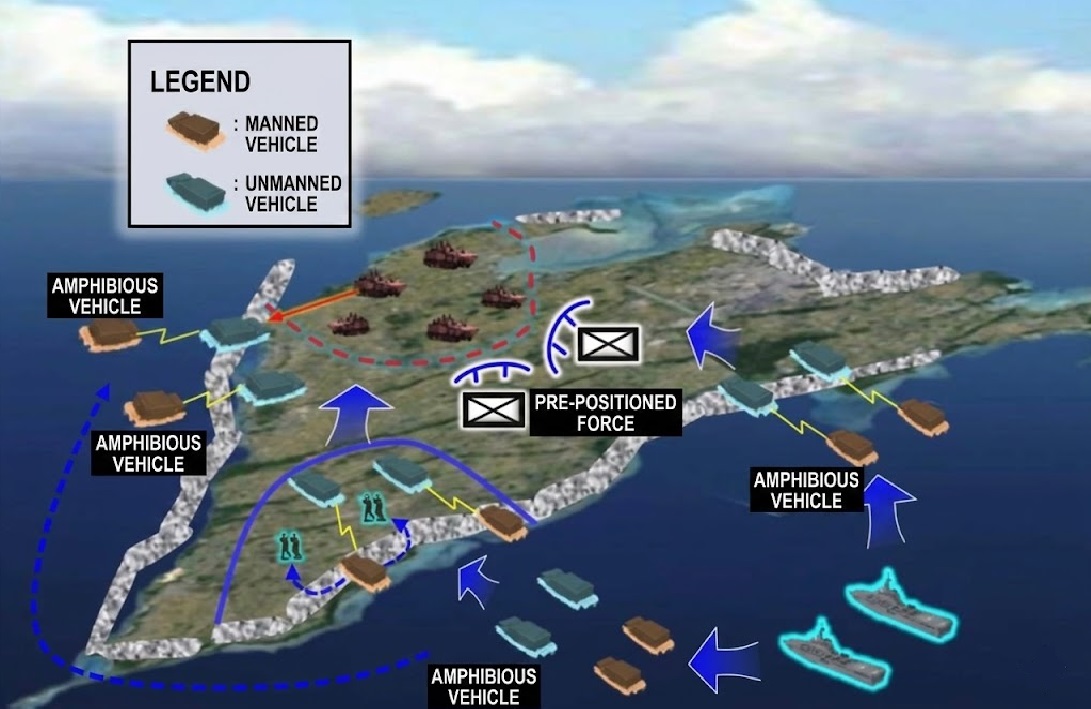
TOKYO — June 05, 2026 : Japan is advancing the development of a domestically produced Amphibious Assault Vehicle (AAV) designed to operate in both manned and unmanned modes, as part of a broader effort to strengthen the defense of its remote southwestern islands. Recent materials released by the Ministry of Defense and the Acquisition, Technology & Logistics Agency (ATLA) have revealed new details about the vehicle’s capabilities, highlighting its role in future amphibious operations and the growing emphasis on manned-unmanned teaming (MUM-T).
The new platform is being developed to enhance the operational effectiveness of the Japan Ground Self-Defense Force (JGSDF) in challenging island environments while reducing risks to personnel during amphibious assaults. The project forms part of Japan’s long-term efforts to improve its ability to defend and, if necessary, recapture remote territories.
Strengthening Defense of the Nansei Islands
For more than a decade, Japan has steadily expanded its defense capabilities in response to the changing security environment in the region. Particular attention has been placed on the Nansei Islands, a chain stretching southwest from Kyushu to Okinawa and toward Taiwan.
Japanese defense planners view these islands as strategically important due to their location along key maritime routes. In a potential regional contingency, including a scenario involving Taiwan, some of these islands could face threats from amphibious operations. As a result, Japan has invested heavily in developing specialized forces and equipment capable of operating across dispersed island chains.
To support this mission, the JGSDF established the Amphibious Rapid Deployment Brigade (ARDB) in 2018 at Camp Ainoura in Nagasaki Prefecture. Often compared to marine infantry formations, the brigade became Japan’s first unit dedicated exclusively to amphibious warfare and island recapture operations.
The ARDB currently consists of three Amphibious Rapid Deployment Regiments and a Combat Landing Battalion responsible for conducting amphibious landings and securing beachheads during operations.
Limitations of the Existing AAV-7 Fleet
The Combat Landing Battalion currently operates 52 U.S.-made AAV-7 amphibious assault vehicles. These vehicles are used to transport infantry forces from ships to shore and provide protection and fire support during landing operations.
While the AAV-7 has served as the backbone of Japan’s amphibious capability, defense officials have identified several limitations when operating in the country’s remote island environment.
One major challenge involves the geography of many islands in the Nansei chain. Numerous coastlines are surrounded by steep coral reefs that create significant obstacles for amphibious vehicles. The AAV-7 often struggles to cross these reefs, limiting potential landing sites to gently sloping sandy beaches and reducing tactical flexibility during operations.
The vehicle’s armament has also been viewed as insufficient for modern combat scenarios. Equipped with a 12.7 mm machine gun and a 40 mm automatic grenade launcher, the AAV-7 has limited capability against armored vehicles or heavily defended coastal positions.
These operational constraints prompted the Ministry of Defense to pursue a more capable domestic alternative.
New Vehicle Designed for Difficult Coastal Terrain
The new amphibious assault vehicle emerged from ATLA’s Future Amphibious Technology Research (FAT-R) program, which has focused on improving mobility, survivability, and amphibious performance for operations around Japan’s southwestern islands.
Unlike the existing AAV-7, the new vehicle is designed specifically to overcome the challenges posed by coral reef coastlines. It utilizes a propulsion system that combines heavy-duty tracks with dual rear-mounted water jets, enabling the vehicle to generate both forward and upward thrust while approaching shore.
According to the released specifications, the system will allow the vehicle to climb coral reefs with slopes of up to 50 degrees. This capability is expected to significantly increase the number of potential landing locations available to Japanese forces and reduce reliance on predictable beach approaches.
The vehicle is also designed to provide greater firepower. It will be fitted with a Remote Weapon Station (RWS) capable of mounting a 30 mm automatic cannon alongside a 12.7 mm machine gun. The upgraded armament will enable the vehicle to engage lightly armored vehicles and fortified positions more effectively than the current AAV-7.
Manned-Unmanned Teaming at the Core of the Program
A defining feature of the new AAV is its integration of manned-unmanned teaming (MUM-T) technologies.
The platform is being engineered to operate under direct crew control, remote control from another vehicle, or fully autonomous navigation. These capabilities are intended to support a range of operational scenarios while reducing risks to personnel during high-threat missions.
Military planners consider the first wave of an amphibious assault to be one of the most dangerous phases of an operation, as forces must establish a foothold while facing concentrated enemy resistance. By deploying unmanned vehicles during the initial landing phase, the JGSDF aims to reduce potential casualties while maintaining operational momentum.
To support remote and autonomous operations, the vehicle will incorporate a networked sensor suite featuring visible-light and infrared sensors. These systems will provide real-time battlefield and environmental data to operators and nearby units.
The AAV will also be capable of autonomous movement using pre-programmed waypoints, allowing it to navigate independently across designated routes.
Advanced Battlefield Networking
In addition to its mobility and autonomous functions, the vehicle will feature an advanced command-and-control system derived from the JGSDF’s Type 10 main battle tank.
The system will enable vehicles and units to share target location data, exchange tactical information, allocate targets, and transmit combat instructions across the battlefield in real time. This level of connectivity is intended to improve coordination between amphibious assault forces and support more efficient decision-making during operations.
The networking capability is expected to play a central role in future amphibious missions involving both manned and unmanned platforms operating together.
Prototype Production and Testing Schedule
Further details of the program were revealed after Japanese military analyst Santaro Iwamoto obtained internal ATLA documents through a freedom-of-information request and later shared the information with Naval News.
According to the documents, ATLA plans to manufacture four prototype vehicles for practical testing beginning in 2027.
All four prototypes will incorporate the baseline remote-control and autonomous operating functions planned for the production vehicle. The fourth prototype will feature enhanced power-generation capacity designed to support future technological upgrades.
The additional electrical power is intended to accommodate next-generation systems, including potential modular hybrid-propulsion technologies and other advanced capabilities that may be integrated in later versions of the vehicle.
Deployment Planned From 2028
Following the completion of testing and evaluation in 2027, Japan’s Ministry of Defense plans to begin deploying the new amphibious assault vehicles in 2028.
Current plans call for the procurement of approximately 97 domestically produced AAVs, which will equip the Amphibious Rapid Deployment Brigade and gradually supplement or replace the existing AAV-7 fleet.
The program represents one of Japan’s most significant amphibious modernization efforts in recent years. By combining enhanced mobility, greater firepower, advanced networking, and manned-unmanned teaming capabilities, the new vehicle is expected to strengthen the JGSDF’s ability to conduct amphibious operations and defend remote islands across Japan’s southwestern region.
——— End of Article ———