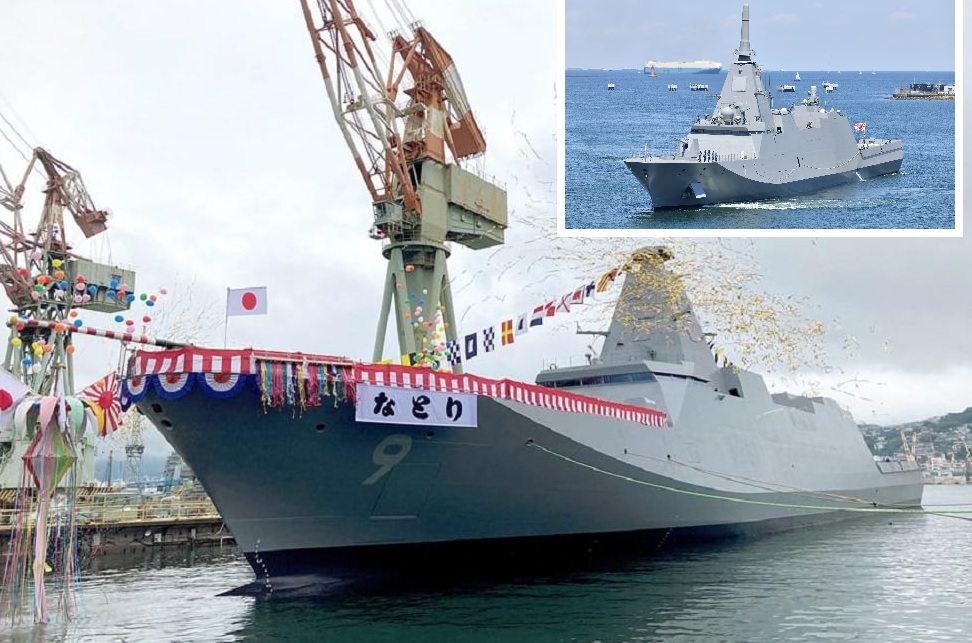
NAGASAKI / ŌMINATO, Japan, — May 22, 2026 : The Japan Maritime Self-Defense Force (JMSDF) officially commissioned JS Natori (FFM-9), the ninth vessel of the Mogami-class multirole frigate program, during delivery and self-defense ship flag-raising ceremonies held on May 21, 2026, at Mitsubishi Heavy Industries’ (MHI) Nagasaki Shipyard.
The ceremony was attended by MHI President Eisaku Ito and Vice Admiral Tatsuya Fukuda, Commandant of the Sasebo District. Commanded by Commander Yoichiro Hiratsuka, the vessel was assigned to Patrol and Defense Squadron 5 of the newly established Patrol and Defense Group based at Ōminato Naval Base in Aomori Prefecture.
The frigate is named after the Natori River in Miyagi Prefecture in northeastern Japan. It becomes the second Japanese warship to carry the name following a Nagara-class light cruiser that served with the Imperial Japanese Navy during World War II.
Construction and Commissioning
JS Natori was built under Japan’s fiscal year 2022 procurement plan at Mitsubishi Heavy Industries’ Nagasaki Shipyard & Machinery Works at a cost of approximately 51.4 billion yen ($323 million).
The ship was laid down on July 6, 2023, launched on June 24, 2024, and formally commissioned into JMSDF service on May 21, 2026. The construction timeline reflects Japan’s continued effort to accelerate naval shipbuilding amid regional maritime security developments.
Natori is the third Mogami-class frigate to enter service with the Mk 41 Vertical Launching System (VLS) installed from the outset, following JS Niyodo (FFM-7) and JS Yubetsu (FFM-8). The first six vessels of the class are scheduled to receive the Mk 41 VLS during future modernization refits.
Automation-Focused Warship Design
The Mogami-class has gained international attention for its extensive use of automation and reduced manpower requirements. The design reflects Japan’s long-term strategy to sustain naval operational capability despite demographic pressures and recruitment challenges affecting the Self-Defense Forces.
While conventional JMSDF destroyers generally require crews of approximately 200 personnel, Mogami-class frigates operate with a complement of around 90 sailors. The bridge is normally operated by only four personnel, compared with seven or eight aboard older destroyers.
A major factor enabling this reduction is the ship’s redesigned Combat Information Center (CIC). The CIC integrates radar, sonar, electronic warfare, tactical data, anti-submarine warfare operations, and engineering controls into a centralized real-time operational picture.
The system includes a 360-degree circular display wall, 14 multifunction consoles, four additional consoles, and two large tactile command tables. The layout allows senior officers and operators to share situational awareness more efficiently while supporting faster operational decision-making.
The architecture is also designed to support future integration with unmanned aerial vehicles (UAVs), unmanned surface vehicles (USVs), and unmanned underwater vehicles (UUVs), positioning the frigate as a networked command node within Japan’s evolving maritime warfare structure.
Specifications and Combat Systems
The Mogami-class features a stealth-oriented hull design intended to reduce radar cross-section and improve survivability. JS Natori is also part of the first JMSDF surface combatant class to employ a combined diesel and gas (CODAG) propulsion system.
The vessel has a standard displacement of 3,900 tons and a full-load displacement of approximately 5,500 tons. It measures 132.5 meters in length, with a beam of 16.3 meters and a draft of 9 meters.
The propulsion system consists of one Rolls-Royce MT30 gas turbine and two MAN 12V28/33D STC diesel engines, enabling speeds exceeding 30 knots.
JS Natori is equipped with a modern multirole weapons suite that includes:
- One BAE Systems 5-inch (127 mm) Mk 45 Mod 4 naval gun
- Two Japan Steel Works 12.7 mm remote weapon systems
- One 16-cell Mk 41 Vertical Launching System
- Eight Type 17 anti-ship missiles
- One Raytheon SeaRAM close-in weapon system
- Type 12 torpedoes
- Simplified mine-laying capability
The ship’s sensor package includes the Mitsubishi OPY-2 AESA multifunction radar, OAX-3 electro-optical/infrared sensor, Hitachi OQQ-11 sonar, and NEC OQQ-25 anti-submarine warfare sonar system featuring variable depth and towed-array capabilities.
Future upgrades are expected to include unmanned underwater and unmanned surface systems for mine countermeasure operations.
Growing International Interest
The commissioning of JS Natori comes amid increasing international interest in Mogami-derived frigate designs.
Australia recently selected an upgraded Mogami-based design for its future general-purpose frigate program, while New Zealand and Indonesia have also expressed interest in the platform.
At the same time, Japan’s Ministry of Defense has begun procurement of a larger and more capable successor known as the New FFM or 06FFM.
Designed by Mitsubishi Heavy Industries, the New FFM will feature a larger hull and significantly expanded missile capacity, including 32 Mk 41 VLS cells, double the number carried by the current Mogami-class configuration.
The future class is expected to incorporate enhanced anti-air and anti-submarine warfare capabilities, including the Type 23 ship-to-air guided missile and an upgraded long-range version of the Type 12 surface-to-ship missile.
The first two New FFM vessels are scheduled to enter service in fiscal year 2028. Under Japan’s current naval procurement schedule, all 12 ships of the class are expected to be commissioned by fiscal year 2032.
——— End of Article ———