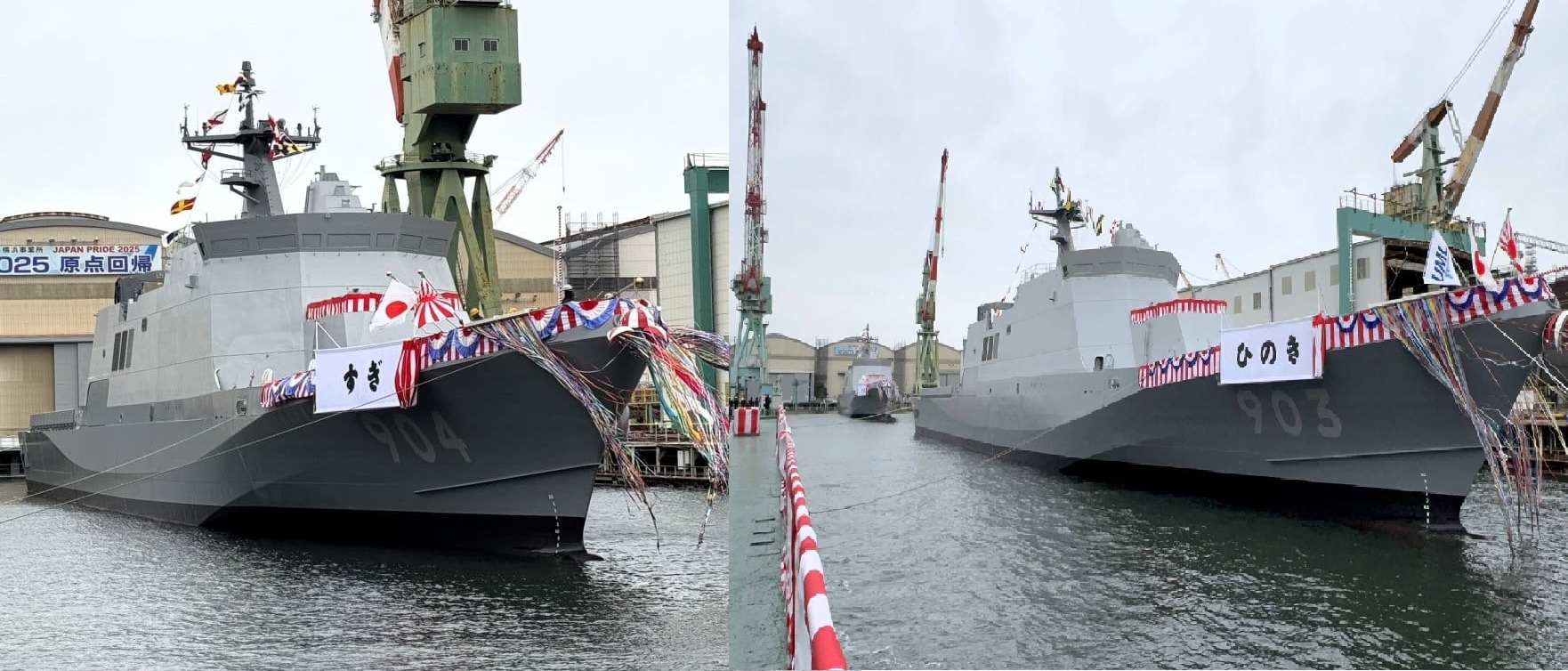
YOKOHAMA, Japan — March 13, 2026 : Japan has launched the third and fourth vessels of its new Sakura-class offshore patrol vessel (OPV) program, continuing a procurement effort designed to strengthen routine maritime surveillance and free larger warships for higher-intensity missions.
The launching ceremony for the vessels Hinoki (OPV-903) and Sugi (OPV-904) was held on March 13 at the Japan Marine United (JMU) Isogo shipyard in Yokohama, Kanagawa Prefecture. Both ships are being constructed for the Japan Maritime Self-Defense Force (JMSDF) under a new patrol vessel program introduced as part of Japan’s broader Defense Buildup Program.
The Sakura-class marks the first time the JMSDF has formally used the “offshore patrol vessel” designation for a naval platform. The vessels are intended to conduct routine patrol, maritime domain awareness, and security missions across Japan’s surrounding waters, including areas around the Nansei Islands chain and the country’s large Exclusive Economic Zone (EEZ), which is the sixth largest in the world.
Naming Conventions and Historical Lineage
The two newly launched ships follow a naming convention distinct from the traditional JMSDF destroyer naming system.
JMSDF destroyers are usually named after meteorological phenomena, mountains, rivers, or regions. By contrast, the Sakura-class OPVs are named after trees. The names were selected through an internal solicitation and review process within the JMSDF and received final approval from Japan’s Minister of Defense, Shinjiro Koizumi.
The third vessel, Hinoki, is named after the Japanese cypress tree. It is the third Japanese naval vessel to carry the name. Earlier ships included the third vessel of the Imperial Japanese Navy’s Momo-class destroyers and the sixteenth vessel of the Matsu-class destroyers during World War II.
The fourth ship, Sugi, takes its name from the Japanese cedar tree, a species widely found across Japan. It becomes the fourth Japanese naval vessel to carry that name. Previous ships included the ninth vessel of the Kaba-class destroyers, the seventh vessel of the Matsu-class destroyers, and a Kusu-class escort ship leased from the United States Navy in 1953.
Hinoki and Sugi were laid down on February 14, 2025, together with the first two ships of the class, Sakura (OPV-901) and Tachibana (OPV-902). The lead pair were launched earlier on November 13, 2025.
According to the JMSDF Maritime Staff Office, all four vessels are scheduled to enter service around March 2027.
Design Characteristics and Technical Specifications
The Sakura-class OPVs are designed primarily for long-duration patrol missions rather than high-intensity naval combat. The design emphasizes automation, operational efficiency, and reduced manpower requirements.
Each vessel measures approximately 95 meters in length, with a beam of about 12 meters, depth of 7.7 meters, and draft of 4.2 meters. Standard displacement is roughly 1,900 to 1,950 tons, while full-load displacement is estimated at around 2,300 tons.
The ships incorporate stealth-oriented hull shaping influenced by the design principles used in the JMSDF’s Mogami-class frigates. However, the patrol vessels are not equipped with the extensive combat systems found on frontline warships.
Propulsion is provided through a Combined Diesel-electric And Diesel (CODLAD) system. This arrangement uses one diesel engine and one electric motor connected to a single propeller shaft. The configuration allows the vessels to operate efficiently during patrol missions while still achieving a maximum speed of approximately 20 to 25 knots.
A key design feature of the Sakura-class is its high level of automation. The ships require a crew of only 30 personnel, significantly smaller than the roughly 90 sailors assigned to a Mogami-class frigate. The reduced crew size addresses long-term manpower concerns within Japan’s Self-Defense Forces, particularly as the country faces demographic decline and shrinking recruitment pools.
Armament on the patrol vessels is limited to a single 30-millimeter naval gun mounted on the foredeck for self-defense. The ships do not carry anti-ship missiles or anti-aircraft missile systems, unlike destroyers and frigates.
The design also incorporates a modular architecture, allowing mission systems to be adapted depending on operational requirements. According to Japan’s Acquisition, Technology and Logistics Agency (ATLA), the concept emphasizes surveillance, operational flexibility, and long-term sustainability rather than combat capability.
Integration of Unmanned Aerial Systems
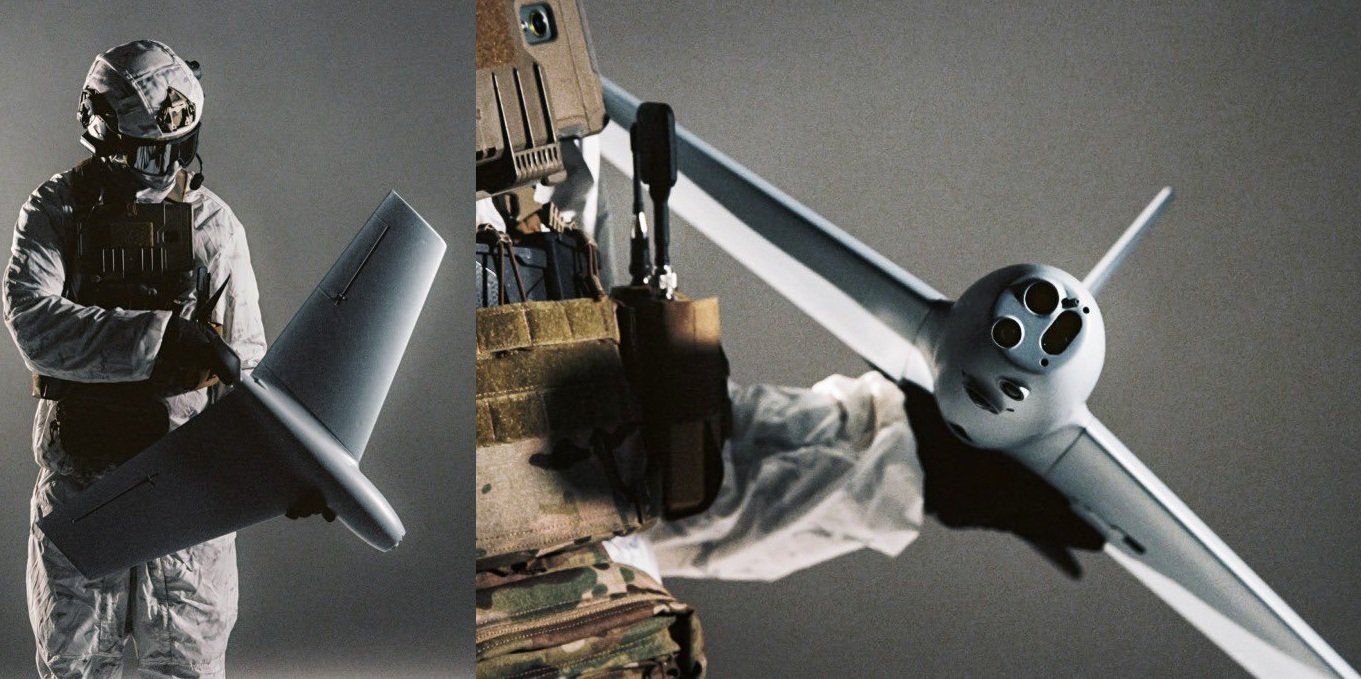
To enhance surveillance capability, the Japanese Ministry of Defense plans to equip the Sakura-class vessels with unmanned aerial vehicles (UAVs).
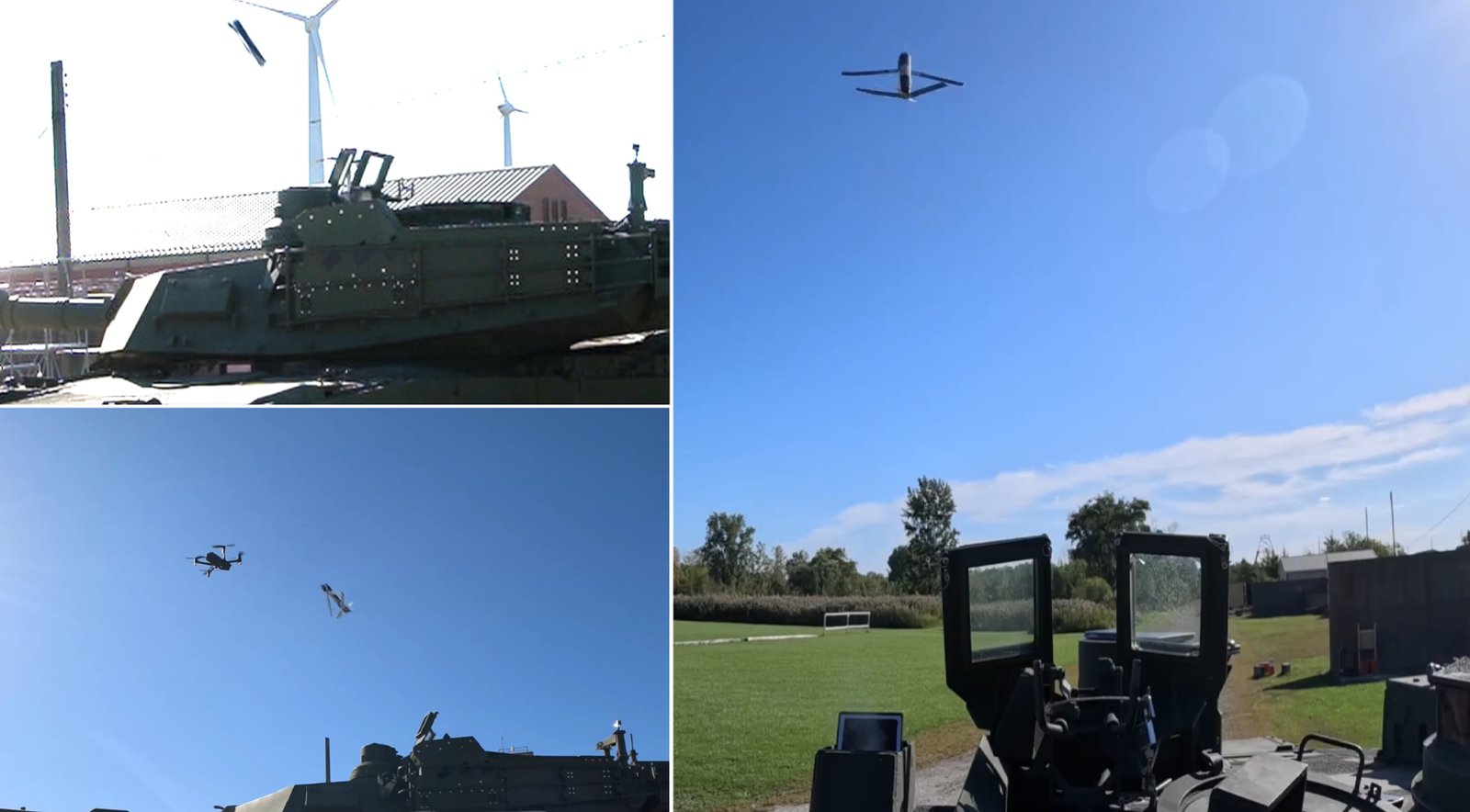
In the fiscal year 2025 defense budget, approximately 4 billion yen was allocated for the procurement of six V-BAT unmanned aerial systems produced by the U.S. defense company Shield AI. The UAV systems are expected to be installed on the OPVs at a later stage after the ships enter service.
The vertical takeoff and landing (VTOL) V-BAT drones are intended to extend reconnaissance range and improve maritime domain awareness during surveillance operations.
Procurement Plan and Rising Construction Costs
The Sakura-class program forms part of Japan’s Defense Buildup Program, adopted in December 2022, which outlines the modernization and expansion of Japan’s defense capabilities over the coming decade.
Under the plan, the Ministry of Defense intends to acquire 12 Sakura-class offshore patrol vessels.
The Japanese government initially allocated 35.7 billion yen in the fiscal year 2023 defense budget for construction of the first four ships. The third and fourth vessels, Hinoki and Sugi, each cost approximately 8.9 billion yen, equivalent to roughly $56 million per ship.
However, construction costs have increased. In the fiscal year 2026 defense budget, 28.5 billion yen was allocated for the fifth and sixth ships of the class. This raises the estimated unit cost to approximately 14.25 billion yen per vessel, reflecting broader shipbuilding cost increases.
Strategic Role in Japan’s Naval Force Structure
The introduction of the Sakura-class OPVs is part of a broader restructuring effort within the JMSDF aimed at optimizing the deployment of naval assets.
Routine maritime security patrols currently require the use of larger and more heavily armed destroyers and frigates. By assigning these missions to smaller OPVs, the JMSDF intends to allow frontline combat ships to focus on high-intensity operations and combat readiness.
The patrol vessels will eventually be assigned to a newly planned Patrol and Defense Group, which will operate under a reorganized command structure known as the Fleet Surface Force, expected to be established by the JMSDF in March 2026.
This new formation will include both Sakura-class OPVs and Mogami-class frigates, supporting maritime surveillance and security operations across Japan’s surrounding waters.
Regional Security Context
Japan’s naval modernization efforts are occurring amid expanding Chinese maritime activity in the western Pacific and East China Sea.
According to Japan’s 2025 Defense White Paper, China currently operates 94 modern destroyers and frigates and 55 modern submarines. In comparison, the JMSDF operates 51 destroyers and 22 submarines as of March 31, 2025.
Japanese defense planners view the Sakura-class vessels as a cost-effective platform for maintaining continuous surveillance over Japan’s territorial waters and its large exclusive economic zone.
The vessels are also intended to support overseas deployments, multinational exercises, and maritime security missions, while helping mitigate long-term manpower shortages caused by Japan’s demographic trends.
With four ships already launched and eight more planned, the Sakura-class program represents a new category of naval vessel within the JMSDF designed specifically for sustained maritime monitoring and patrol operations.
——— End of Article ———