TEHRAN / JERUSALEM, — June 1, 2026 : Indirect diplomatic communications between Iran and the United States have stalled after Tehran announced the suspension of message exchanges with Washington, citing Israel’s military operations in Lebanon as a violation of a ceasefire framework established earlier this year.
The decision, reported by Tasnim News Agency, comes amid renewed fighting in southern Lebanon and increased Israeli military activity targeting Hezbollah positions. Iranian officials stated that no further diplomatic engagement with the United States would take place until specific conditions are met, including the cessation of Israeli operations and withdrawal from areas Tehran considers occupied.
The latest development marks a setback in efforts to reduce tensions after months of regional conflict. According to reports, U.S. and Iranian representatives had continued exchanging proposals through intermediaries regarding a broader ceasefire arrangement and maritime security, although progress remained limited.
Israel Expands Military Operations in Lebanon
Tensions escalated after the Israel Defense Forces (IDF) launched their deepest ground advance into southern Lebanon in more than two decades, capturing the historic Beaufort Castle and the surrounding strategic ridge. The site, approximately 900 years old, overlooks key areas in southern Lebanon and holds military significance due to its elevated position.
Following the advance, the IDF reissued evacuation warnings covering southern Lebanon on Sunday, urging residents to move away from areas expected to face military activity.
On Monday, Israeli Prime Minister Benjamin Netanyahu and Defense Minister Israel Katz directed the military to expand strikes into Beirut’s Dahiyeh district, a southern suburb regarded as a Hezbollah stronghold.
In a joint statement, Israeli authorities said the decision followed repeated violations of the Lebanon ceasefire by Hezbollah and continued missile and drone attacks targeting Israeli soldiers and northern communities.
“Following the repeated violations of the ceasefire in Lebanon by the Hezbollah terror organization and the attacks against our cities and citizens, Prime Minister Benjamin Netanyahu and Defense Minister Israel Katz instructed the IDF to strike terror targets in the Dahiyeh quarter of Beirut,” the statement said.
Israeli operations in Beirut had previously remained limited after pressure from the administration of former U.S. President Donald Trump, which sought to maintain conditions favorable for a broader diplomatic understanding involving Iran. However, Israeli officials said a rise in Hezbollah drone and missile attacks prompted renewed military action.
Hezbollah Rejects U.S. De-escalation Proposal
Diplomatic efforts to reduce hostilities in Lebanon encountered difficulties after Hezbollah reportedly rejected a recent U.S.-backed de-escalation proposal on Monday. According to reports, the proposal required Hezbollah to halt attacks before Israel implemented reciprocal measures.
Hezbollah began attacks against Israel on March 2, shortly after the United States and Israel launched a joint air campaign against Iran. Since then, cross-border exchanges between Hezbollah and Israeli forces have continued despite ceasefire efforts.
Lebanese Parliament Speaker Nabih Berri, who has acted as an intermediary in negotiations, reportedly conveyed Hezbollah’s position to U.S. officials, emphasizing that any sustainable ceasefire arrangement would require Israel to stop military activity first.
Iran Suspends Talks and Raises Ceasefire Concerns
Iranian officials maintain that the ceasefire reached between Tehran and Washington on April 8 extended beyond direct U.S.-Iran tensions and included military activity across regional fronts, including Lebanon.
While Israeli strikes briefly slowed after the agreement took effect, military confrontations resumed as Israel maintained that operations against Hezbollah were not covered by the U.S.-Iran agreement.
Iranian Foreign Minister Abbas Araghchi said on Monday that Tehran views the ceasefire as applicable to all regional fronts.
“The ceasefire between Iran and the US is unequivocally a ceasefire on all fronts, including in Lebanon. Its violation on one front is a violation of the ceasefire on all fronts,” Araghchi said in a post on X.
Tasnim reported that Iran would not resume diplomatic exchanges with the United States until Israeli military operations stop and forces withdraw from areas in Lebanon and Gaza.
Iran’s chief negotiator and Parliament Speaker Mohammad Bagher Ghalibaf accused Washington of failing to uphold commitments related to the ceasefire, citing a U.S. naval blockade of Iranian ports that Tehran says began on April 13.
Ghalibaf described the blockade and Israeli escalation in Lebanon as evidence of “US non-compliance with the ceasefire,” adding in a post on X that “every choice has a price and the bill comes due.”
Threat of Maritime Disruption
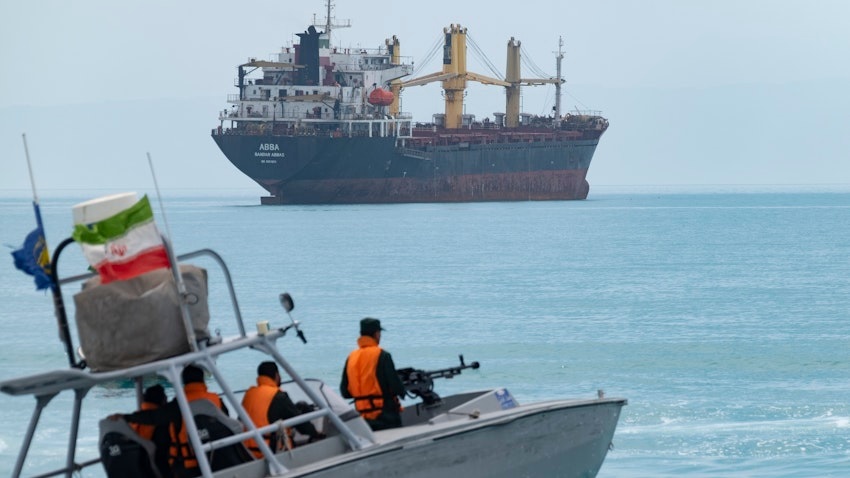
Alongside the suspension of diplomatic contacts, Iranian officials and allied groups within the “Resistance Front”, including partners in Yemen, Lebanon, and Iraq, have reportedly discussed plans to increase pressure through maritime chokepoints.
The proposed measures include a potential blockade of the Strait of Hormuz and the Bab el-Mandeb Strait, two globally significant maritime routes used for energy exports and international trade.
The Strait of Hormuz, located between Iran and Oman, serves as one of the world’s most important oil transit corridors. The Bab el-Mandeb Strait, near Yemen and linking the Red Sea to the Gulf of Aden, is a major commercial route connecting shipping through the Suez Canal.
A disruption in either route could affect global energy transportation, shipping schedules, and trade flows, particularly for cargo moving between Asia, Europe, and the Middle East.
Separately, U.S. military officials confirmed that American forces intercepted two Iranian ballistic missiles targeting military bases in Kuwait late Sunday night. According to U.S. Central Command, no casualties or damage to personnel were reported.
International Response and Humanitarian Concerns
The growing regional tensions have prompted an international response. The United Nations Security Council is scheduled to hold an emergency meeting on Monday following requests from international leaders seeking discussions on the expanding conflict in Lebanon and Israel’s continued military operations.
Meanwhile, renewed evacuation warnings in southern Lebanon and anticipated strikes near Beirut’s southern suburbs have contributed to additional civilian displacement. Humanitarian agencies estimate that more than one million people have already been displaced in Lebanon since the broader conflict began.
Diplomatic uncertainty now surrounds the future of U.S.-Iran engagement, with regional stability increasingly tied to developments in Lebanon, military exchanges involving Hezbollah, and the potential impact of threats to international shipping routes.
——— End of Article ———