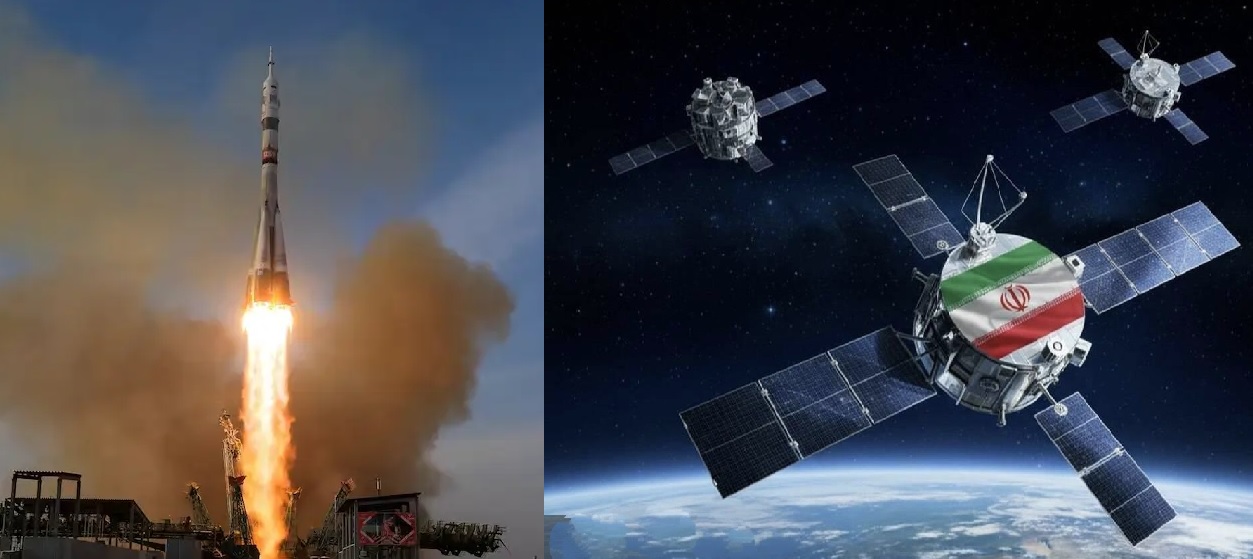
Tehran: Iran on Sunday successfully placed three domestically built observation satellites into orbit using a Russian Soyuz rocket, marking another milestone in the country’s expanding space programme amid ongoing Western sanctions.
State television reported that the satellites — Zafar-2, Paya, and Kowsar-1.5 — were launched from the Vostochny Cosmodrome, one of Russia’s newest and most strategically important spaceports. The mission represents one of Iran’s most advanced multi-satellite deployments so far.
Satellite Capabilities
According to the official IRNA news agency, all three satellites were designed and developed within Iran, with a strong role played by the country’s private aerospace sector. The spacecraft are intended exclusively for Earth observation and civilian applications, Iranian officials said.
Among them, Paya is described as Iran’s most technologically advanced imaging satellite to date. It incorporates artificial intelligence–based image processing, allowing enhanced resolution and faster data analysis. IRNA said the satellite will be used for water resource management, environmental and climate monitoring, land-use mapping, and disaster assessment.
Zafar-2 and Kowsar-1.5 are also observation satellites, designed to expand Iran’s ability to collect geospatial data for agriculture, urban planning and infrastructure monitoring, contributing to what officials describe as greater data self-reliance.
Why a Russian Launch
Iranian media, citing the Fars News Agency, said the Soyuz launch vehicle was selected because of its reputation as one of the world’s most reliable orbital rockets, particularly for missions involving sensitive and high-value payloads. The use of Russian launch services reflects Tehran’s growing reliance on international partnerships to ensure consistent access to space.
The launch further strengthens technical cooperation between Iran and Russia, which has expanded in recent years across defence, energy and aerospace sectors.
A Growing Space Programme
The mission brings the number of Iranian satellite launches to 10 in the past two years, highlighting an accelerated pace in the country’s space activities. Iran conducted another launch from the same Russian spaceport in July, signalling a sustained operational relationship with Russian launch facilities.
International Concerns
Western governments have long expressed concern that satellite launch systems share technologies with ballistic missile platforms, which could theoretically be adapted to carry nuclear payloads. These concerns are frequently linked to Iran’s controversial nuclear programme.
Iran has rejected those accusations, insisting that its aerospace activities are peaceful, civilian in nature, and compliant with United Nations Security Council resolutions. Tehran continues to deny seeking nuclear weapons, maintaining that its satellite programme is focused on scientific research, environmental monitoring and economic development.
Strategic Signal
With the successful deployment of Zafar-2, Paya and Kowsar-1.5, Iran has demonstrated that international sanctions have not halted its progress in space technology. The emphasis on AI-enabled satellites, private-sector involvement and reliable foreign launch partnerships points to a more mature and strategically significant phase of Iran’s space ambitions.
——— End of Article ———