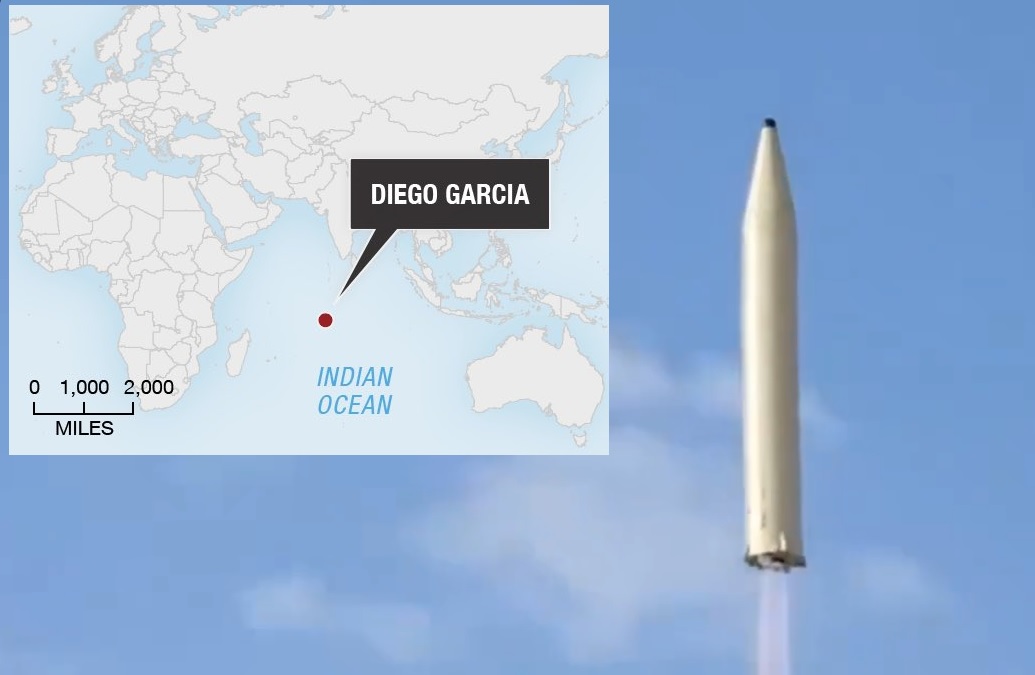
LONDON / WASHINGTON / TEHRAN, — March 21, 2026 : Iran launched two intermediate-range ballistic missiles (IRBMs) toward Diego Garcia, a joint United States–United Kingdom military installation in the central Indian Ocean, in an operation conducted between March 20 and 21, according to U.S. officials and multiple reports. Neither missile struck the target.
The launch marks the first recorded attempt by Iran to target a location at this distance, approximately 3,800 to 4,000 kilometers from Iranian territory, and represents one of the longest-range missile operations publicly demonstrated by Tehran.
Incident Overview
Defense officials stated that both missiles were fired from Iranian territory toward the strategic atoll, which serves as a key logistics and operations hub for U.S. and allied forces.
According to U.S. officials cited by The Wall Street Journal, one missile failed during flight and broke apart before reaching its intended target. The second missile was engaged by a Standard Missile-3 (SM-3) interceptor launched from a U.S. Navy warship deployed in the region. Officials have not confirmed whether the interception directly caused the missile’s failure to reach the base.
Iran’s semi-official Mehr News Agency confirmed the launch, describing it as a demonstration that the range of Iran’s missile capabilities exceeds previous external assessments.
Target Significance
Diego Garcia, part of the Chagos Archipelago, is a critical forward operating base used by U.S. forces for long-range bomber deployments, naval operations, and logistical support across the Middle East, Africa, and the Indo-Pacific region. The base also supports surveillance and strategic mobility missions.
The attempted strike follows recent authorization by U.K. Prime Minister Keir Starmer permitting U.S. forces to conduct operations from British bases, including Diego Garcia, in the context of ongoing military actions involving Iran.
Iranian Foreign Minister Abbas Araghchi stated that the launch was conducted in self-defense and warned that the use of U.K. bases for operations against Iran could place British interests at risk.
Missile System and Technical Assessment
U.S. officials and defense analysts assess that the missiles used in the launch were likely from the Khorramshahr-4 class, also known as Kheibar, operated by the Islamic Revolutionary Guard Corps Aerospace Force.
The Khorramshahr-4 is a liquid-fueled ballistic missile approximately 13 meters in length, typically listed with a range of around 2,000 kilometers when carrying a 1,500 to 1,800 kilogram warhead. Analysts note that extended ranges can be achieved with reduced payload weight.
The missile is equipped with a maneuverable re-entry vehicle and is capable of delivering cluster munitions. Similar cluster warheads have been used in missile strikes on Israeli urban areas during the ongoing conflict over the past three weeks, according to intelligence assessments.
Range Implications
The attempted strike demonstrates an operational reach of up to 4,000 kilometers, exceeding Iran’s long-standing public position that its ballistic missile program is limited to a maximum range of 2,000 kilometers.
This extended range significantly alters geographic threat assessments. A strike radius of this scale from Iranian launch sites encompasses large parts of Europe, including major cities such as Paris and London, placing them within theoretical reach of similar missile systems.
Strategic and Operational Context
The launch occurred amid ongoing U.S. and Israeli military operations targeting Iranian infrastructure and missile capabilities. By targeting a remote but strategically significant base in the Indian Ocean, Iran appears to be attempting to demonstrate the ability to reach and potentially disrupt allied logistical and operational nodes beyond the immediate Middle Eastern theater.
Although neither missile successfully impacted the base, the incident required the use of high-end missile defense assets, including the SM-3 interceptor, indicating the level of defensive resources necessary to counter such threats.
Military analysts note that the event highlights the increasing importance of ballistic missile defense (BMD) systems and may prompt the United States, the United Kingdom, and European allies to reassess force posture and defensive deployments, including the potential expansion of layered missile defense coverage.
Outcome and Current Assessment
No damage or casualties were reported at Diego Garcia, and the failed strike did not alter the immediate military balance. However, the launch provides operational evidence that Iran possesses missile capabilities extending beyond previously declared limits.
Iranian officials have stated that the country will continue to exercise what it describes as its right to self-defense. The development is expected to factor into ongoing assessments of regional and broader security dynamics involving Iran and Western allied forces.
——— End of Article ———