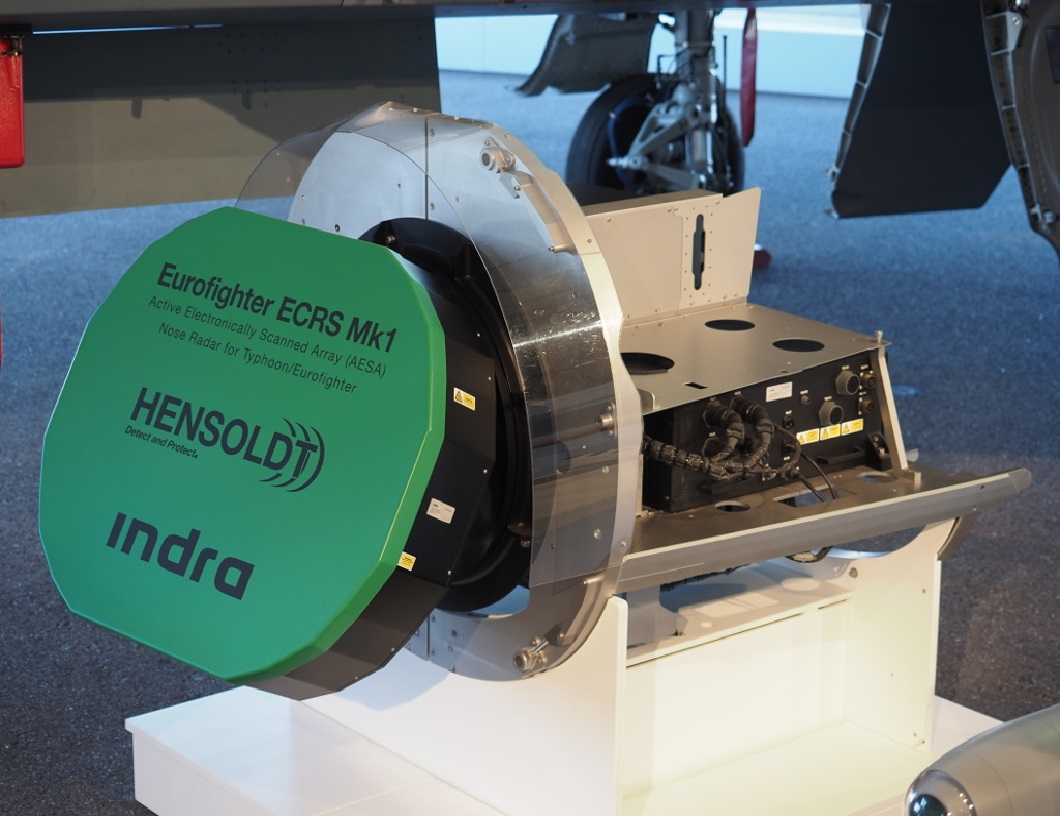
ULM, Germany / MADRID, Spain — June 05,2026 : Spanish defense technology company Indra and German sensor specialist HENSOLDT have commenced live operational testing of the Eurofighter Common Radar System Mark 1 (ECRS Mk1), a next-generation Active Electronically Scanned Array (AESA) radar developed for the German Luftwaffe and the Spanish Air and Space Force Eurofighter fleets.
The milestone marks the programme’s transition from ground-based testing to operational evaluations using live targets, while comprehensive airborne flight trials are scheduled to continue throughout 2026. The programme remains on track for initial deliveries in 2027.
Radar Enters Operational Testing Phase
Developed jointly by HENSOLDT and Indra under a contract awarded in 2020, the ECRS Mk1 has now been fully integrated with its operational hardware and the most advanced software version currently available.
During the current testing phase, engineers are evaluating the radar using live targets of opportunity and cooperative targets to replicate real-world operational scenarios. The objective is to further refine the radar’s software while validating system performance under realistic conditions.
According to the industry partners, early testing results have demonstrated improvements in both the robustness of the hardware architecture and the performance of the software system. These results support the enhanced subsystem configuration selected by Germany and Spain in 2024.
Advanced AESA Architecture
The ECRS Mk1 incorporates a multi-channel AESA architecture, a high-performance processor, a new multi-channel receiver, and broadband transmit-receive modules (TRMs).
These technologies are designed to improve:
- Target detection, tracking, and classification
- Operational agility and mission responsiveness
- Electronic protection measures
- Electronic Support Measures (ESM)
- Electronic Attack (EA) capabilities
The radar is capable of supporting the full range of Eurofighter missions, enabling the aircraft to conduct multiple tasks simultaneously while maintaining high levels of situational awareness.
Enhanced Air-to-Air, Air-to-Ground, and Electronic Warfare Capabilities
The new radar has been designed to support both current and future operational requirements across the full mission spectrum.
For air-to-air operations, the system provides enhanced target detection and tracking capabilities. In the air-to-ground role, it supports advanced functions including Synthetic Aperture Radar (SAR) imagery, Ground Moving Target Indication (GMTI), and Space-Time Adaptive Processing (STAP).
The radar also delivers expanded electronic warfare capabilities, allowing Eurofighter aircraft to operate more effectively in complex and contested electromagnetic environments.
Wider Field of View Than Conventional AESA Radars
One of the distinguishing features of the ECRS Mk1 is its large antenna design, made possible by the Eurofighter's nose structure and mechanical repositioning capability.
The radar offers a field of view of approximately ±90 degrees, providing significantly broader angular coverage than many conventional AESA radar systems. This wider coverage enhances pilot situational awareness and improves the aircraft's ability to monitor and engage threats across a larger area of the battlespace.
Modernization Programmes Driving Integration
The radar will be integrated across German and Spanish Eurofighter fleets, including Tranche 2 and Tranche 3 retrofit aircraft, as well as newly produced Tranche 4 and Tranche 5 fighters.
The programme supports major modernization initiatives including:
- Germany’s Quadriga Programme
- Spain’s Halcón Programme
Current plans call for the production of approximately 200 ECRS Mk1 radars for both nations.
2024 Upgrades Improve Processing Power
In April 2024, Germany and Spain approved advanced upgrades to the radar’s processor and Antenna Power Supply & Control (APSC) systems under the Mk1 Step 1 configuration.
The enhancements provide:
- Increased computational throughput
- Improved parallel processing capabilities
- Faster mode switching
- Greater real-time mission adaptability
- Support for future AI-assisted functions
- Enhanced sensor fusion capabilities
Production of the first radars incorporating the upgraded hardware was completed in less than 13 months, demonstrating the programme’s accelerated development pace.
Flight Testing and Deliveries
The revised Mk1 Step 1 configuration is scheduled for flight evaluation aboard Germany’s Airbus A320 ATRA flying testbed.
The radar will ultimately be installed on operational aircraft at Airbus Defence and Space's facilities in Manching, Germany.
Initially, the Step 1 configuration will focus on delivering advanced air-to-air capabilities. Future software upgrades will expand functionality to include full multi-role operations, including air-to-ground missions and electronic warfare tasks, while also reducing pilot workload through greater automation and task-based operations.
The programme remains on schedule for initial deliveries to German and Spanish Eurofighter fleets in 2027.
Industry Partners Highlight Progress
Commenting on the milestone, Falko Firl, Head of Eurofighter Radar at HENSOLDT, said the start of live operational testing reflects the continued commitment of the programme’s industrial partners and the strong support provided by German and Spanish customers.
He noted that teams from Airbus Defence and Space, Indra, and HENSOLDT across Germany and Spain have worked closely to advance the programme toward planned deliveries in 2027.
Mónica Pérez Fernández, Eurofighter Programme Director at Indra, described the start of testing as a major step in equipping the Eurofighter with an advanced AESA radar system capable of supporting the aircraft’s operational requirements in the years ahead.
She added that the programme demonstrates the value of long-term cooperation between European defense companies in delivering advanced capabilities to allied armed forces.
Strategic Importance for the Eurofighter Fleet
The ECRS Mk1 forms a central part of broader Eurofighter modernization efforts aimed at ensuring the aircraft remains a highly capable combat platform for European air forces.
By combining advanced sensor performance, electronic warfare capabilities, and multi-role mission flexibility, the radar is expected to significantly enhance the operational effectiveness of German and Spanish Eurofighter fleets.
To support ongoing development and qualification activities, HENSOLDT received a contract extension worth approximately €350 million in early 2025.
With live operational testing now underway and airborne evaluations continuing throughout 2026, the programme is progressing toward the planned introduction of the ECRS Mk1 AESA radar into operational service with German and Spanish Eurofighter aircraft beginning in 2027.
——— End of Article ———