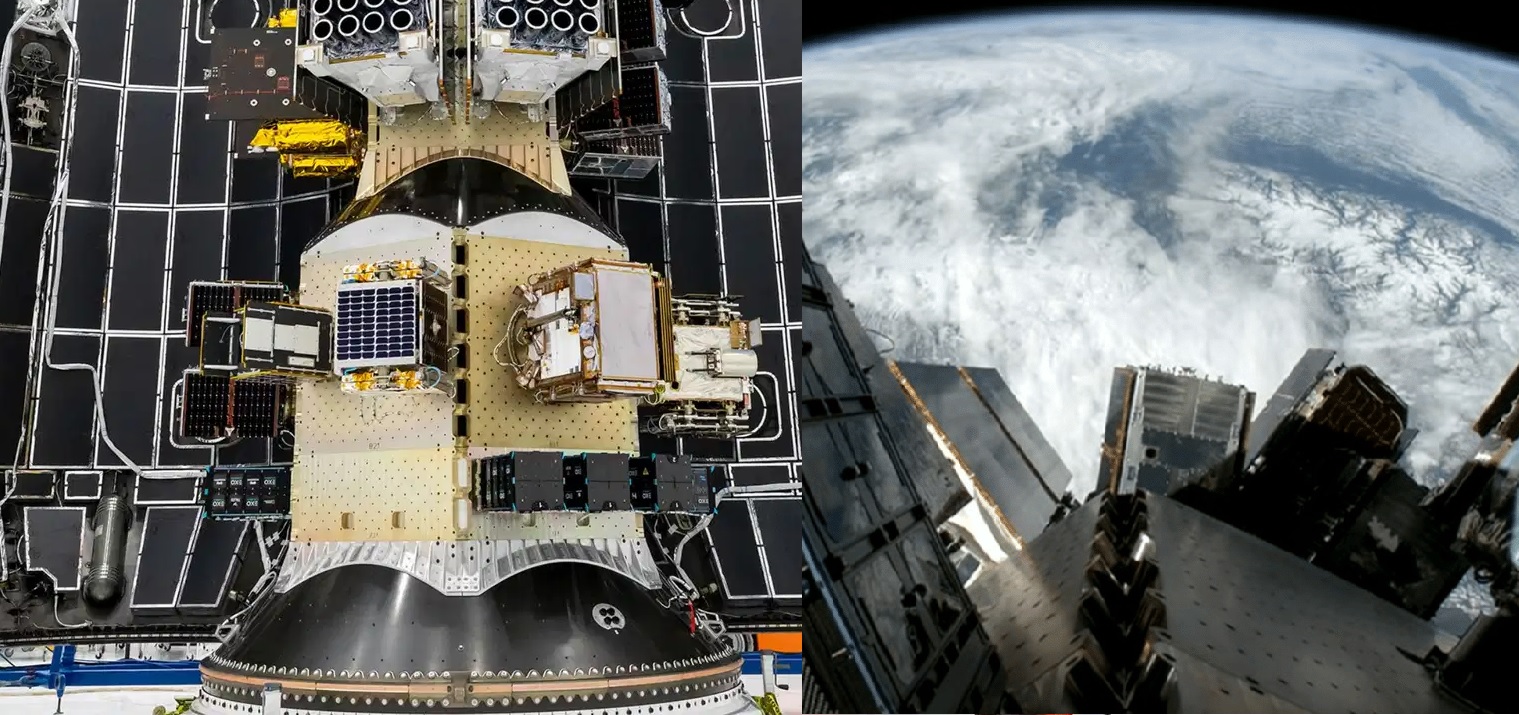
BENGALURU — May 3, 2026 : Bengaluru-based space technology startup GalaxEye has successfully launched “Mission Drishti,” the world’s first OptoSAR Earth observation satellite, marking a significant development in India’s private space sector. The satellite was deployed into low Earth orbit aboard a SpaceX Falcon 9 rocket from Vandenberg Space Force Base at 12:30 PM IST on May 3, 2026.
The 190-kilogram spacecraft is the largest Earth observation satellite developed by an Indian private company to date. The mission represents the outcome of approximately five years of research and development led by the startup, which was founded in 2021 by alumni of the Indian Institute of Technology Madras.
Mission Overview and Technical Configuration
Mission Drishti operates in a sun-synchronous low Earth orbit at an altitude of approximately 500 ± 10 kilometres. The satellite offers a global revisit capability of about four days for the same location and delivers spatial resolution ranging from 1.2 to 3.6 metres, with an average fused resolution of approximately 1.8 metres.
The platform integrates a multispectral imager (MSI) and an X-band synthetic aperture radar (SAR) sensor within a single payload architecture. The MSI operates across seven spectral bands—coastal blue, blue, green, red, red edge, near-infrared, and panchromatic—and provides a native ground sample distance of 3.6 metres at nadir with a swath width of 10 kilometres.
The SAR system operates in X-band with VV polarisation and supports both stripmap and spotlight imaging modes. It achieves up to 0.9-metre resolution in spotlight mode with a swath width of 30 kilometres. The combined OptoSAR data product enables simultaneous acquisition of optical and radar datasets in a single orbital pass.
OptoSAR Technology and Data Fusion
OptoSAR represents a hybrid imaging approach combining optical sensing and radar-based observation within a unified system. Traditional Earth observation architectures rely on separate satellites for optical and SAR imaging, leading to temporal gaps and data misalignment when capturing the same location.
Optical systems provide high-resolution, color-rich imagery but are limited by cloud cover, smoke, and lighting conditions. In contrast, SAR systems operate using radio waves and can capture data through clouds, precipitation, and darkness, though the resulting imagery is less intuitive for visual interpretation.
Mission Drishti uses a proprietary “SyncFused OptoSAR” payload that captures both datasets simultaneously and aligns them at the source. This reduces latency and eliminates inconsistencies associated with multi-satellite data fusion. The resulting datasets provide combined visual clarity and structural information, increasing analytical reliability.
In-Orbit Processing and Data Delivery
The satellite incorporates onboard artificial intelligence capabilities powered by Nvidia’s Jetson Orin computing platform. This enables edge processing of imagery directly in orbit, reducing the need to transmit large volumes of raw data to ground stations.
By processing selected data segments in space, Mission Drishti can deliver analysis-ready outputs with reduced turnaround time. According to the company, the fused dataset provides approximately three times more usable information compared to single-sensor satellites.
Applications Across Sectors
Mission Drishti is designed as a dual-use platform supporting both commercial and strategic applications. The satellite enables persistent, all-weather, day-and-night observation capabilities, supporting sectors that require consistent and reliable geospatial data.
In defence and border monitoring, the system provides continuous surveillance independent of weather or time-of-day constraints. For disaster management, it enables near real-time assessment during events such as floods, cyclones, and landslides, where optical systems alone are often limited.
Additional applications include agriculture monitoring for crop health assessment, aquaculture management, mining operations, urban infrastructure planning, and environmental monitoring. The system’s ability to generate consistent datasets improves decision-making across these sectors.
Institutional Support and Industry Collaboration
The launch received acknowledgment from Indian government leadership. Prime Minister Narendra Modi stated that the mission reflects innovation and technological progress among India’s youth. External Affairs Minister S. Jaishankar also noted that the development strengthens India’s position in the global space technology domain.
For commercial operations, GalaxEye has partnered with NewSpace India Limited, the commercial arm of the Indian Space Research Organisation. The company has also established distribution partnerships across more than 20 countries and reported interest from clients in the Middle East, the United States, and Europe.
Company Background and Leadership
GalaxEye was founded by Suyash Singh (Chief Executive Officer and co-founder) and Denil Chawda (Chief Technology Officer and co-founder). Both founders are alumni of IIT Madras. The company has focused on developing integrated Earth observation systems using proprietary sensor fusion technology since its inception in 2021.
Following the successful launch, the company has initiated an early adopters programme to provide initial access to Mission Drishti datasets for selected users in priority sectors.
Constellation Roadmap and Future Plans
Mission Drishti is the first satellite in a planned constellation. GalaxEye intends to deploy between eight and 12 OptoSAR satellites by 2029–2030. The expansion is aimed at increasing revisit frequency, improving coverage, and enhancing data resolution.
Future satellites in the constellation are expected to incorporate incremental technological improvements, including higher imaging resolution and expanded onboard processing capabilities.
The company’s long-term objective is to establish a scalable, all-weather geospatial intelligence infrastructure capable of serving both domestic and international markets, while reducing dependence on multiple satellite systems for comprehensive Earth observation.
——— End of Article ———