PUNE, INDIA — March 15, 2026 : Scientists at the Council of Scientific and Industrial Research – National Chemical Laboratory (CSIR-NCL) in Pune have developed and scaled a patented technology to produce dimethyl ether (DME), a clean-burning synthetic fuel that can be blended with or used as an alternative to liquefied petroleum gas (LPG). Researchers say the indigenous process could help reduce India’s dependence on imported LPG while strengthening domestic energy production.
The technology converts methanol into dimethyl ether using a specially designed catalyst, allowing the fuel to be produced efficiently and handled through infrastructure already used for LPG distribution.
Indigenous Catalyst and Production Process
The technology was developed by a research team led by Thirumalaiswamy Raja, Chief Scientist in the Catalysis Division at CSIR-NCL. The process integrates catalyst chemistry and reactor engineering to convert methanol into dimethyl ether in a controlled catalytic reaction.
Dimethyl ether is produced through a catalytic dehydration process, in which methanol molecules react over a solid catalyst at elevated temperature and moderate pressure. In this reaction, two methanol molecules combine and release a molecule of water, forming DME as the main product.
The simplified chemical reaction is:
2CH₃OH → CH₃OCH₃ + H₂O
In the CSIR-NCL system, methanol vapor is passed through a fixed-bed catalytic reactor containing the indigenous catalyst developed by the laboratory. Under reaction conditions, typically at around 10 bar pressure, the catalyst accelerates the dehydration reaction, converting methanol into dimethyl ether and water vapor.
After the reaction stage, the product mixture is cooled and separated. The dimethyl ether is condensed and purified, while water and any unreacted methanol are removed or recycled back into the reactor system to improve efficiency.
Researchers say the catalyst developed at CSIR-NCL offers high activity, selectivity, and long operational life, helping lower operational costs and improving conversion efficiency compared with conventional catalyst systems.
Because the process operates at relatively low pressure, the produced DME can be liquefied and filled directly into conventional LPG cylinders, enabling integration with existing storage and distribution infrastructure.
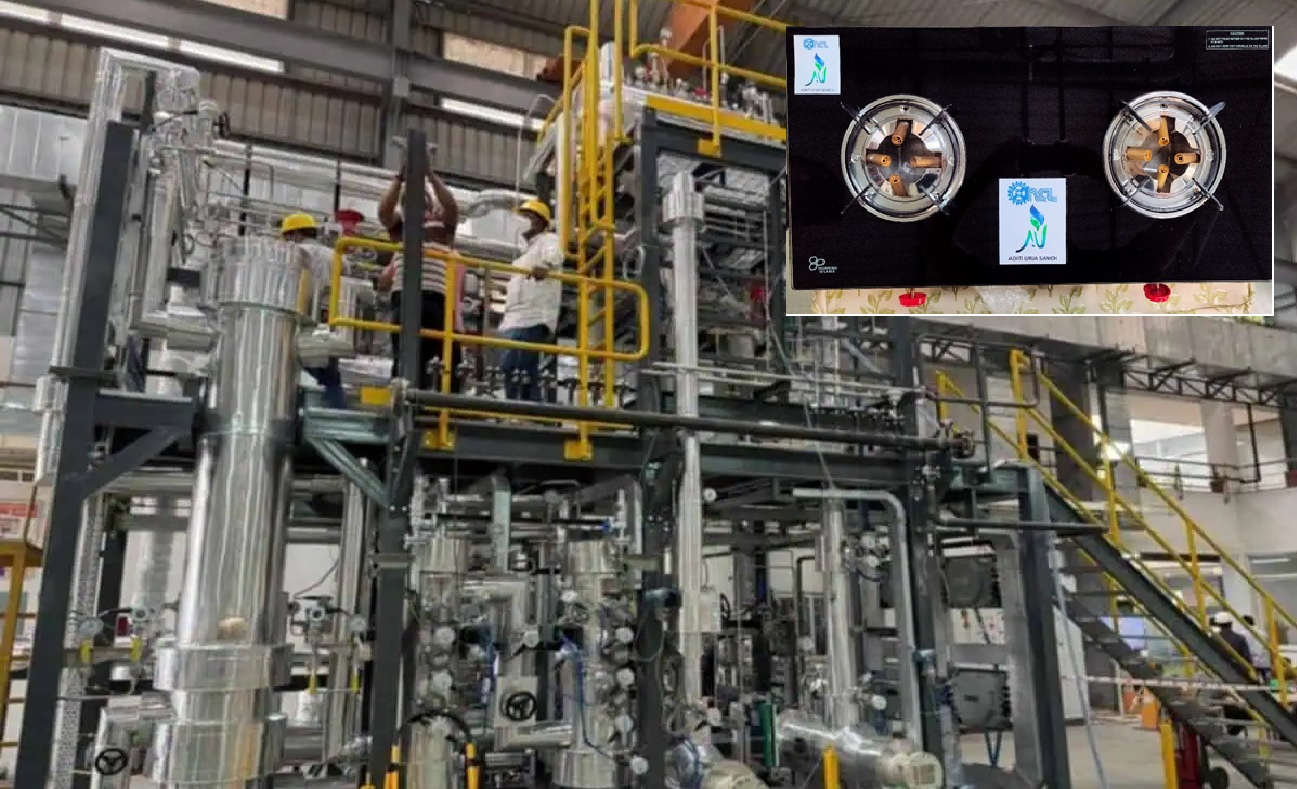
The technology has already been demonstrated through a pilot plant capable of producing approximately 250 kilograms of DME per day, validating the catalytic process at a pre-commercial scale.
Compatibility With Existing LPG Infrastructure
Dimethyl ether has physical properties similar to LPG, particularly its ability to remain in liquid form under moderate pressure. This makes it compatible with the infrastructure already used to store, transport, and distribute LPG.
Technical assessments show that blending up to 8% DME with LPG requires no modifications to existing cylinders, regulators, valves, hoses, gaskets, or household cooking burners.
Regulatory approval for such blending has been established through the IS 18698:2024 standard issued by the Bureau of Indian Standards, which allows up to 20% DME blending with LPG for domestic, commercial, and industrial applications.
Flex-Fuel Burner Development
To enable higher blend ratios or potential full substitution in the future, CSIR-NCL scientists have also developed a patented flex-fuel burner prototype capable of operating on 100% LPG, 100% DME, or any mixture between the two fuels.
The burner prototype was tested at the LPG Equipment Research Centre in Bengaluru, where performance trials demonstrated stable combustion and acceptable efficiency across different blending ratios.
Such equipment could support gradual increases in DME usage without requiring widespread replacement of household cooking devices.
Potential Economic Impact
India remains heavily dependent on imported fossil fuels. The country imports more than 80% of its fossil energy requirements, including significant quantities of LPG used in domestic cooking and commercial applications.
In 2024, India imported nearly 21 million tonnes of LPG, contributing substantially to the national energy import bill.
Researchers estimate that substituting about 8% of LPG consumption with domestically produced DME could generate annual foreign exchange savings of approximately ₹9,500 crore.
Supplying this level of substitution for the roughly 10.5 crore LPG connections under the Pradhan Mantri Ujjwala Yojana would require around 1,300 tonnes of DME production per day nationwide.
Environmental Characteristics
Dimethyl ether burns cleaner than many conventional fuels. Combustion studies show that it produces very low levels of soot and particulate matter, while emissions of nitrogen oxides (NOx) and sulfur oxides (SOx) are significantly reduced.
The fuel’s thermal efficiency is comparable to LPG, allowing it to provide similar cooking performance while producing fewer combustion pollutants.
Beyond cooking fuel applications, DME can also be used as:
-
an automotive fuel substitute for diesel in modified engines,
-
a propellant in aerosol products replacing ozone-depleting chlorofluorocarbons,
-
a chemical intermediate for manufacturing lower olefins, dimethyl sulfate, and methyl acetate.
Industrial Scale Demonstration Plans
Following successful pilot testing, CSIR-NCL is preparing to scale the technology to an industrial demonstration plant capable of producing around 2.5 tonnes of DME per day. The facility is expected to be developed within six to nine months in collaboration with process engineering partners.
If the demonstration phase is successful, the technology could be expanded to commercial plants producing between 50 and 500 tonnes of DME per day, depending on demand and industrial partnerships.
The laboratory is currently exploring collaboration opportunities with oil public sector undertakings (PSUs) and bioenergy companies to support commercialization and large-scale deployment.
Future Feedstock Options
Scientists involved in the project say the methanol required for DME production could be produced through multiple domestic pathways. These include coal-to-methanol conversion using India’s coal reserves, biomass gasification, and methanol synthesized from captured carbon dioxide.
Such feedstock flexibility could allow DME production to integrate with broader energy transition strategies while supporting domestic fuel manufacturing.
Role in India’s Energy Strategy
Researchers say the development aligns with national efforts to expand indigenous energy technologies under the Atmanirbhar Bharat initiative.
If deployed at large scale, dimethyl ether blending could provide a domestically produced supplement to LPG, helping reduce import dependence while maintaining compatibility with India’s existing cooking fuel distribution infrastructure.
——— End of Article ———