NEW DELHI — April 19, 2026 : India’s Ministry of Defence has finalised contracts to procure Su-57 fifth-generation fighter aircraft from Russia, adopting a phased acquisition strategy that combines immediate off-the-shelf purchases with long-term licensed production of an upgraded variant.
The decision follows confirmation by Russia’s state arms exporter, Rosoboronexport, that multiple countries have placed orders for the Su-57, with Algeria already receiving deliveries beginning in late 2025 and additional interest reported from Iran.
Two-Phase Acquisition Plan
According to defence sources, India is evaluating the near-term procurement of approximately 40 baseline Su-57 fighters to rapidly strengthen the Indian Air Force’s frontline capabilities. These aircraft will be sourced directly from Russia while negotiations for local production continue.
The approach mirrors India’s late-1990s acquisition of Su-30MK fighters, which were inducted ahead of the more advanced Su-30MKI variant that later entered licensed production in the early 2000s.
In January 2026, the Ministry confirmed that discussions on licensed production of the Su-57 had reached an advanced technical stage. However, large-scale domestic manufacturing is expected to proceed only after the improved Su-57M1 variant becomes available for export.
Transition to Su-57M1 Variant
The Indian Air Force is expected to procure the enhanced Su-57M1 in significant numbers under a future license production agreement. The interim induction of baseline aircraft is intended to familiarise pilots, engineers, and maintenance personnel with the platform before transitioning to the upgraded version.
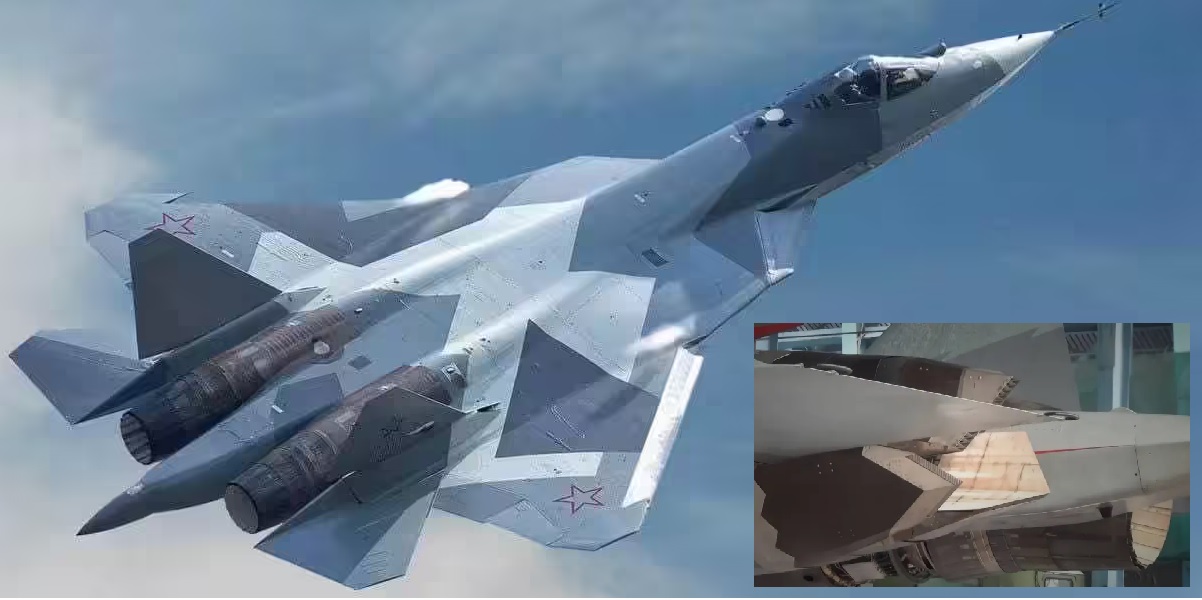
The Su-57M1 incorporates major technological improvements over the current model. Central to the upgrade is the AL-51F-1 engine (Izdeliye 30), which enables sustained supersonic flight without afterburners while improving thrust, fuel efficiency, and maintenance cycles. The engine is assessed to provide performance exceeding the U.S. F-22 and comparable to China’s J-20.
Additional enhancements include a widened airframe for improved lift and supersonic stability, a flatter fuselage and redesigned internal weapon bays to reduce radar and infrared signatures, and a new primary sensor replacing the N036 AESA radar. The aircraft will also feature AI-assisted avionics, an advanced helmet-mounted targeting system, and compatibility with the Izdeliye-810 hypersonic air-to-air missile, capable of speeds of Mach 6–7 and a range of approximately 300 kilometres.
Strategic Context
India’s move comes amid a widening capability gap with China’s expanding fleet of J-20 stealth fighters and the Pakistan Air Force’s induction of J-10C aircraft. With U.S. F-35 fighters and Chinese platforms excluded for political and strategic reasons, the Su-57 remains India’s only near-term option for acquiring a fifth-generation combat aircraft.
The urgency is further reinforced by delays in India’s indigenous Advanced Medium Combat Aircraft (AMCA) programme, which is now projected to enter service in the 2040s.
Technology Transfer and Local Production
The long-term plan involves using the Su-57M1 as the baseline for a heavily customised Indian variant, potentially incorporating indigenous avionics, local subsystems, and a twin-seat configuration. This model is expected to follow the trajectory of the Su-30MKI programme, under which more than 270 aircraft were produced.
Russia has reportedly offered extensive technology transfer to support the deal. In June 2025, the Russian Defence Ministry proposed providing full access to the aircraft’s source code. In December 2025, Dmitry Shugayev, Director of the Federal Service for Military-Technical Cooperation, indicated the possibility of a joint development programme for an India-specific variant.
Hindustan Aeronautics Limited (HAL) has assessed that approximately 50 percent of its existing infrastructure can support Su-57 production, though additional investments will be required. Russia has proposed manufacturing at least 100 aircraft in India, including at HAL’s Nashik facility.
Industrial and Export Outlook
The proposed collaboration could provide India with partial ownership of key technologies, enabling future export opportunities. Defence analysts note that a customised Su-57M1 variant developed jointly by India and Russia could be positioned competitively in international markets.
India’s procurement strategy is therefore structured to address immediate operational requirements while establishing a foundation for long-term domestic production and technological integration.
——— End of Article ———