LISBON, Portugal — German unmanned systems company Quantum Systems has entered the maritime domain with two new autonomous platforms, the Seavex unmanned surface vessel (USV) and Subvex unmanned underwater vehicle (UUV).
The systems were unveiled in Sesimbra, Portugal, on the sidelines of a NATO maritime exercise involving the Portuguese Navy, the University of Porto (FEUP), NATO CMRE, NATO JCGMUS and the European Defence Agency. Both platforms are undergoing sea trials to test and validate their capabilities in an operational setting.
Seavex and Subvex are integrated into Quantum Systems’ MOSAIC UXS software architecture, allowing unmanned air, land, surface and underwater systems to operate through a common control framework. The architecture can also incorporate additional platforms, sensors and third-party technologies.
“We started in the air, expanded to land, and now we are going to sea. But the real step forward is not adding another domain. It is connecting them,” said Florian Seibel, Co-CEO and Founder of Quantum Systems.
Seavex USV
The Seavex is designed for persistent maritime intelligence, surveillance and reconnaissance (ISR), critical infrastructure protection and Counter-UAS missions.
The vessel measures 8.5 meters long, 6.5 meters wide and has a 1.8-meter draft. It has a displacement of 4,500 kg, a payload capacity of up to 400 kg, a maximum speed of 15 knots and a surveillance speed of 3 knots. Its endurance is up to 60 days.
Seavex carries 2D surveillance radar, 4D counter-drone radar, electro-optical and infrared sensors, a laser rangefinder and onboard edge computing. Its counter-UAS system is designed to detect and track aerial threats.
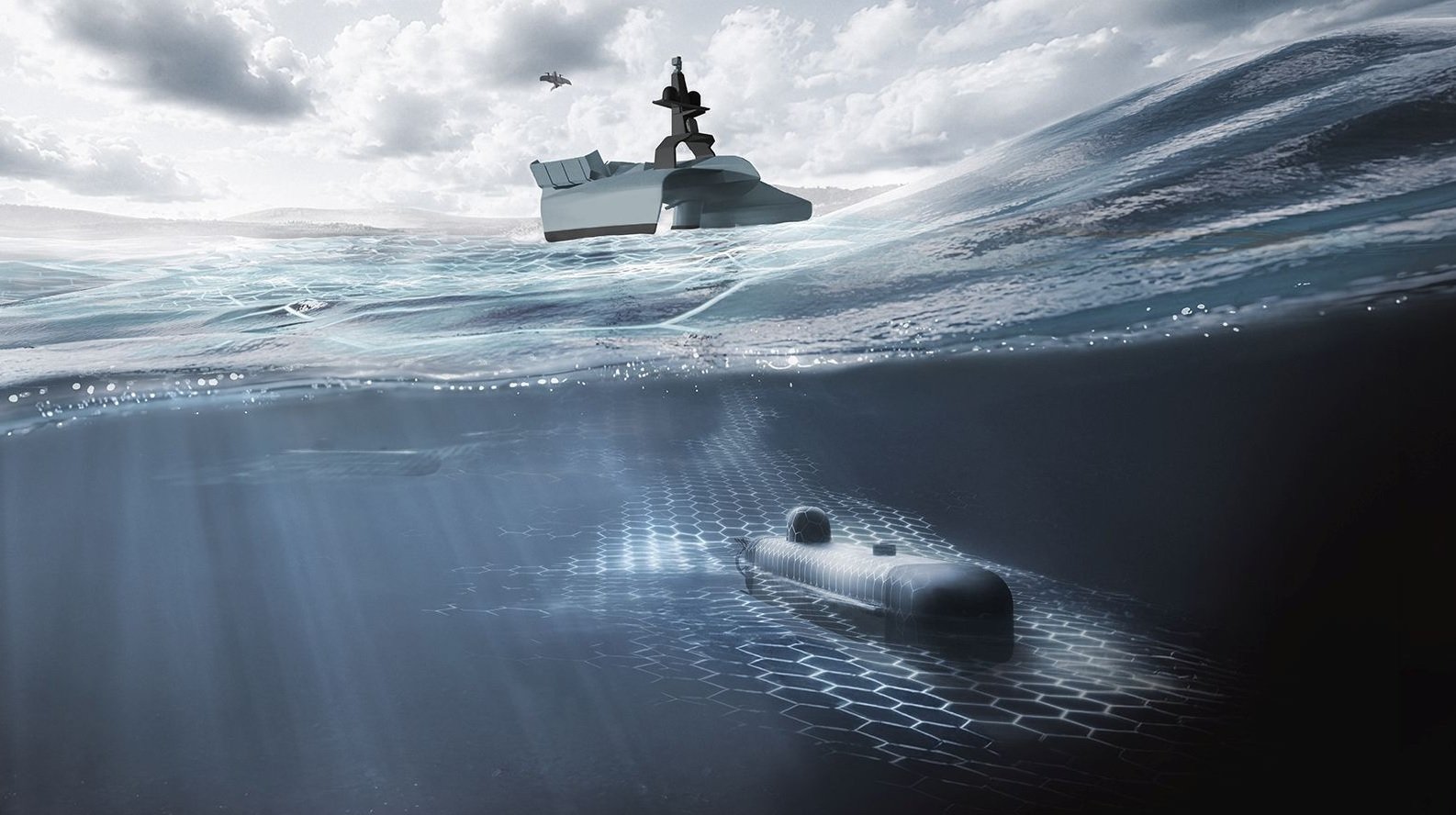
An integrated DronePort allows autonomous launch and recovery of UAVs. Seavex can also dock, recharge and retrieve mission data from Subvex underwater vehicles.
The vessel can operate in water temperatures from 0°C to 40°C, with normal operations in sea state 3 and survivability up to sea state 6. Communications include SATCOM, 5G, Wi-Fi and Silvus, with AES-256 encryption.
Subvex UUV
The Subvex is an AI-enabled underwater vehicle designed for deep-sea ISR, seabed monitoring and underwater surveillance. It can operate at depths of up to 6,000 meters.
The vehicle weighs 400 kg, is 4.2 meters long and has a 533-mm diameter, compatible with NATO torpedo-tube standards. It carries up to 20 kg of payload, has a 42-kWh battery, a surveillance speed of 3 knots and a maximum speed of 8 knots.
Subvex can operate actively for up to four days using systems including side-scan sonar, DVL, forward-imaging sonar and acoustic communications. In passive seabed-surveillance mode, it can remain deployed for weeks while using hydrophones to collect acoustic information.
Multiple Subvex vehicles can operate in a distributed configuration. Communications include USBL, Wi-Fi, inductive, Silvus, 5G and Iridium, also using AES-256 encryption.
Combined Maritime System
Seavex provides docking, recharging, secure data transfer and redeployment for Subvex. Together, the two platforms can support missions involving critical maritime infrastructure protection, maritime border security, anti-submarine surveillance and blue-water surveillance.
Sensor information from aerial, surface and underwater systems can be combined through MOSAIC UXS into a common operational picture.
“Maritime operations have a fundamental challenge: the areas are vast, while crews and assets are limited,” said Dirk Zademack, Vice President of Quantum Maritime at Quantum Systems.
The launch expands Quantum Systems’ unmanned systems portfolio from its established aerial and land platforms into surface and underwater operations, with the Seavex and Subvex trials continuing in Portugal.
——— End of Article ———