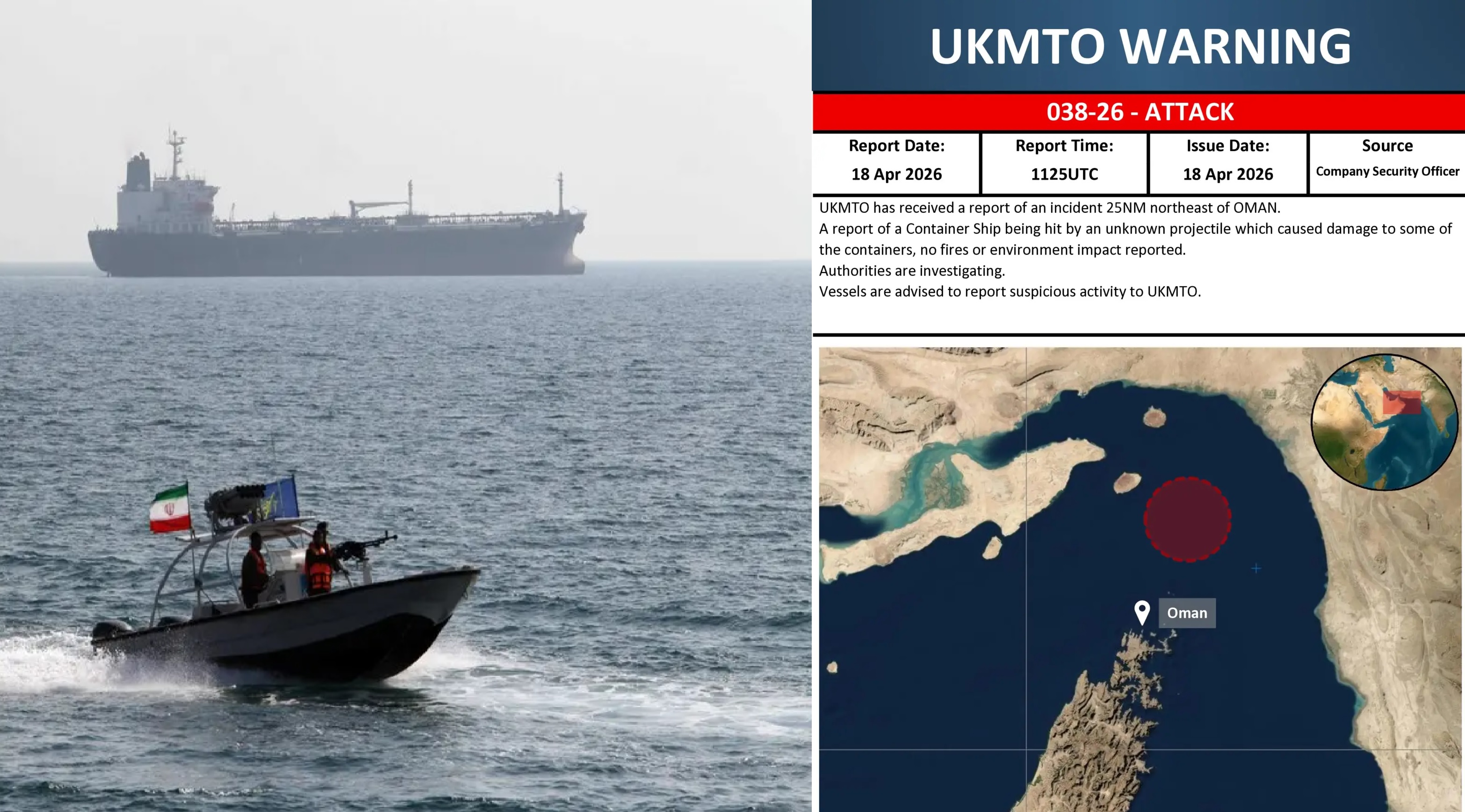
NEW DELHI / MUSCAT — April 18, 2026 : India’s Ministry of External Affairs (MEA) on Saturday summoned Iran’s Ambassador to India, Dr. Mohammad Fathali, and lodged a formal protest following firing incidents involving two Indian-flagged commercial vessels in the Strait of Hormuz. The developments occurred amid Iran’s decision to reimpose restrictions on maritime transit through the strategic waterway.
Incidents Reported on April 18
According to the United Kingdom Maritime Trade Operations (UKMTO), two separate security incidents were recorded on April 18, 2026, in waters northeast of Oman.
At 09:20 UTC, approximately 20 nautical miles northeast of Oman, a tanker reported being approached by two gunboats belonging to Iran’s Islamic Revolutionary Guard Corps (IRGC) Navy. The vessels reportedly did not establish communication via VHF radio before opening fire. The tanker and its crew were reported safe, and an investigation is ongoing.
At 11:25 UTC, around 25 nautical miles northeast of Oman, a container ship reported being struck by an unidentified projectile. The incident caused damage to cargo containers onboard. No fire or injuries were reported.
Maritime tracking service TankerTrackers.com and ship tracking data indicated that the vessels involved in these incidents were Indian-flagged.
Indian-Flagged Vessels Identified
The two Indian vessels directly affected were identified as:
-
Sanmar Herald (IMO 9330563), a Very Large Crude Carrier (VLCC) owned by Chennai-based Sanmar Shipping, carrying approximately 2 million barrels of Iraqi crude oil.
-
Jag Arnav (IMO 9705354), a bulk carrier owned by Mumbai-based Great Eastern Shipping Company.
Both vessels had reportedly received clearance to transit the Strait of Hormuz before being intercepted by IRGC Navy gunboats. Warning fire was directed at the vessels, forcing them to abort their passage and turn back westward into the Persian Gulf. No damage or injuries were reported on either vessel.
An audio transmission recorded on maritime Channel 16 from the Sanmar Herald was released by TankerTrackers.com. In the recording, the vessel’s master is heard stating:
“Sepah Navy! Motor Tanker Sanmar Herald! You gave me clearance to go. My name second on your list. You gave me clearance to go. You are firing now! Let me turn back!”
Additional Indian Shipping Affected
Ship tracking data further indicated that multiple Indian-flagged vessels altered course following the incidents. These included:
- Desh Vaibhav and Desh Vibhor, both operated by the state-owned Shipping Corporation of India.
- Additional vessels, including Desh Suraksha, were also reported to have turned back after the firing incidents.
At least four Indian-flagged ships reversed course after Iran announced renewed restrictions on transit through the strait. One Indian tanker, Desh Garima, had successfully transited earlier in the day before the enforcement measures were reinstated.
At the time of the incidents, approximately 14 Indian-flagged vessels were reported to be present in the Persian Gulf.
Diplomatic Response from India
During the meeting at the MEA in New Delhi, Foreign Secretary Vikram Misri conveyed India’s “deep concern” regarding the firing on Indian merchant vessels. The Indian government emphasized the safety of its seafarers and reiterated that the Strait of Hormuz constitutes an international trade route that should remain open to all commercial shipping.
India urged that vessels bound for Indian ports be allowed safe passage through the strait. The MEA stated that the protest was conveyed in the “strongest terms,” though further details of the diplomatic exchange were not disclosed.
Iran Reimposes Strait Restrictions
The incidents followed Iran’s announcement on April 18, 2026, that the Strait of Hormuz had returned to its previous operational status under the control of its armed forces, effectively restricting civilian maritime traffic.
Earlier, on April 8, Iranian Foreign Minister Abbas Araghchi had stated that the strait would remain open to commercial vessels following a ceasefire in Lebanon that came into effect on April 16. However, transit was limited to routes approved by Iran’s Ports and Maritime Organization due to the presence of previously laid sea mines that had not been fully cleared.
Iran’s decision to reimpose restrictions was linked to ongoing tensions with the United States. On April 16, the United States expanded its naval blockade measures targeting Iranian and sanctioned vessels globally. Iranian authorities cited these actions as the basis for restoring stricter control over maritime access in the strait.
Radio broadcasts from Iranian forces were reported to have informed civilian vessels that the strait had been closed again and that vessel movement was prohibited without authorization.
Impact on Maritime Traffic
The Strait of Hormuz remains a critical global energy corridor, handling a significant share of international crude oil shipments. Following the incidents, multiple commercial vessels, including Indian-flagged ships, were reported to have halted movement or anchored in nearby waters awaiting further clarity.
No casualties or confirmed structural damage to the Indian-flagged vessels involved in the April 18 incidents were reported by UKMTO or maritime tracking sources.
——— End of Article ———