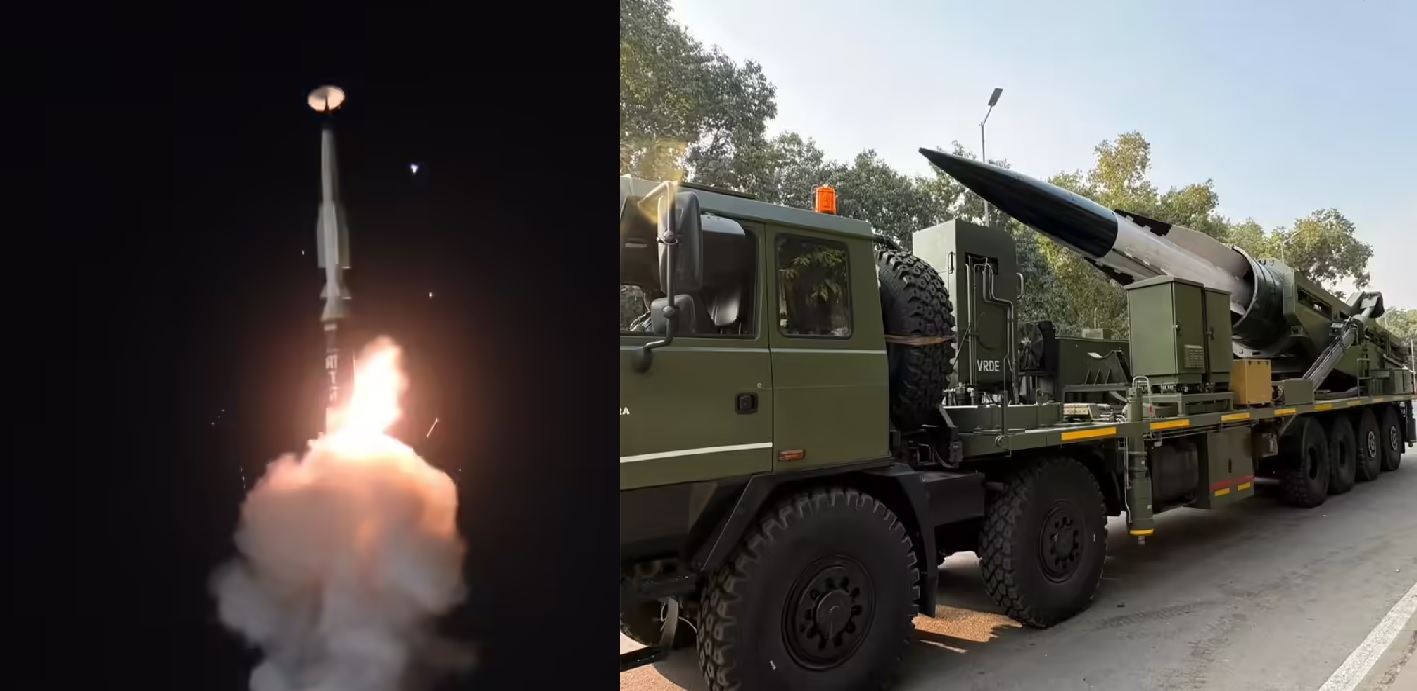
NEW DELHI, — May 2, 2026 : India has reportedly conducted a Phase-II trial of its Long Range Anti-Ship Hypersonic Missile (LR-AShM) from a defence testing facility off the Odisha coast in the Bay of Bengal on May 1, 2026, according to multiple defence sources, local reports, and open-source tracking accounts monitoring the region.
The reported launch aligns with a Notice to Airmen (NOTAM) issued earlier for missile activity between May 1 and May 3, establishing a restricted maritime and airspace zone extending approximately 1,680 kilometres over the Bay of Bengal. Observers tracking the NOTAM window indicated that the test activity occurred within the designated timeframe.
As of the evening of May 1, there has been no official confirmation or detailed statement from the Defence Research and Development Organisation (DRDO), the Ministry of Defence, or the Press Information Bureau. The absence of immediate official disclosures continues a broader pattern in which detailed confirmations of certain strategic weapons tests are delayed or not publicly released.
Test Overview and Reported Performance
The May 1 activity is described as a Phase-II trial of a hypersonic glide vehicle (HGV) system designed for long-range anti-ship roles. Preliminary information from defence observers indicates that the missile demonstrated a range of approximately 1,500 kilometres, within its estimated operational envelope of 1,500–1,680 kilometres.
The trial reportedly evaluated multiple mission parameters, including launch sequence validation, mid-course trajectory corrections, and terminal-phase targeting. The system is designed to deliver a direct kinetic strike while maintaining sustained hypersonic velocity.
Technical Characteristics
The LR-AShM is an indigenously developed boost-glide hypersonic missile system intended primarily for the Indian Navy’s coastal defence requirements. It is designed to engage both moving naval targets and fixed land-based assets.
The missile uses a two-stage solid propulsion system and is launched from a shore-based transporter erector launcher. After boost phase acceleration, the vehicle transitions into a hypersonic glide phase, travelling at speeds of Mach 5 or higher, with initial boost speeds reportedly reaching up to Mach 10.
The glide vehicle follows a low-altitude quasi-ballistic trajectory and is capable of manoeuvring during flight, including atmospheric skipping, to reduce detection and interception probability. It is equipped with an inertial navigation system (INS) integrated with satellite navigation for mid-course guidance, and an advanced radar-based seeker for terminal homing.
Thermal protection is provided by a carbon-based heat shield designed to withstand temperatures exceeding 2,000°C during sustained hypersonic flight.
Development Background
If confirmed, the May 1 trial would represent the third known test of the LR-AShM programme. The first developmental test was conducted in 2023, followed by a second test on November 16, 2024, from Dr APJ Abdul Kalam Island.
The system was publicly displayed for the first time during the Republic Day parade 2026 on January 26, 2026, indicating its transition from developmental testing toward early operational visibility.
The programme is associated with DRDO laboratories, including the Advanced Systems Laboratory (Hyderabad), with production support from Bharat Dynamics Limited.
Operational Role and Future Variants
The LR-AShM is designed as part of India’s broader effort to develop long-range hypersonic strike capabilities and enhance anti-access/area-denial (A2/AD) capacity in the Indian Ocean Region (IOR). The current configuration is deployed as a land-based coastal battery system.
Future variants under development include ship-launched versions for naval platforms, as well as potential land-attack and air-launched configurations for other branches of the armed forces.
The missile is capable of carrying different payload configurations depending on mission requirements.
Strategic Context
The reported test comes amid ongoing regional security developments, including increased maritime activity in the Indian Ocean Region and continued tensions with Pakistan. At sustained hypersonic speeds, the missile’s range profile suggests the capability to reach deep inland targets within a short time frame; estimates indicate that distances such as Rawalpindi could be covered in approximately 120 seconds.
According to defence analysts, there are currently no operational systems in the region capable of reliably intercepting highly manoeuvrable hypersonic glide vehicles of this class.
Information Status
Despite multiple independent reports and tracking observations, no official technical data, including detailed flight trajectory, telemetry, or performance validation metrics, has been released by Indian authorities as of May 2, 2026.
Separately, the Bharatiya Janata Party acknowledged the test in a social media statement, describing it as a significant development in indigenous defence capability.
Further details are expected only if formal confirmation is issued by relevant government agencies.
——— End of Article ———