TEHRAN — April 23, 2026 : Iran’s Islamic Revolutionary Guard Corps (IRGC) Navy seized two foreign-flagged container ships and fired upon a third vessel during a series of maritime security incidents in the Strait of Hormuz on Wednesday, according to statements from Iranian authorities, maritime security agencies, and shipping industry sources.
The incidents occurred amid heightened regional tensions following the earlier interception of an Iranian-flagged vessel by the United States Navy in the Gulf of Oman on April 20, 2026. Shipping companies have since begun diverting traffic away from the strategic waterway, the Wall Street Journal reported, citing shipowners and analysts.
Incident Overview
According to the United Kingdom Maritime Trade Operations (UKMTO) and maritime security firm Vanguard, three separate commercial vessels were involved in the events during the morning hours of April 22.
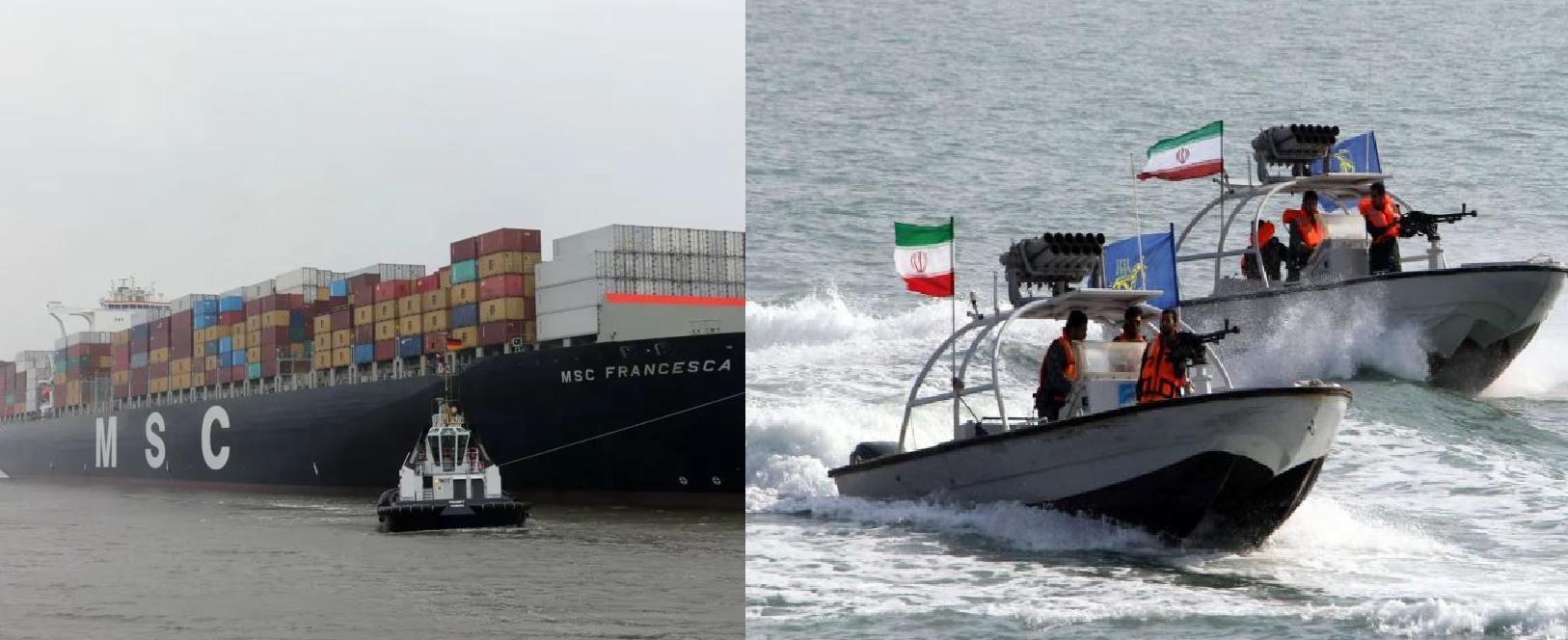
The first vessel, MSC Francesca, is an 11,312 TEU container ship flying the Panamanian flag and operated by Mediterranean Shipping Company. Iranian authorities stated that the vessel was linked to Israel, though no supporting evidence was provided. Footage released by the IRGC showed armed personnel boarding the ship from fast boats using pilot ladders. The vessel was subsequently redirected toward Iranian territorial waters.
The second vessel, Epaminondas, is a Liberian-flagged container ship owned by Greece-based Technomar Shipping and time-chartered to Mediterranean Shipping Company. The ship was traveling from Jebel Ali, Dubai, to Gujarat, India, when it was approached by an IRGC gunboat. The vessel’s master reported that no prior warning was issued before it came under fire from rocket-propelled grenades and small arms, causing significant damage to the navigation bridge.
A third vessel, Euphoria, a 2,478 TEU container ship flagged in Panama and operated by Silmar Shipping, was also fired upon approximately eight nautical miles west of Iran while transiting eastbound. The ship halted briefly following the incident but sustained no reported damage and later resumed its voyage toward the Gulf of Oman.
Both MSC Francesca and Epaminondas were escorted by IRGC forces to Iran’s southern coast and anchored at the Port of Bandar Abbas.
Crew Status and Nationalities
Initial reports from maritime authorities indicate that no injuries or environmental damage resulted from the incidents. Across the affected vessels, at least 22 Indian nationals were among the crew members.
A relative of one of the seafarers stated that approximately 20 armed Iranian personnel boarded the ship. According to the account, crew members remain under Iranian control with restricted movement, but are being treated appropriately and have not been harmed.
IRGC Statement and Justification
The IRGC Navy Command stated that the vessels were intercepted for violating maritime regulations. According to the official statement, the ships were operating without necessary permits and had allegedly tampered with navigation systems, actions described as posing risks to maritime security.
Iranian state media reported that the vessels had ignored repeated warnings prior to interception. However, the master of the Epaminondas stated that the ship had initially been informed it had authorization to transit the strait and did not receive prior warning before being fired upon.
The IRGC further described the operations as enforcement measures targeting vessels attempting to transit the strait in violation of established navigational procedures.
International Response and Shipping Impact
The incidents prompted responses from multiple countries connected to the vessels.
Greece’s Ministry of Shipping stated that the Epaminondas had not been formally seized but confirmed that the vessel sustained extensive damage during the attack and remains stationary near Iranian waters under the command of its captain.
Panama condemned the seizure of MSC Francesca, describing the action as unlawful and stating that the vessel had been forcibly redirected into Iranian territorial waters. No official response from Liberia regarding the Epaminondas had been reported at the time of writing.
Shipping companies have begun rerouting vessels to avoid the Strait of Hormuz, a key global energy and trade corridor, reflecting increased concern over maritime security risks in the region.
Geopolitical Context
Maritime analysts assess that the IRGC’s actions are likely linked to developments earlier in the week. On April 20, 2026, the U.S. Navy intercepted and seized the Iranian-flagged container ship Touska in the Gulf of Oman after it allegedly attempted to enter the Strait of Hormuz despite warnings.
The incidents also occurred during an extended temporary ceasefire between the United States and Iran. U.S. President Donald Trump recently confirmed the continuation of the ceasefire, stating that the Iranian government is “seriously fractured.”
In a subsequent statement, the IRGC emphasized its readiness to respond to any perceived aggression and indicated that it would continue monitoring developments closely during what it described as a “so-called ceasefire.”
Current Status
As of April 23, 2026, both MSC Francesca and Epaminondas remain under Iranian control at Bandar Abbas. No timeline has been provided regarding the release of the vessels or their crews, and no formal legal proceedings have been publicly disclosed.
The Euphoria has continued its transit toward the Gulf of Oman following the incident, with no reported damage or casualties.
——— End of Article ———