Hong Kong — Hong Kong has become the primary gateway for semiconductor shipments entering China, with the city handling more than half of the mainland's chip imports during the first five months of 2026 as demand for artificial intelligence (AI) infrastructure continues to reshape regional trade.
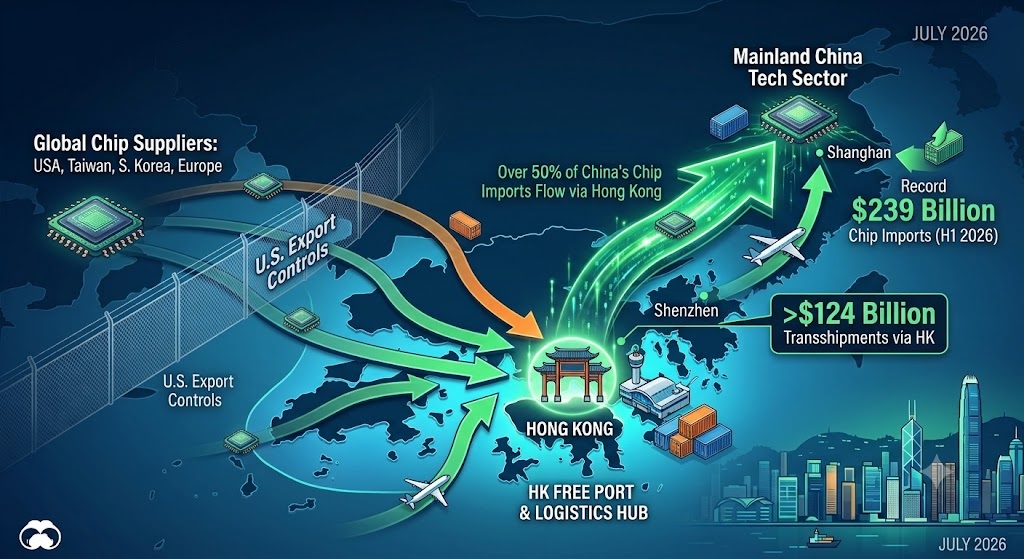
A review of official trade data by Bloomberg found that Hong Kong accounted for over half of China's $239 billion in semiconductor imports between January and May 2026. The city re-exported about $124 billion worth of chips to mainland China, representing around 52% of the country's total semiconductor imports during the period. A decade ago, Hong Kong handled only about one-third of China's chip imports, highlighting its growing role in the regional technology supply chain.
Official figures released in late June also showed that trade between Hong Kong and mainland China increased by nearly 50% in May compared with the same month last year. According to Bloomberg, this marked the fastest annual growth since 1992, excluding the pandemic period.
Hong Kong's position is supported by its free-port status, where imports are not subject to tariffs and capital controls are less restrictive than on the mainland. Combined with one of the world's busiest air cargo networks, the city has become an important transit point for semiconductors, which are high-value, lightweight, and time-sensitive products.
Gary Ng, Senior Economist at Natixis, said Hong Kong's logistics network allows semiconductor companies to transport chips on frequent and reliable schedules while also providing flexibility to store products before re-exporting them.
The city's growing importance reflects a broader expansion in AI-related trade across Asia. Economists at HSBC estimate that AI trade within the region nearly doubled from pre-pandemic levels to almost $2 trillion in 2025, driven by increased investment in semiconductors, data centres, and AI infrastructure.
According to Oxford Economics, Hong Kong exported nearly $159 billion worth of AI-related products in 2025, making it the fifth-largest exporter of such goods in Asia and placing it ahead of Japan. Oxford Economics economist Yongshi Mai said Hong Kong's strength lies in facilitating the movement of AI-related products rather than manufacturing them.
Research from the Hong Kong Trade Development Council (HKTDC) shows AI-related electronic products accounted for 57% of the city's exports, up from 44% in 2024, while Barclays estimates the share could be as high as 70%. Citing continued demand for AI technologies, the HKTDC more than doubled its 2026 export growth forecast for Hong Kong to over 20%.
The increase in technology exports contributed to Hong Kong's economy expanding 5.9% in the first quarter of 2026, its fastest pace in nearly five years.
Despite the growth, Hong Kong's position also places it at the center of ongoing U.S.-China technology tensions. During President Donald Trump's first administration, the United States ended Hong Kong's special customs treatment and began treating the city as part of China for trade purposes. Since Trump's return to office, Washington has introduced additional restrictions on China's access to advanced U.S. semiconductor technology.
Although trade data does not identify specific chip models, Bloomberg reported that Hong Kong has increased imports of U.S.-made semiconductors sourced through third countries. Authorities in the United States and Taiwan have also increased scrutiny of Asian transshipment routes following investigations into the alleged smuggling of Nvidia chips through the region.
Financial services also contribute to Hong Kong's role in semiconductor trade. Stanford University research scholar and former Hong Kong lawmaker Charles Mok said mainland companies often use Hong Kong intermediaries because payments and foreign currency transactions are easier to manage than dealing directly with overseas suppliers.
The geopolitical environment has encouraged Hong Kong to expand trade with other regions. Chief Executive John Lee has led trade missions to the Middle East, Central Asia, and Southeast Asia. During his June visit to Kazakhstan and Uzbekistan, Hong Kong signed 96 agreements valued at more than $1.65 billion.
Supply chain data indicates that around 40% of the semiconductors passing through Hong Kong originate from mainland China, while approximately 20% come from Taiwan, with Singapore and South Korea also serving as major suppliers. Bloomberg's analysis suggests Hong Kong has now become Taiwan's largest export market for semiconductors.
China's semiconductor exports also recorded strong growth, rising 111% year-on-year in May to $36 billion, the fastest increase since 2013. In the same month, Hong Kong imported more than $40 billion worth of Chinese goods, the highest monthly value since 2015. Chinese customs data showed semiconductors accounted for more than one-third of those exports.
While mainland ports such as Shanghai, Ningbo, and Shenzhen now handle much of China's direct ocean freight, Hong Kong continues to play an important role in high-value technology trade. Industry experts say the city's legal system, financial services, and established logistics infrastructure continue to make it an attractive location for handling products with significant intellectual property value.
University of Hong Kong economics professor Heiwai Tang said Hong Kong continues to offer institutional advantages, including quality assurance, standards verification, and intellectual property protection for technology products. Michael Li Chi Fung, vice chairman of the Nam Pak Hong Association, added that Hong Kong's aviation hub provides advantages for moving electronic products that face stricter air transport controls on the mainland.
Hong Kong continues to play an important role as a semiconductor trading and logistics hub in Asia's technology supply chain.
Source: bloomberg
——— End of Article ———