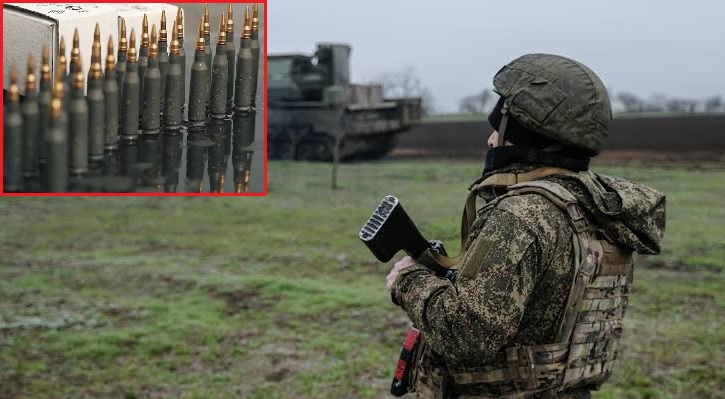
Moscow — Russia's state-owned defense conglomerate Rostec has announced that its subsidiary, High Precision Systems (Vysokotochnie Kompleksy), has started delivering a new anti-drone cartridge known as Mnogotochie to frontline military units. The announcement was made on July 3, with the company confirming that the first experimental batches are already being used by troops while full-scale serial production is now underway.
The new ammunition is designed to improve the ability of infantry soldiers to engage small, fast-moving unmanned aerial vehicles (UAVs), including first-person view (FPV) drones, using standard-issue rifles already in service. According to Rostec, the project was developed to provide troops with an anti-drone capability without requiring dedicated interceptor weapons or changes to existing firearms.
Mnogotochie is produced in two standard Russian military calibers. The SC 226 cartridge is chambered in 5.45×39mm for standard assault rifles, while the SC 228 version uses 7.62×54mm ammunition for machine guns and sniper rifles. Both cartridges are compatible with existing AK-pattern weapons and other standard platforms without modifications. They also function with rifles fitted with muzzle brakes and suppressors.
The defining feature of the cartridge is its three-element projectile. Made from a special bronze-like alloy, the stacked elements separate evenly after leaving the barrel while continuing to spin due to the rifle's rifling. This provides greater aerodynamic stability than conventional shotgun buckshot, allowing the projectiles to spread in a controlled pattern while maintaining accuracy.
According to Rostec, the multi-element design increases the probability of hitting an FPV drone by approximately 2.5 times compared with a conventional single-projectile rifle cartridge. The company states that the 5.45mm SC 226 is effective at distances between 100 and 150 meters, while the 7.62mm SC 228 can engage targets at ranges of up to 300 meters.
To evaluate its effectiveness, the manufacturer carried out penetration tests intended to simulate the structure of commercial drones. Rostec said the 5.45mm cartridge penetrated a 25-millimeter pine board backed by a 0.8-millimeter steel plate at 50 meters, while the 7.62mm version achieved the same result at 100 meters.
Bekhan Ozdoev, Industrial Director of the Rostec Armaments Cluster, said the ammunition received positive feedback following combat use and that production has now entered the serial manufacturing stage.
One of the project's main objectives was to simplify production and military logistics. The cartridges use standard cartridge cases and conventional propellant, allowing them to be manufactured on existing ammunition production lines without significant retooling. This enables large-scale production while remaining compatible with weapons already issued to Russian forces.
Rostec also said the ammunition was designed with urban operations in mind. Because each projectile separates into three lighter elements, they lose energy more quickly than a standard rifle bullet after traveling long distances. According to the company, the elements lose most of their damaging capability beyond 500 meters, reducing the potential risk to people and infrastructure when engaging drones over populated areas. By comparison, a conventional 7.62mm rifle round can retain dangerous kinetic energy for two to three kilometers.
The introduction of Mnogotochie reflects the growing focus on countering small drones that have become a common feature of modern battlefields. Rather than relying solely on specialized air defense systems, militaries are increasingly developing ammunition that allows individual soldiers to engage low-flying UAVs with their standard service rifles.
Russia is not the only country pursuing this approach. The U.S. Army has also developed and tested comparable multi-projectile anti-drone ammunition for 5.56mm and 7.62×51mm NATO rifles. In April 2026, soldiers from the XVIII Airborne Corps trained with the ammunition using unmodified M4 carbines, highlighting a similar effort to improve infantry protection against small drones without introducing new weapon systems.
With serial production now underway, the Mnogotochie cartridge is expected to provide Russian frontline units with an additional option for countering low-flying UAVs while continuing to use their existing rifles and ammunition infrastructure.
——— End of Article ———