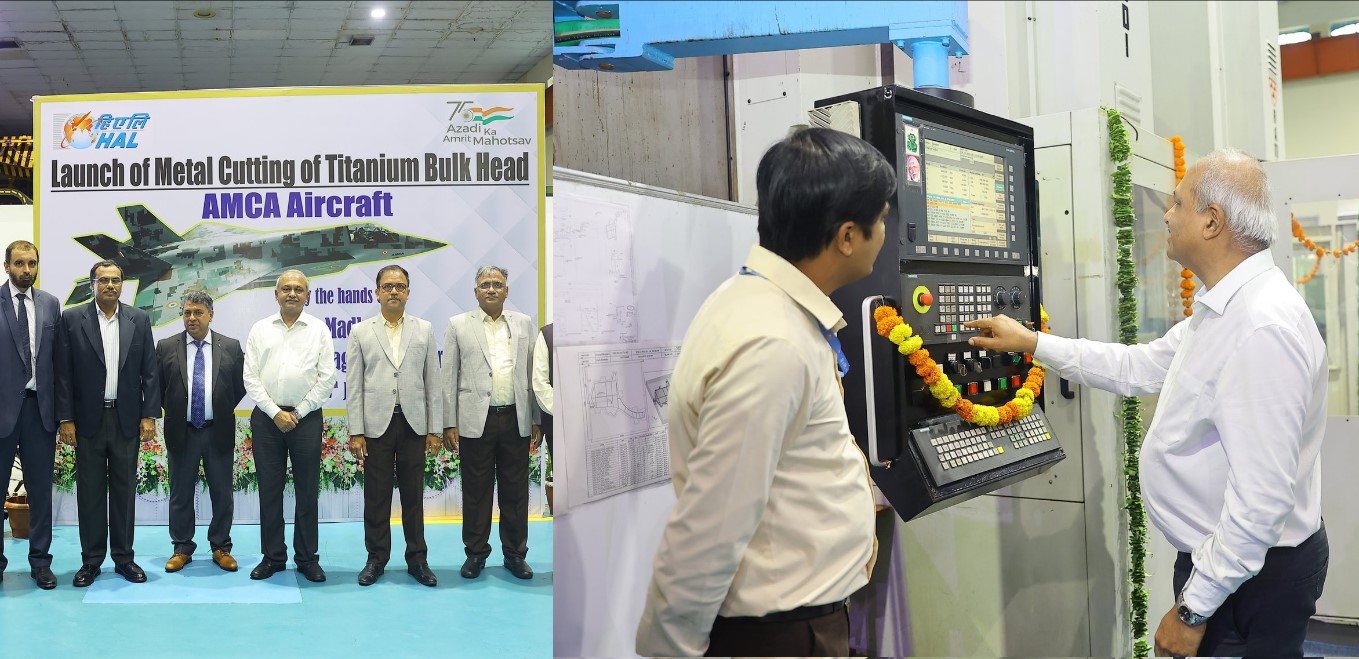
NASHIK, Maharashtra — April 30, 2026 : Hindustan Aeronautics Limited (HAL) has initiated the metal cutting process for the titanium bulkhead of India’s Advanced Medium Combat Aircraft (AMCA) at its Aircraft Manufacturing Division in Nashik, formally transitioning the program from design to early-stage component fabrication.
The inauguration ceremony was attended by senior officials from the Aeronautical Development Agency (ADA), the Defence Metallurgical Research Laboratory (DMRL), and other government defense stakeholders, reflecting coordination across multiple agencies involved in the fifth-generation fighter effort.
Structural Component Enters Manufacturing Phase
The titanium bulkhead is a core structural element of the aircraft’s fuselage. It functions as a pressure-sealing barrier at key sections of the airframe while also absorbing significant aerodynamic and structural loads encountered during high-speed and supersonic flight.
Bulkheads in combat aircraft are typically designed as high-strength, precision-engineered components. In the AMCA, the use of titanium alloys is intended to provide a balance between structural strength, reduced weight, corrosion resistance, and thermal stability—particularly in areas exposed to elevated temperatures during sustained operations.
The current metal cutting stage involves machining a titanium billet to begin forming the bulkhead geometry. Following this, the component will undergo multi-axis CNC machining for final shaping, heat treatment to optimize material properties, and a series of non-destructive testing procedures to validate structural integrity. Surface finishing and dimensional inspections will precede integration into the prototype airframe.
Testing and Validation Pipeline
After fabrication, the titanium bulkheads will be subjected to extensive ground-based testing. These evaluations are intended to confirm load-bearing capacity, fatigue characteristics, and lifecycle durability. The results will also inform weight optimization and maintenance planning parameters before the aircraft enters assembly and subsequent flight trials.
Production Model Still Under Evaluation
While HAL has commenced manufacturing of critical structural elements, the final industrial partner responsible for full-scale AMCA production has not yet been formally selected.
The Ministry of Defence, in coordination with ADA, has adopted a broader industry participation model for the program. An Expression of Interest (EoI) has been issued to establish either a Special Purpose Vehicle (SPV) or a joint venture involving public and private sector entities.
Shortlisted bidders progressing toward the commercial stage include consortia led by Tata Advanced Systems Limited, Larsen & Toubro (with Bharat Electronics Limited and partners), and Bharat Forge (with BEML and Data Patterns). The selected entity will be required to establish dedicated infrastructure capable of handling the full development cycle, including prototyping, flight testing, and serial production.
Engine Development Strategy
The AMCA program is structured in two phases with distinct propulsion solutions.
The initial AMCA Mark 1 variant will be powered by the General Electric F414-INS6 engines, supporting early prototypes and initial operational squadrons.
For the more advanced AMCA Mark 2, India has partnered with Safran to co-develop a higher-thrust engine in the 120-kilonewton class. This collaboration is expected to include technology transfer and the establishment of a domestic manufacturing ecosystem for advanced jet engines.
Program Timeline and Development Stages
The AMCA development is currently funded under a ₹15,000 crore Full-Scale Engineering Development (FSED) program approved by the Cabinet Committee on Security in March 2024.
The program is presently in the Systems Installation Detail Design (SIDD) phase, a 24-month engineering process focused on finalizing a comprehensive digital twin of the aircraft. This includes precise placement of avionics, internal weapons bays, stealth-aligned structures, and Line Replaceable Units.
ADA plans to build five flying prototypes along with one structural test specimen. The first prototype rollout is scheduled between 2028 and 2029, followed by the maiden flight targeted for 2029.
The initial three prototypes will support aerodynamic and systems validation, while the remaining prototypes will be used for weapons integration and payload testing. Certification and operational clearance activities are expected to conclude by around 2032, with induction into the Indian Air Force projected between 2034 and 2035.
HAL’s Role in the AMCA Program
HAL’s involvement in the AMCA program is centered on manufacturing development, industrial capability demonstration, and support for prototype realization. The Nashik division, which has prior experience in producing aircraft structures and assemblies, is contributing specialized expertise in machining high-performance materials such as titanium.
Through activities such as bulkhead fabrication, HAL is generating manufacturing data, refining production processes, and validating tooling approaches that will be relevant for eventual large-scale production.
Although HAL has not been designated as the final production agency, its current work supports the broader ecosystem by reducing technical risk, advancing fabrication readiness, and providing baseline manufacturing insights that can be utilized by the selected development-cum-production partner.
Transition Toward Prototype Assembly
The initiation of titanium bulkhead manufacturing represents an early but tangible step in the AMCA’s progression toward hardware realization. As component-level fabrication advances alongside detailed design work, the program is moving incrementally toward prototype assembly, structural testing, and eventual flight validation within the defined development timeline.
——— End of Article ———