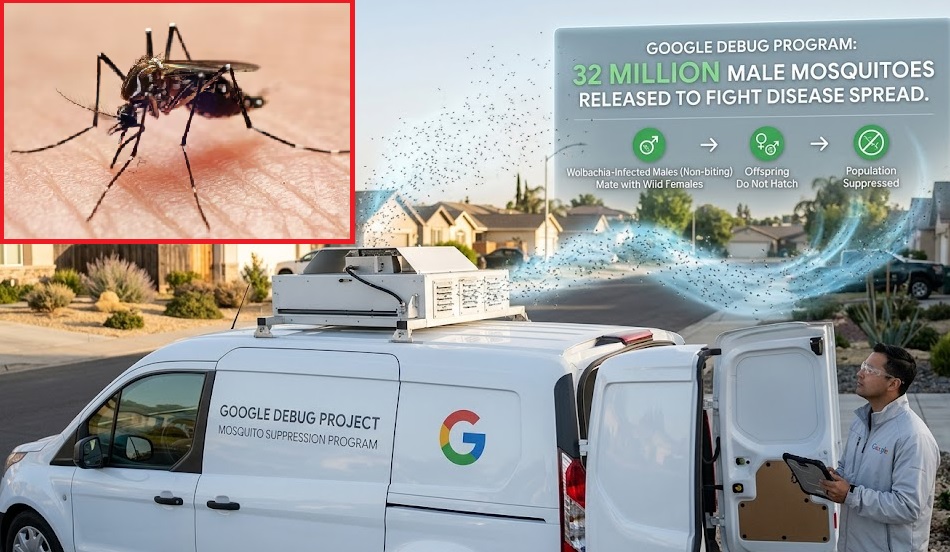
WASHINGTON — June 02, 2026 : Google’s life sciences division, Verily, has formally requested permission from the U.S. Environmental Protection Agency (EPA) to release up to 32 million specially treated male mosquitoes across California and Florida as part of a large-scale mosquito population control initiative aimed at reducing the spread of mosquito-borne diseases.
The proposed project, known as the “Debug” program, seeks to reduce populations of disease-carrying mosquitoes without relying heavily on traditional chemical pesticides. The EPA is currently reviewing Verily’s application for an experimental use permit and accepting public comments on the proposed two-year program through June 5 before making a final decision.
If approved, the initiative would become one of the largest mosquito population-control efforts conducted in the United States and may help assess whether biological and technology-driven mosquito suppression systems can be expanded on a larger scale.
Wolbachia-Based Method Designed to Reduce Mosquito Populations
At the center of the program is a naturally occurring bacterium called Wolbachia, which is already present in many insect species, including butterflies, beetles, and fruit flies. Scientists involved in the project state that the bacterium is harmless to humans, animals, and the environment.
The program primarily targets Aedes aegypti mosquitoes, a species known for spreading diseases such as dengue fever, Zika virus, chikungunya, yellow fever, and, in some regions, West Nile virus.
Under the proposed system, Verily scientists introduce Wolbachia into healthy male mosquitoes before releasing them into the wild. Once released, the males mate with wild female mosquitoes that do not carry the same Wolbachia strain. This biological incompatibility prevents fertilized eggs from hatching, reducing mosquito numbers over time through repeated release cycles.
Importantly, only male mosquitoes are released under the program. Male mosquitoes do not bite humans or animals because they feed on flower nectar rather than blood and therefore do not transmit mosquito-borne diseases.
Artificial Intelligence and Robotics Used for Large-Scale Operations
Although insect-based pest control methods have been used in scientific programs for decades, managing mosquito releases at industrial scale presents logistical challenges. Verily’s Debug program addresses this issue using automation technologies, robotics, computer vision systems, and artificial intelligence (AI).
The company has developed AI-powered mosquito sorting systems designed to distinguish male mosquitoes from females with high accuracy. Since female mosquitoes are responsible for biting humans and spreading disease, the sorting process is considered a key operational requirement.
Following separation, automated systems and specially equipped vehicles are used to distribute the male mosquitoes across selected neighborhoods in target regions of California and Florida.
Alternative to Chemical Mosquito Spraying
Supporters of the program say the Wolbachia-based approach provides a more targeted method of mosquito control than conventional insecticide spraying.
Traditional chemical pesticides can affect beneficial insect species, including bees and butterflies, while mosquito populations in several regions have also developed resistance to standard chemical treatments. Because the Wolbachia method targets one mosquito species through biological reproduction, researchers argue it may help avoid those limitations while reducing environmental impact.
Public health experts note that lowering mosquito populations over time could help reduce the transmission risk of diseases linked to infected mosquitoes, particularly in regions vulnerable to seasonal outbreaks.
Previous Trials Reported Significant Results
Verily’s mosquito-control efforts have previously been tested in California. During field trials in Fresno, the company reported reductions of up to 95% in local biting female mosquito populations.
Internationally, mosquito suppression programs using Wolbachia technology have also produced notable results. In Singapore, similar deployments reportedly reduced Aedes aegypti mosquito populations by between 80% and 90%, while treated areas recorded an estimated 70% decline in dengue fever cases.
Researchers say such results suggest biological mosquito-control systems may become an increasingly important tool for managing disease risks in densely populated regions.
EPA Review and Next Steps
The EPA is evaluating the proposal under biological pest-control regulations because the project uses a biological mechanism to suppress pest populations rather than chemical insecticides.
As part of the review process, the agency is collecting scientific analysis, expert feedback, and public comments before deciding whether to approve, reject, or impose conditions on the proposed two-year field deployment.
If the project receives approval, Verily would begin gathering additional field data to evaluate whether AI-supported mosquito suppression programs can be scaled more broadly in the United States as part of long-term public health and pest-management efforts.
The proposal also reflects increasing interest in biological pest-control technologies that rely on natural reproductive mechanisms instead of chemical treatments to manage disease-carrying insects while limiting environmental disruption.
——— End of Article ———