WASHINGTON — April 28, 2026 : General Dynamics is presenting a range of land combat, communications, and engineering systems at Modern Day Marine 2026, held April 28–30 at the Walter E. Washington Convention Center. The exhibit integrates capabilities from its Land Systems, Mission Systems, and European Land Systems divisions, aligned with the U.S. Marine Corps’ Force Design 2030 modernization framework.
Combat Vehicles and Sustainment Systems
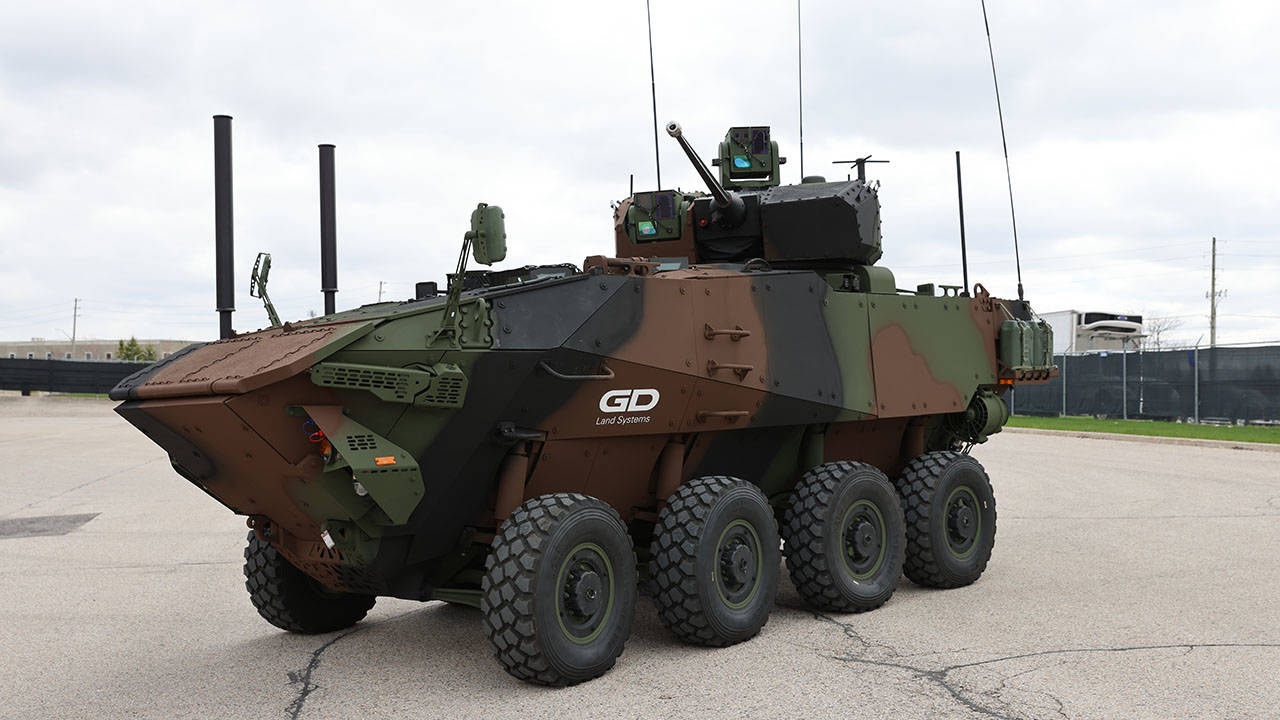
At Booth 2206, General Dynamics Land Systems is exhibiting the Advanced Reconnaissance Vehicle ARV-30, an 8×8 wheeled amphibious platform equipped with a 30 mm autocannon mounted in a remote turret. The vehicle is designed to operate alongside the ARV-C4UAS variant, supporting command, control, communications, computers, and unmanned aircraft systems missions.
The ARV platform incorporates open architecture, automated data fusion, and cybersecurity features to enable coordination between manned and unmanned systems. The prototype on display follows a $450 million pre-production development contract awarded for multiple test variants, supporting the Marine Corps’ plan to replace the aging LAV-25 fleet by the mid-2030s. Testing activities for the ARV-30 include land mobility trials, amphibious swim evaluations, and lethality demonstrations, with further evaluations scheduled through 2026.
Also displayed is the Digital Twin Sustainment Suite (DTSS), a software-based logistics and training system. It includes self-guided e-learning modules, instructor-led training, and advanced maintenance simulations. The system functions as an integrated logistics support tool aimed at improving training throughput, retention, and maintenance efficiency across ground vehicle fleets.
Communications, Electronic Warfare, and PNT Capabilities
At Booth 2113, General Dynamics Mission Systems is presenting systems focused on electronic warfare, communications, and assured positioning, navigation, and timing (PNT).
The RAMPART CMOSS Chassis consolidates PNT, radio, and electronic warfare functions into a single unit compatible with standard SINCGARS radio space, eliminating the need for vehicle modifications. Built on modular 3U OpenVPX processor cards, it supports high data throughput with a 100-gigabit interconnect and enables rapid upgrades for C5ISR missions.
PhantomLink, a Free Space Optics communication system, uses waveform-adaptable optical modems to deliver high-bandwidth laser communications for mobile command posts. Operating outside the radio frequency spectrum, it avoids frequency deconfliction and enhances transmission security. The system has demonstrated a 52-kilometer link with data rates of up to 10 Gbps.
The PNT portfolio includes GPS Source’s ED3M PNT Hub, with more than 1,000 units fielded, along with the Modified Reception Pattern Antenna for operations in GPS-contested environments. Secure communications systems on display include TACLANE high-assurance encryptors, the Sectéra vIPer Universal Secure Phone for VoIP and analog networks, the ProtecD@R Multi-Platform Encryptor, and the GEM One Encryptor Manager.
Bridging and Tactical Mobility Systems
General Dynamics European Land Systems is exhibiting three bridging and mobility systems designed to support expeditionary operations.
The COBRA Armored Assault Bridge is integrated onto a Dok-Ing KOMODO unmanned ground vehicle, enabling bridge deployment while maintaining the carrier’s operational functions. The system supports Military Load Classification (MLC) 120 and is scheduled for formal testing on the KOMODO platform beginning in July 2026.
The HYDRA Multifunctional Floating Platform is a modular pontoon system configurable as a ferry, floating bridge, working platform, or transport vessel, with a load capacity of up to MLC 50.
The VIPER Modular Trackway Bridge, mounted on a Joint Light Tactical Vehicle, can be configured in spans of 5, 7, or 9 meters and supports loads up to MLC 50. The system enables forward units to conduct rapid gap-crossing operations without waiting for dedicated engineering assets.
Operational Context
The combined display reflects an integrated approach to mobility, sustainment, and networked operations. The systems presented address requirements for distributed maritime operations, including reconnaissance, secure communications, and rapid maneuver across complex terrain, consistent with the U.S. Marine Corps’ ongoing force restructuring objectives under Force Design 2030.
——— End of Article ———