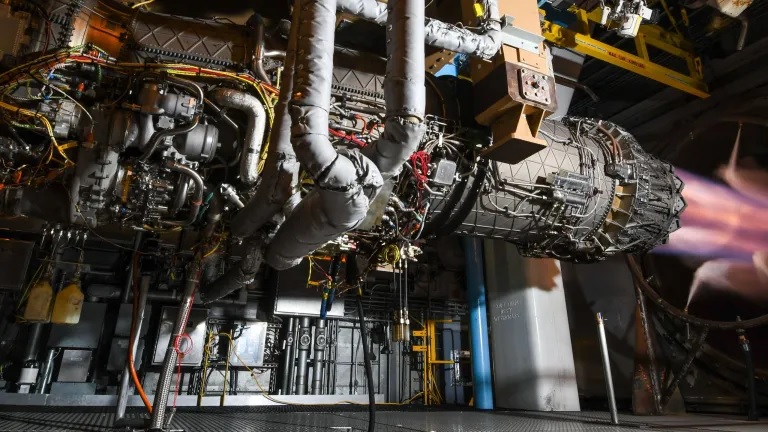
EVENDALE, Ohio — May 12, 2026 : GE Aerospace announced on May 11, 2026, that it has successfully completed the Assembly Readiness Review (ARR) for its XA102 adaptive cycle engine, marking a major milestone in the development of next-generation propulsion systems for the United States Air Force.
The review confirms that the XA102 program has reached the required level of design maturity and production readiness to advance into hardware assembly, procurement, and physical prototyping under the U.S. Air Force’s Next Generation Adaptive Propulsion (NGAP) program.
The Assembly Readiness Review is a formal engineering and manufacturing evaluation conducted before the start of physical engine assembly. The process verifies that all required production systems, tooling, manufacturing plans, measurement systems, supplier networks, and workforce preparation are fully established and capable of supporting hardware fabrication and testing activities.
Completion of the ARR also confirms that GE Aerospace has validated the XA102’s engineering architecture and reduced major structural and manufacturing risks before entering the demonstrator phase. With the review complete, the company will proceed toward assembly and testing of a full-scale XA102 demonstrator engine later in 2026.
Adaptive Cycle Engine Design
The XA102 is a three-stream adaptive cycle engine designed to provide improved fuel efficiency, greater operational range, higher thrust output, and enhanced thermal management compared with conventional fighter aircraft engines.
Unlike traditional turbofan engines that operate with a fixed bypass ratio, the XA102 can dynamically adjust airflow during flight through a variable third-stream architecture. During subsonic cruise operations, airflow is directed into a third bypass stream to improve fuel efficiency and extend aircraft range. During high-performance combat operations, airflow can be redirected into the core and fan streams to maximize thrust generation.
The engine is estimated to operate in the 35,000 to 40,000-pound thrust class and is expected to provide approximately 20 percent greater thrust compared with current-generation fighter engines.
Adaptive cycle technology developed through the program is also expected to deliver roughly 25 percent lower specific fuel consumption and more than 30 percent greater operational range compared with existing fighter propulsion systems such as the Pratt & Whitney F135 engine.
Thermal Management and Advanced Materials
A key feature of the XA102 design is its increased thermal management capability. Modern combat aircraft generate substantial heat from advanced radar systems, electronic warfare equipment, sensors, avionics, and future directed-energy systems. The XA102’s third airflow stream functions as an additional heat sink, allowing the engine to manage significantly larger thermal loads than current fighter engines.
To withstand the extreme operating temperatures associated with advanced adaptive cycle propulsion, the engine incorporates Ceramic Matrix Composite (CMC) materials in critical turbine components. These lightweight materials are designed to tolerate higher temperatures while reducing overall engine weight and improving thermodynamic efficiency.
Digital-First Development Approach
The XA102 is the first engine in GE Aerospace’s history to be fully developed using Model-Based Systems Engineering (MBSE), a digital engineering methodology that replaces traditional two-dimensional engineering drawings with integrated three-dimensional digital models.
These digital models contain detailed geometric data, tolerances, assembly instructions, and manufacturing information directly linked to computer-aided production systems. According to GE Aerospace, the ARR confirmed the successful completion of all model-based engine demonstrations associated with the first phase of the development program.
The company stated that the digital-first approach is intended to reduce manufacturing errors, accelerate development timelines, and improve coordination across the supply chain.
NGAP and NGAD Program Context
The XA102 is being developed under the U.S. Air Force’s Next Generation Adaptive Propulsion program, which supports propulsion development for the planned Next Generation Air Dominance (NGAD) fighter and other future combat aircraft.
The engine builds upon technologies originally developed under the earlier Adaptive Engine Transition Program through GE Aerospace’s XA100 demonstrator engine.
GE Aerospace is currently competing against Pratt & Whitney, which is developing the competing XA103 adaptive cycle engine for the NGAP program.
The ARR follows the successful completion of the XA102 Detailed Design Review in February 2025. No official timeline for full-scale flight demonstration testing has been publicly released.
Dr. Steve “Doogie” Russell, Vice President and General Manager of Edison Works at GE Aerospace, stated that completion of the ARR demonstrates both the maturity of the XA102 engine design and the effectiveness of the company’s digital-first development strategy for next-generation military propulsion systems.
——— End of Article ———