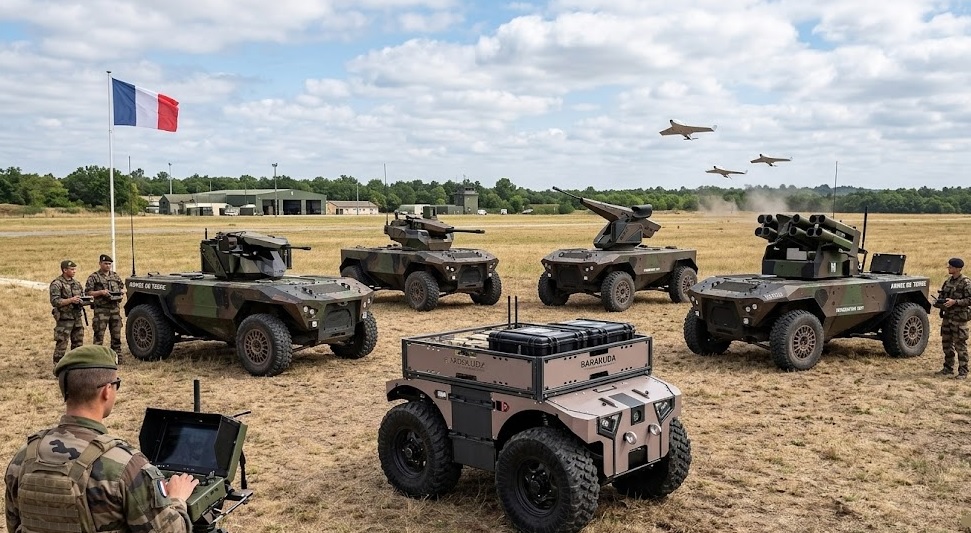
PARIS — June 05, 2026 : The French Army is advancing its use of unmanned systems through the integration of a new family of robotic platforms designed to support logistics, reconnaissance, fire support, and precision strike missions. The newly detailed configuration combines the BARAKUDA autonomous mule robot developed by Shark Robotics, four CENTURIO heavy tactical unmanned ground vehicles from KNDS France, and a specialized MATARIS box-kit capable of launching ten MT-10 loitering munitions.
The combination reflects France’s continued investment in manned-unmanned teaming concepts, where robotic systems operate alongside military personnel to improve operational effectiveness while reducing risks to troops in contested environments. The integrated system provides capabilities ranging from battlefield logistics and casualty evacuation to armed reconnaissance and precision engagement.
BARAKUDA Designed for Battlefield Logistics Support
The BARAKUDA is an all-terrain unmanned ground vehicle developed jointly with the French Army to assist troops operating in demanding conditions. Designed primarily as a robotic mule, the platform reduces the physical burden on personnel by transporting equipment, supplies, and injured soldiers across difficult terrain.
The vehicle measures approximately 185 cm by 120 cm and weighs around 590 kilograms. It is powered by four 2,200-watt electric motors using Shark Energy lithium-ion battery packs, providing up to 10 hours of operational endurance. The battery system can be recharged in approximately 3.5 hours.
BARAKUDA can carry payloads of up to 500 kilograms and tow loads reaching 1,100 kilograms. The vehicle is capable of overcoming obstacles up to 30 centimeters high, traversing slopes of up to 40 degrees, and reaching speeds of 20 kilometers per hour. Its IP65 protection rating allows operation in challenging weather and environmental conditions.
Operators control the system through a dual-frequency 2.4 GHz remote-control system offering a line-of-sight range of 500 meters. An optional mesh relay system extends this range to approximately 1,000 meters.
The platform is intended for logistics transport, casualty evacuation, towing mission-critical equipment, and supporting infantry units operating away from vehicle access routes. Its modular design also allows adaptation for security and reconnaissance tasks.
CENTURIO Provides Heavy Tactical Support
Complementing the BARAKUDA is the CENTURIO family of heavy tactical unmanned ground vehicles developed by KNDS France. Based on the PHOBOS rolling platform previously tested by SERA Engineering and developed in partnership with Sogeclair, CENTURIO belongs to the 2- to 3-ton class of robotic combat vehicles.
The platform is powered by a 60 kW diesel engine operating on JP8 fuel and can achieve speeds of up to 45 kilometers per hour. Measuring approximately 350 cm in length and 190 cm in width, the vehicle features four-wheel drive, four-wheel steering, and independent suspension, enabling it to operate effectively across varied terrain and alongside armored formations.
CENTURIO supports secure teleoperation at speeds of up to 35 kilometers per hour while incorporating advanced robotic functions including autonomous route recovery, trajectory replay, vehicle-following capability, and autonomous navigation. A 360-degree camera suite equipped with night-vision capability provides operators with continuous situational awareness.
The platform’s modular architecture allows it to be rapidly configured for different mission requirements. Depending on the variant, CENTURIO can carry reconnaissance sensors, explosive ordnance investigation equipment, CBRN detection systems, logistics modules, or weapon stations.
One of the most heavily armed configurations, the CENTURIO-X30, integrates the ARX30 remotely operated turret armed with a 30 mm autocannon capable of firing up to 225 rounds per minute. The system is designed to engage light armored vehicles, fortified positions, and other battlefield threats at ranges of up to 1,500 meters.
By combining autonomous navigation with leader-follower functionality, the vehicle can accompany manned units while maintaining heavy fire support and reconnaissance capabilities without exposing operators directly to hostile fire.
MATARIS Box-Kit Expands Precision Strike Capability
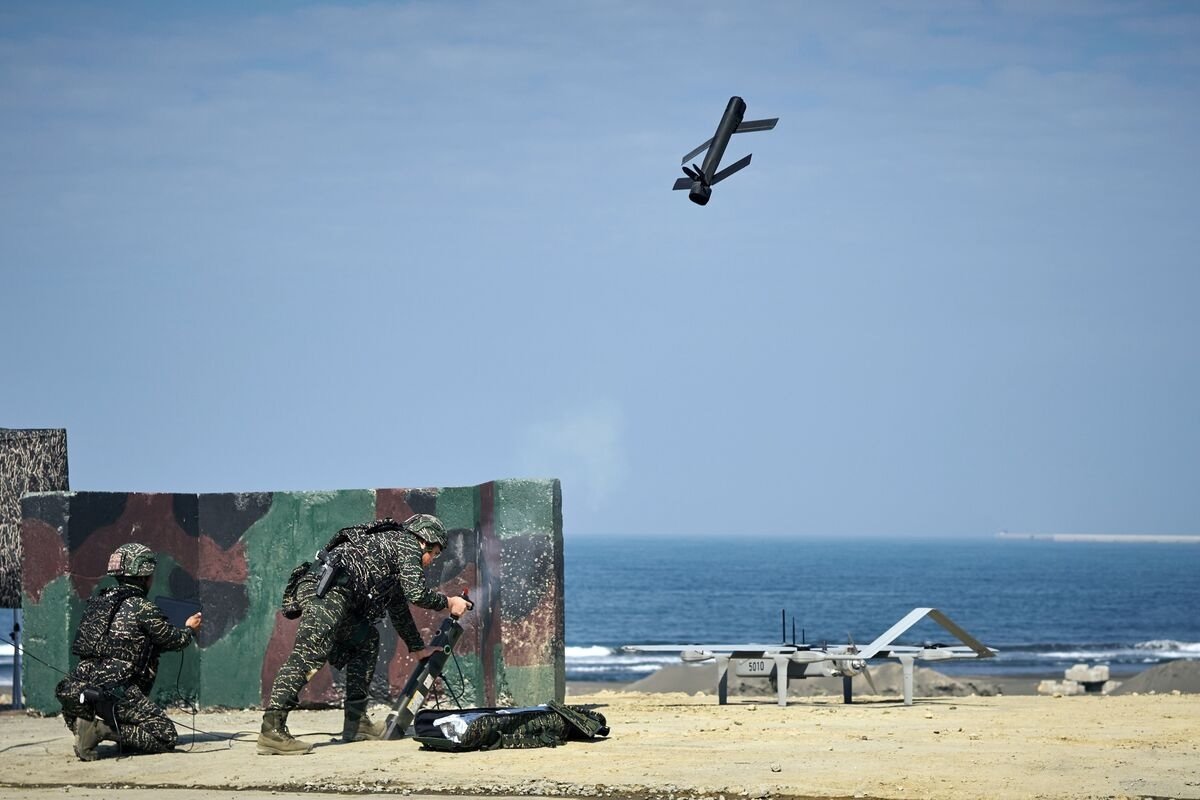
To provide organic strike capability, KNDS has integrated its MATARIS loitering munition family into a dedicated deployment system featuring a pneumatic launch box-kit capable of carrying and launching ten MT-10 munitions.
The MT-10 is a short-range loitering munition employing a folding counter-rotating bi-rotor design. Each munition weighs approximately 3.8 kilograms, has a wingspan of 70 centimeters, and is powered by an electric propulsion system.
The drone carries a 550-gram MW-FRAG explosive-incendiary warhead intended for engagements against infantry positions and light vehicles. It offers a maximum operational range of 10 kilometers and an endurance of approximately 30 minutes.
Designed for low acoustic detectability, the MT-10 can operate in environments where satellite navigation signals are degraded or unavailable. The munition can be launched from tubes using pneumatic ejection or deployed through vertical takeoff and landing configurations.
The dedicated box-kit allows rapid consecutive launches from either vehicle-mounted or stationary positions, enabling operators to deploy multiple loitering munitions in a short period of time. Onboard sensors and cameras support target identification and precision engagement in both urban and open-terrain environments.
A notable feature of the system is its new-generation safety arming mechanism. If mission conditions change after launch, operators can abort an attack and return the drone to a loitering state until a new target is assigned, improving operational flexibility and reducing the risk of unintended damage.
Integrated Robotic Force Structure
The combination of BARAKUDA logistics vehicles, CENTURIO tactical UGVs, and MT-10 loitering munitions creates a layered robotic force structure capable of supporting multiple battlefield functions simultaneously. BARAKUDA reduces soldier workload and enhances mobility, CENTURIO provides reconnaissance and heavy fire support, while MATARIS-equipped MT-10 drones deliver precision strike capability.
French defense planners view such integrated robotic formations as an important element of future operations, allowing military units to conduct logistics, surveillance, combat support, and precision engagement missions while limiting personnel exposure to battlefield threats. Further testing and operational integration are expected to refine tactics and procedures as the French Army continues expanding its use of unmanned systems across a range of mission profiles.
——— End of Article ———