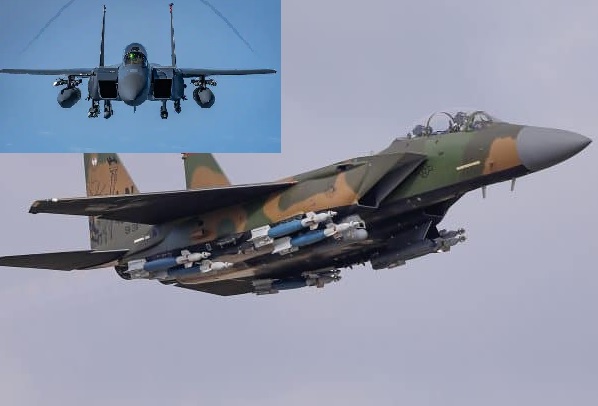
RAF LAKENHEATH, United Kingdom — May 7, 2026 : A specially painted F-15E Strike Eagle assigned to the 48th Fighter Wing conducted a heavy-load training sortie from RAF Lakenheath on May 7, carrying eight inert GBU-12 Paveway II guided bombs as part of commemorative activities marking the 40th anniversary of Operation El Dorado Canyon.
The aircraft, serial number 91-0311, recently received a heritage camouflage scheme replicating the Cold War-era paint used by F-111F Aardvarks that operated from RAF Lakenheath during the 1986 U.S. strike mission against Libya. The sortie combined aerial refueling, low-level penetration flying, and inert weapons release training, closely simulating a long-range strike profile.
Heavy-Load Strike Training Mission
Operating under the callsign EAGLE 31, the F-15E departed RAF Lakenheath shortly after 08:30 local time alongside wingman EAGLE 32. Shortly after takeoff, the formation linked up with a KC-135 Stratotanker for aerial refueling before continuing toward designated low-flying areas in North Wales.
The aircraft then conducted low-level navigation through the Welsh valleys to simulate terrain-following ingress operations commonly associated with strike missions in contested environments. Following the low-altitude segment, the formation proceeded to the Holbeach Air Weapons Range on the coast north of RAF Lakenheath.
At the range, EAGLE 31 released its full payload of eight inert GBU-12 Paveway II bombs, completing the weapons employment phase of the mission before returning to base.
Images captured during the sortie showed the aircraft carrying all eight bombs on fuselage stations and conformal fuel tank hardpoints while leaving the wing pylons completely unoccupied. This configuration preserves the option to carry additional external fuel tanks or air-to-air weapons on the wings during operational deployments.
Heritage Paint Scheme Honors 1986 Libya Strike
The commemorative F-15E officially debuted its heritage livery on April 28, 2026. Airmen from the 48th Equipment Maintenance Squadron spent 22 days sanding, masking, priming, painting, and applying stencils to recreate the Southeast Asia-style camouflage scheme worn by F-111F aircraft during the Cold War period.
The camouflage consists of tan and two shades of green and was specifically designed to honor Operation El Dorado Canyon, conducted on April 14–15, 1986.
During the operation, twenty-four F-111F Aardvarks from the 48th Tactical Fighter Wing launched from RAF Lakenheath to conduct long-range strikes against Libyan targets in response to the bombing of a Berlin nightclub linked to Libyan-sponsored terrorism.
The operation required a 6,400-mile round trip lasting approximately 13 hours and involved multiple aerial refueling operations. At the time, it was considered the longest fighter combat mission ever flown.
Tribute to “Karma 52”
The heritage markings specifically commemorate “Karma 52,” the only F-111 lost during Operation El Dorado Canyon. The aircraft was shot down over the Mediterranean Sea during the mission, resulting in the deaths of pilot Captain Fernando L. Ribas-Dominicci and Weapon Systems Officer Captain Paul F. Lorence.
To honor the crew, the F-15E’s nose section features a red “Karma 52” inscription alongside the silhouette of an F-111 aircraft. The tail markings include the 494th Fighter Squadron panther emblem and the 48th Fighter Wing’s Statue of Liberty insignia, along with dedicated 40th anniversary markings.
The commemorative aircraft remains an operational F-15E assigned to the 48th Fighter Wing and continues to participate in regular training and operational activities while carrying the heritage design.
GBU-12 Paveway II and Strike Eagle Payload Configuration
The sortie also highlighted the F-15E Strike Eagle’s ability to carry large air-to-ground payloads while maintaining operational flexibility.
The GBU-12 Paveway II is a laser-guided precision munition built around the 500-pound Mk 82 general-purpose bomb body. The weapon uses a nose-mounted laser seeker and deployable tail guidance fins to steer toward laser-designated targets.
The bomb’s guidance system utilizes what is commonly referred to as “bang-bang” guidance. Instead of making gradual adjustments, the control surfaces move to maximum deflection whenever course corrections are required and then reverse direction as the weapon compensates back toward the target path. This creates a sinusoidal flight pattern while simplifying the guidance system’s mechanical design and reducing manufacturing costs for the single-use munition.
The mission additionally demonstrated the operational importance of the F-15E’s conformal fuel tanks, also known as FAST Packs — Fuel and Sensor, Tactical packs. Mounted along both sides of the fuselage near the engine intakes, the tanks provide additional fuel capacity and extra hardpoints for weapons carriage without occupying wing stations.
Although conformal fuel tanks were originally developed for the F-15C air superiority fighter, they were generally unpopular among F-15C crews because they cannot be jettisoned in flight and permanently affect maneuverability. For the F-15E Strike Eagle, however, the tanks became a central feature of the aircraft’s long-range strike mission and heavy payload capability.
Fleet Modernization and Future Strike Role
The commemorative training sortie took place amid broader modernization efforts within the U.S. Air Force fighter fleet.
In April 2026, the Air Force announced plans to increase procurement of Boeing F-15EX Eagle II aircraft from 129 to 267 units, significantly expanding the future fleet size. While early F-15EX acquisition plans primarily focused on homeland defense roles within the Air National Guard, the larger procurement objective indicates the aircraft will eventually replace aging F-15E Strike Eagles in frontline strike missions.
Initial F-15EX planning did not heavily emphasize the use of conformal fuel tanks, but the transition from the F-15E fleet suggests that long-range strike configurations and heavy air-to-ground payload operations will remain central to the platform’s future role.
The May 7 sortie at RAF Lakenheath demonstrated that the operational concepts associated with the Strike Eagle — including extended-range strike profiles, aerial refueling integration, and high-capacity precision weapons carriage — continue to remain relevant as the U.S. Air Force prepares for the next phase of tactical fighter modernization.
——— End of Article ———