PARIS / LONDON — April 17, 2026 : European air forces are advancing the rapid integration of short-range, laser-guided rockets on frontline fighter aircraft to address the growing threat posed by low-cost strike drones and drone swarms. The initiative reflects a broader operational shift toward cost-efficient interception methods that preserve high-value air-to-air missiles while maintaining sustained combat availability.
The effort focuses on adapting existing rocket systems with laser-guidance kits and integrating them with modern fighter sensors and targeting pods. By doing so, air forces aim to combine precision engagement capability with significantly reduced per-shot costs compared to conventional missile systems.
French Rafale Program Advances Toward Summer 2026 Readiness
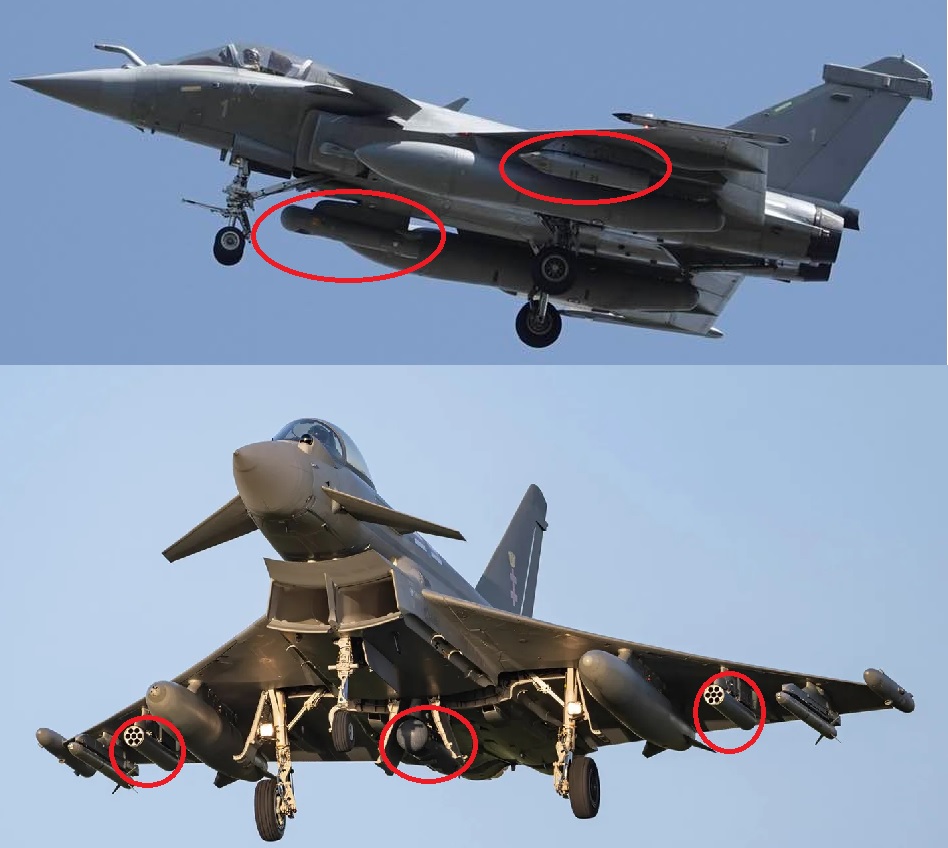
In France, testing is actively underway to establish a dedicated counter-drone configuration for the Rafale fleet using domestically developed systems. On April 16, 2026, a French Navy Rafale M fighter was observed at Dassault Aviation’s flight test center in Istres equipped with two TELSON 12 JF rocket pods and a TALIOS targeting pod mounted on the centerline.
Each TELSON 12 JF pod, developed by TDA Armements (a subsidiary of Thales), carries 12 induction-activated 68 mm SNEB rockets, enabling a total loadout of 24 rockets per aircraft when two pods are installed. The SNEB system, originally introduced in the 1950s as an unguided rocket, has been upgraded with laser guidance under the SYROCOT program, converting it into a precision-guided munition suitable for engaging aerial and ground targets.
This configuration marks the first integration of the SNEB rocket pod on the Rafale platform. The TALIOS targeting pod provides target acquisition, tracking, and laser designation required for guided rocket employment.
On April 15, 2026, during a parliamentary hearing, the head of the French Directorate General of Armaments (DGA), Patrick Pailloux, confirmed that the capability is expected to reach operational readiness by summer 2026. The system is intended to complement existing air-to-air weapons by offering a lower-cost alternative for engaging drones.
Recent operational experience has informed this development. French Rafale aircraft deployed in the Gulf reportedly expended approximately 80 MICA air-to-air missiles against Shahed-type drones, highlighting the cost imbalance between high-value interceptors and low-cost aerial threats.
Royal Air Force Integrates APKWS on Typhoon Fleet
In parallel, the United Kingdom’s Royal Air Force (RAF) is progressing with the integration of the Advanced Precision Kill Weapon System II (APKWS II) on its Eurofighter Typhoon aircraft. In March 2026, images emerged showing an RAF Typhoon fitted with two LAU-131 rocket pods and a LITENING III targeting pod.
Each LAU-131 pod accommodates seven 70 mm rockets, allowing a total of 14 laser-guided rockets per aircraft in this configuration while preserving other weapon stations. The APKWS II system, developed in the United States, converts standard Hydra 70 unguided rockets into precision-guided munitions through the addition of a laser guidance kit with a seeker and control fins.
On April 8, 2026, BAE Systems, in coordination with the RAF, conducted test firings of APKWS rockets from a Typhoon test and evaluation aircraft at a UK military testing range. The trials included engagement of a ground-based target and validated the system’s integration with Typhoon avionics and targeting systems.
The rockets are equipped with proximity fuzes, enabling detonation near aerial targets such as drones without requiring a direct impact. This feature is particularly relevant for intercepting small, maneuverable unmanned systems.
BAE Systems stated that the integration provides a cost-effective counter-uncrewed aerial system capability, with significantly lower unit costs compared to traditional air-to-air missiles.
Broader Operational Context and NATO Alignment
The adoption of laser-guided rockets for air-to-air interception has already been implemented extensively by the United States. U.S. Air Force platforms, including the F-16 Fighting Falcon, F-15E Strike Eagle, and A-10 Thunderbolt II, routinely employ APKWS-equipped rocket pods as a primary countermeasure against one-way attack drones in operational theaters such as the Middle East.
Ukraine has also begun employing similar systems in a limited capacity. Recent defense reporting indicates that APKWS rockets are being used alongside newly delivered F-16 aircraft for counter-drone operations, although detailed information on deployment and effectiveness remains limited.
The parallel programs in France and the United Kingdom indicate a wider standardization trend across European and NATO air forces. The approach emphasizes the use of fighter aircraft for short-range drone interception using lower-cost munitions, supported by onboard sensors and targeting pods.
Transition Toward Cost-Efficient Air Combat Engagement
The integration of laser-guided rockets represents a shift in air combat doctrine driven by the increasing prevalence of low-cost unmanned threats. By employing precision-guided rockets instead of high-cost missiles, air forces can maintain operational sustainability while addressing large volumes of targets.
These systems are designed to engage small, slow-moving aerial targets at short ranges, as well as provide secondary air-to-surface capabilities. Their compatibility with existing aircraft systems enables rapid integration without extensive platform modifications.
France and the United Kingdom are progressing toward full operational capability in 2026. The developments reflect an ongoing adjustment in force structure and procurement priorities, aligning air combat capabilities with evolving threat environments characterized by widespread drone use.
——— End of Article ———