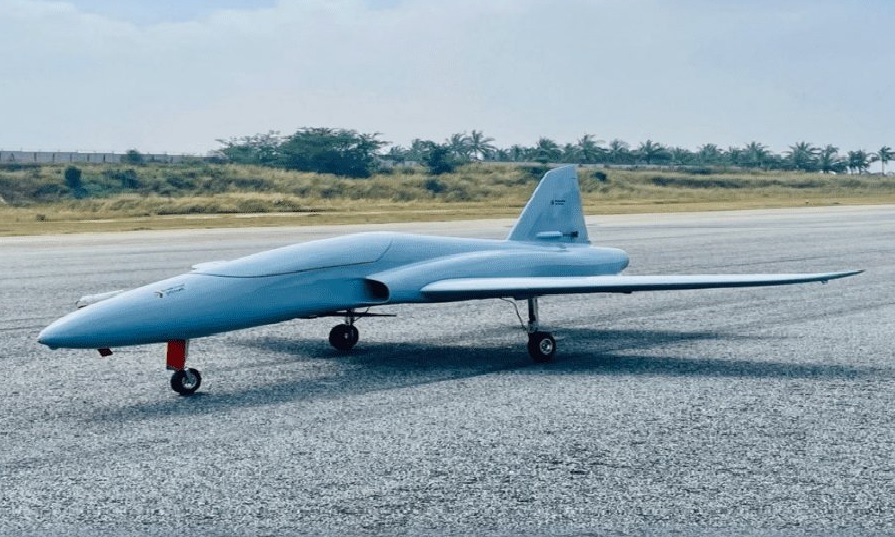
BENGALURU — April 27, 2026 : Dynamatic Technologies has outlined plans for a new supersonic loitering munition, designated “Super Kaatil,” under its Dynauton Systems division. The programme focuses on expanding India’s indigenous capabilities in long-range autonomous strike systems designed for deep-penetration missions.
The Super Kaatil is being developed as a jet-powered loitering munition that combines high-speed transit with precision strike functionality. According to the company, the system is configured as a 100 kg-class platform and is powered by a compact jet engine, enabling it to achieve supersonic speeds—significantly higher than conventional subsonic loitering munitions currently in service.
The munition is designed with an operational strike range of up to 350 kilometres and carries a 35 kg warhead. This payload capacity is intended to support engagement of high-value and fortified targets at extended stand-off distances.
Flight Profile and Survivability
The Super Kaatil incorporates a terrain-following flight capability, allowing it to operate at low altitudes by tracking ground contours. This flight profile is intended to reduce radar visibility during ingress into contested airspace.
The system is also designed to function in GPS-denied and electronically contested environments. Its onboard guidance architecture is expected to maintain navigation and targeting performance under conditions of signal jamming or disruption, a requirement for operations against modern integrated air defence systems.
The use of a jet propulsion system enables faster time-to-target compared to propeller-driven or electrically powered loitering munitions. This reduces exposure time to interception and enhances mission survivability.
Evolution from Earlier Kaatil System
The Super Kaatil represents an upgraded iteration of the original “Kaatil” loitering munition developed by Dynauton Systems. The earlier platform featured a range of approximately 100 kilometres and operated at speeds of around 600 km/h.
The baseline Kaatil system is a compact jet-powered kamikaze unmanned aerial vehicle with a maximum take-off weight of about 12 kg and a wingspan of roughly 2 metres. It is capable of carrying a 1 kg modular payload and supports both catapult and short-runway launch configurations.
For guidance, the original system uses GNSS combined with optical and electro-optical systems, enabling autonomous “fire-and-forget” operation, including in environments where satellite navigation signals are degraded or unavailable.
The Super Kaatil extends the operational range to 350 kilometres—more than three times that of the earlier version—while introducing supersonic flight capability and a substantially increased payload capacity.
Industrial Context and Development Status
Dynauton Systems, the unmanned systems division of Dynamatic Technologies, has been involved in the design and development of unmanned aerial platforms as part of broader defence manufacturing efforts in India. The Super Kaatil programme aligns with ongoing national initiatives to increase domestic production of advanced unmanned and precision-strike systems.
As of now, the company has not disclosed a timeline for prototype rollout, testing phases, or potential induction into service. Additional technical and programme details are expected to be released as development progresses.
——— End of Article ———