WASHINGTON / TEHRAN — March 9, 2026 : Military assessments of the first week of the conflict that began on February 28, 2026 indicate that Iran’s naval forces experienced extensive losses while command disruption significantly affected the country’s initial military response. Analysts attribute the rapid reduction of Iranian naval capabilities to a combination of leadership disruption, damage to command infrastructure, and the technological advantages of United States naval and air forces.
Operational evaluations attributed to U.S. Central Command indicate that more than 20 Iranian vessels were sunk or rendered inoperable within the first seven days of the conflict, while some estimates place total losses between 30 and 42 surface ships. During the same period, U.S. officials reported no confirmed damage to any U.S. Navy platforms.
Structure of Iran’s Naval Forces Before the Conflict
Prior to the outbreak of hostilities, Iran maintained two separate naval organizations: the Islamic Republic of Iran Navy (IRIN), which functions as the country’s conventional maritime force, and the naval arm of the Islamic Revolutionary Guard Corps (IRGCN), which is responsible for asymmetric maritime warfare and coastal defense.
The IRIN operated an estimated fleet of roughly 100 vessels and submarines. These included seven frigates, three or four corvettes, between 17 and 25 submarines—primarily Russian-built Kilo-class boats and smaller domestically produced midget submarines—along with 21 patrol vessels and multiple logistical support ships.
The IRGCN maintained a smaller but specialized fleet focused on asymmetric operations in the Persian Gulf and the Strait of Hormuz. Its inventory included approximately 45 missile boats and fast-attack craft such as the Houdong class, Peykaap II missile boats, C-14 vessels, and MK13 fast patrol craft. In addition, the organization controlled hundreds of smaller speedboats configured for swarm tactics.
These naval forces were primarily concentrated around Iran’s southern coastline, particularly at major bases in Bandar Abbas and Konarak, as well as throughout the Persian Gulf and the Strait of Hormuz.
Prior to the conflict, Iranian military officials repeatedly emphasized their ability to disrupt maritime traffic through the Strait of Hormuz using coordinated swarm attacks, naval mines, coastal missile batteries, and anti-ship missile systems. Iranian commanders described these capabilities as sufficient to challenge technologically superior naval forces operating in the Gulf.
Strike on Leadership and Command Infrastructure
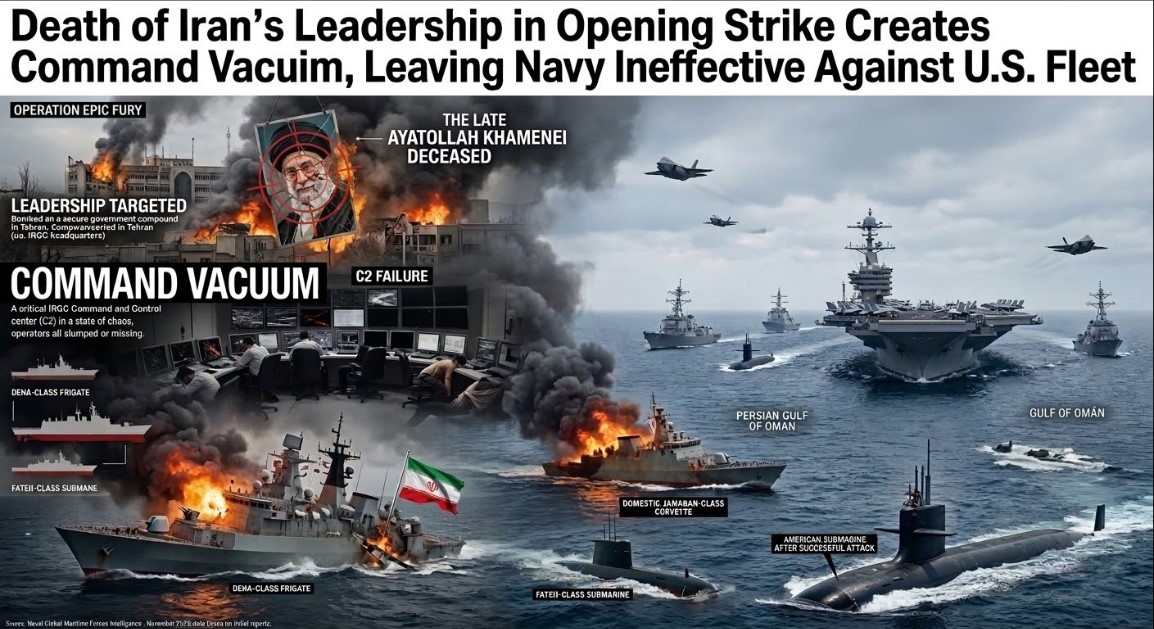
The initial disruption to Iranian military operations followed a joint United States and Israeli strike carried out on February 28 against a secured compound in Tehran. According to military assessments referenced by Western officials, the strike eliminated Supreme Leader Ayatollah Ali Khamenei along with several senior officials. Simultaneous attacks targeted key Islamic Revolutionary Guard Corps headquarters facilities and military communications networks.
Under Iran’s constitutional framework and the doctrine of Velayat-e Faqih (Guardianship of the Islamic Jurist), the Supreme Leader serves as the commander-in-chief of all armed forces. Both the conventional military and the Islamic Revolutionary Guard Corps operate through command structures that ultimately report directly to the Supreme Leader’s office.
The IRGC operates largely outside the civilian government framework, and its operational directives flow through parallel chains of command that bypass the elected president and standard military hierarchy. The naval branch of the IRGC, which controls most of Iran’s coastal missile boats and asymmetric maritime capabilities, is directly integrated into this structure.
Military analysts say that the loss of the central command authority combined with the destruction of communications nodes created immediate command-and-control paralysis across both the IRGC and the regular armed forces.
Field commanders across multiple branches of the Iranian military were left without updated targeting data, operational coordination, or strategic directives. In a system where major operational decisions require authorization from the highest levels of command, the sudden absence of that authority resulted in widespread disruption of coordinated military activity.
Initial Iranian Retaliatory Strikes
The command disruption was reflected in the early stages of Iran’s missile response during the first days of the conflict. According to U.S. and Israeli military assessments, initial Iranian ballistic missile and drone launches were dispersed across multiple targets throughout the Middle East without clear operational prioritization.
Without functional command-and-control centers capable of providing real-time targeting telemetry and strategic direction, missile units reportedly relied on pre-planned or locally selected targets. Many of these strikes were intercepted by U.S. and Israeli air defense systems and caused limited damage.
The absence of centralized coordination also affected naval operations. Iranian naval units did not receive immediate orders to disperse, redeploy, or initiate swarm tactics that had previously formed the core of Iran’s maritime doctrine.
Rapid Losses Within the Iranian Navy
The lack of coordinated naval response allowed U.S. forces to target Iranian vessels at ports and at sea during the early phase of the conflict.
Satellite imagery and official assessments indicate that multiple ships were destroyed while docked at Iranian naval facilities, particularly at Bandar Abbas and Konarak. Several domestic Jamaran-class surface combatants were reportedly struck while moored at their piers before they could deploy.
Among the notable losses was the newly converted drone-carrier Shahid Bagheri, which had been adapted to operate unmanned aerial systems. The vessel was hit by Tomahawk cruise missiles while docked at Bandar Abbas before it could launch its drone payload.
On March 4, the Iranian frigate IRIS Dena was torpedoed in the Indian Ocean by a U.S. submarine. U.S. officials described the engagement as the first submarine torpedo sinking of a surface combatant by the U.S. Navy since the Second World War.
Additional losses included several Bayandor-class corvettes and at least one Kilo-class submarine reportedly destroyed at dock. Reports also indicated the destruction of the IRIS Fateh, one of Iran’s domestically produced submarines.
Amid the disruption to command structures, reports also indicated unusual movements by surviving Iranian naval units operating outside their normal patrol areas. The Iranian naval frigate IRIS Alborz, an Alvand-class guided-missile frigate of the Islamic Republic of Iran Navy, reportedly requested assistance from Indian authorities and proceeded toward Kochi, India. According to regional maritime reports, the vessel’s crew was unable to obtain operational instructions from higher command following the breakdown of communications with Iranian naval headquarters, prompting the ship to seek logistical support and guidance after operating for several days without confirmed command directives.
By targeting naval assets early in the campaign, U.S. forces effectively eliminated Iran’s ability to deploy conventional naval power beyond the Strait of Hormuz or threaten maritime traffic using larger surface vessels.
U.S. operations during this period included the use of stealth B-2 bombers, Tomahawk cruise missiles launched from surface ships and submarines, and persistent surveillance provided by carrier-based aircraft and reconnaissance systems.
Within 48 hours, U.S. officials reported that Iranian naval presence east of the Strait of Hormuz had been largely neutralized.
Limitations of Asymmetric Naval Doctrine
Iran’s naval strategy prior to the conflict relied heavily on asymmetric tactics, particularly coordinated swarm attacks involving fast boats supported by coastal anti-ship missile batteries.
However, analysts note that these tactics still required functioning command-and-control links to coordinate targeting, timing, and engagement zones. The removal of central leadership and communications networks disrupted those links.
As a result, Iranian fast-attack craft and other asymmetric naval units were unable to organize large-scale coordinated operations against U.S. naval forces during the initial phase of the conflict.
Reorganization of Iranian Command
After several days of command disruption, Iran’s political leadership began restoring central authority through emergency coordination measures and surviving military communication networks. During this period, Iranian missile operations gradually shifted from dispersed launches to more focused targeting. Military analysts report that surviving localized command nodes and emergency communications protocols enabled missile units to regain a degree of operational coordination.
Recent strikes have increasingly focused on military and economic infrastructure belonging to the United States and its regional partners.
Among the reported targets were advanced radar and early-warning systems used in regional missile defense networks. Iranian missiles struck an AN/TPY-2 radar system associated with the Terminal High Altitude Area Defense (THAAD) network at Muwaffaq Salti Air Base in Jordan. Additional radar installations in Saudi Arabia were also targeted.
Iranian missile strikes have also focused on energy infrastructure. The Bapco refinery in Bahrain and several industrial facilities in the United Arab Emirates were hit in recent attacks, resulting in large fires and forcing state energy companies to declare force majeure at some facilities.
On March 8–9, the Assembly of Experts formally appointed Mojtaba Khamenei as the country’s new Supreme Leader, ending the leadership vacancy that had existed since the death of his father, Ayatollah Ali Khamenei. The decision restored the formal chain of command for Iran’s armed forces, which constitutionally report directly to the office of the Supreme Leader.
Current Status of Iranian Naval Forces
By March 9, Iranian naval capabilities have been significantly reduced. Surviving assets consist primarily of a limited number of fast-attack craft, submarines undergoing refit, and coastal defense units.
Most remaining vessels remain confined to port or operating under restricted conditions amid continued surveillance and strike operations by U.S. and allied forces.
Military analysts note that the rapid collapse of Iranian naval operations during the opening phase of the conflict reflects the highly centralized structure of Iran’s command system. The simultaneous removal of the Supreme Leader and multiple command centers disrupted operational continuity across both the Islamic Revolutionary Guard Corps and the conventional military.
Subsequent developments indicate that Iran’s missile forces have begun adapting under restored leadership, shifting toward targeted strikes against regional military infrastructure and energy facilities.
——— End of Article ———