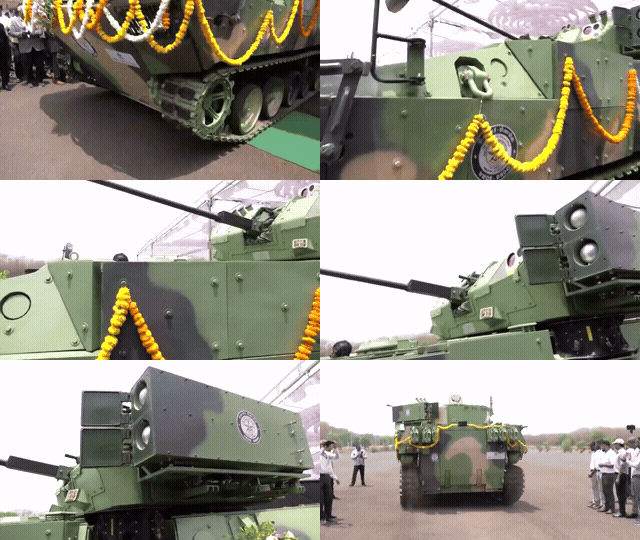
PUNE / NEW DELHI — April 25, 2026 : The Defence Research and Development Organisation (DRDO) has rolled out the first two prototypes of the Vikram VT-21 Advanced Armoured Platform (AAP), marking a key stage in India’s effort to develop a next-generation infantry combat vehicle and armoured personnel carrier for the Indian Army.
The prototypes comprise two distinct configurations developed under a public-private partnership model led by DRDO’s Vehicles Research and Development Establishment (VRDE). The tracked variant has been developed in collaboration with Tata Advanced Systems Limited (TASL), while the wheeled variant has been produced with Kalyani Strategic Systems Limited (KSSL), a subsidiary of Bharat Forge Limited.
Development Timeline and Programme Context
The Vikram VT-21, also referred to as the Advanced Armoured Platform, is being developed as a candidate for the Future Infantry Combat Vehicle (FICV) programme. The programme is intended to replace the Army’s existing fleet of BMP-2 vehicles deployed across approximately 49 mechanised infantry battalions.
The Indian Army’s projected requirement under the FICV programme is estimated at 1,750 to 1,770 vehicles across multiple configurations, including infantry combat, command, reconnaissance, and surveillance roles.
The metal-cutting ceremony for the prototypes was conducted on April 2, 2025, at manufacturing facilities in Pune. The rollout of the first prototypes has been completed within three years of project initiation, reflecting accelerated timelines under the Development cum Production Partner (DcPP) framework adopted by the Ministry of Defence.
Firepower and Combat Systems
The Vikram VT-21 is equipped with a 30 mm crewless turret designed as a remote-controlled weapon station. The turret uses standard 30×165 mm ammunition and eliminates the need for personnel inside the turret structure, reducing vehicle silhouette and improving crew protection.
The platform is integrated with an anti-tank guided missile (ATGM) system to provide capability against heavily armoured targets. DRDO has scheduled the integration and testing of the Nag Mk-2 ATGM on the platform as part of the next phase of development and trials.
Protection and Survivability
The platform incorporates modular armour compliant with NATO STANAG 4569 Level 4 and Level 5 protection standards. The armour design includes layered composite panels developed using GFRP, CFRP, and PVC foam materials.
This configuration provides scalable protection against ballistic threats, artillery fragments, and explosive shocks. The vehicle structure also incorporates a double-floor design and a V-shaped hull configuration to enhance resistance against mine blasts and improvised explosive devices (IEDs).
Mobility and Platform Characteristics
Both tracked and wheeled variants are powered by high-output diesel engines coupled with automatic transmission systems, targeting a power-to-weight ratio of approximately 30 hp per tonne. The overall vehicle weight is in the 18 to 25 tonne class.
The wheeled variant follows an 8×8 configuration derived from the Wheeled Armoured Platform (WhAP) programme. It includes run-flat tyre inserts and is designed for high mobility across varied terrain conditions.
Both variants are amphibious and capable of operating in riverine and water-crossing environments with minimal preparation.
The platform accommodates a crew of three personnel and can carry eight infantry soldiers. It is equipped with advanced thermal and optical sights, a fire control system, a digital dashboard, and enhanced crew vision systems.
Modular Design and Multi-Role Capability
The Vikram VT-21 has been designed with a modular, plug-and-play architecture that allows rapid reconfiguration for multiple operational roles. These include infantry combat vehicle (ICV), armoured personnel carrier (APC), command-and-control vehicle, reconnaissance platform, and medical evacuation configurations.
This modularity is intended to reduce lifecycle costs and improve operational flexibility for the Indian Army.
Indigenisation and Industrial Participation
At the prototype rollout stage, the Vikram VT-21 platform has an indigenous content level of approximately 65 per cent. Plans are in place to increase this to 80–90 per cent through phased localisation of key subsystems, including power packs and critical components.
The programme is aligned with the Atmanirbhar Bharat initiative, which seeks to enhance self-reliance in defence manufacturing.
The development model under the DcPP framework has enabled direct participation of private-sector companies such as Tata Advanced Systems Limited and Bharat Forge Limited in core design and production activities.
Trials and Next Steps
Following the rollout, the Vikram VT-21 prototypes are expected to enter Indian Army trials in the coming months. The evaluation process will include testing across varied terrain and climatic conditions to assess operational performance, mobility, protection, and system integration.
Successful completion of trials could lead to further development phases and potential production orders under the FICV programme.
The Vikram VT-21 programme reflects DRDO’s continued focus on developing modular, reconfigurable armoured systems in collaboration with domestic industry partners to meet the evolving operational requirements of the Indian armed forces.
——— End of Article ———