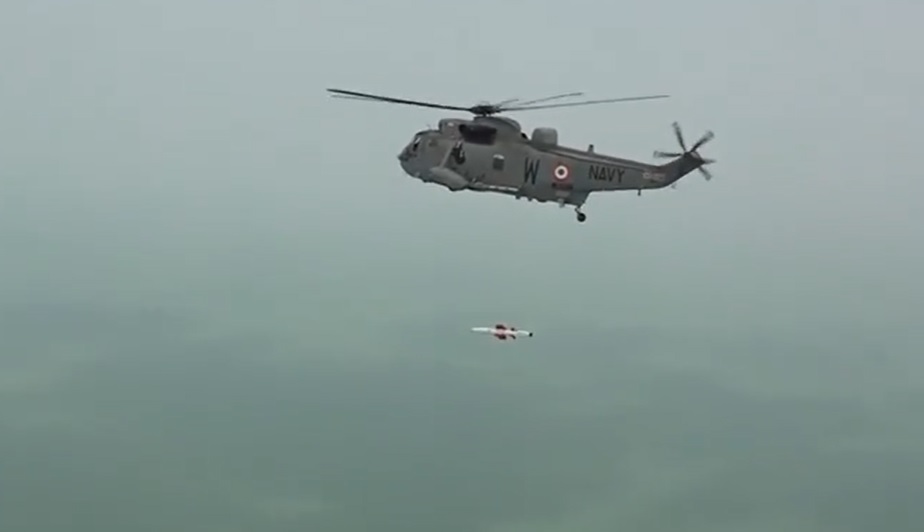
NEW DELHI — April 29, 2026 : Defence Research and Development Organisation and the Indian Navy have successfully carried out the maiden salvo launch of the Naval Anti-Ship Missile-Short Range (NASM-SR), marking a key milestone in India’s indigenous naval strike capability development.
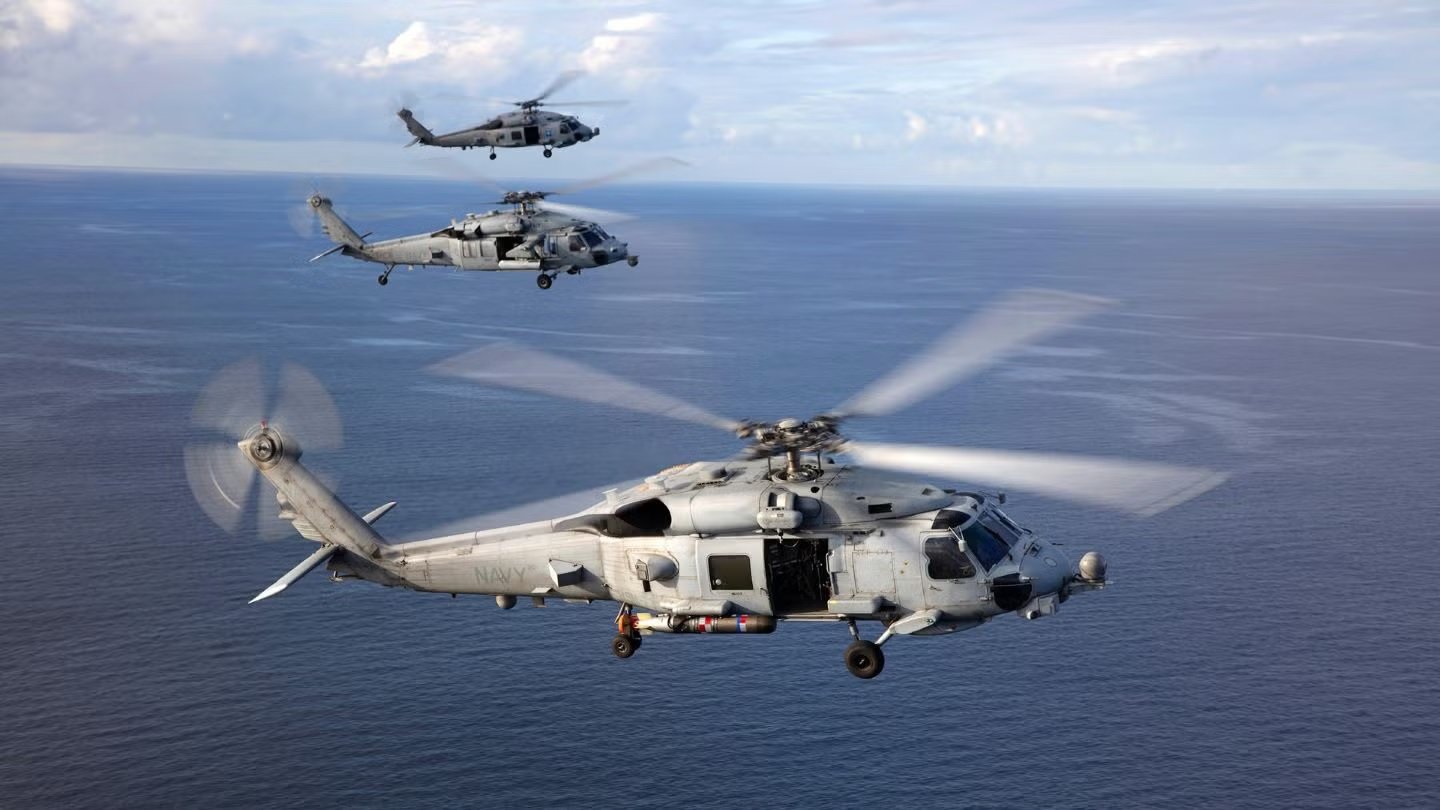
The test was conducted from an Indian Navy helicopter platform off the coast of the Bay of Bengal near Chandipur. During the trial, two missiles were launched in rapid succession from the same helicopter, representing the first successful salvo firing of this air-launched anti-ship missile system. The launch validated the missile’s ability to engage maritime targets with coordinated multi-shot capability.
A salvo launch involves firing multiple missiles within a short interval to overwhelm enemy air defence systems and improve strike probability. In this configuration, medium-lift helicopters such as the Westland Sea King—used as the standard test platform—typically carry two NASM-SR missiles on side pylons. The trial therefore demonstrated a full single-platform operational salvo.
The NASM-SR is India’s first indigenously developed air-launched anti-ship cruise missile, designed to replace legacy systems such as the Sea Eagle missile. It is intended to neutralize small to medium-sized vessels and strengthen the Navy’s close-range maritime strike capability.
The missile has a launch weight of approximately 380 kg, a length of around 3.6 metres, and a diameter of 300 mm. It carries a 100 kg high-explosive insensitive munition warhead, including a multi-explosively formed penetrator configuration with a radio proximity fuze. Propulsion is provided by a solid-propellant rocket motor with an in-line ejectable booster and sustainer engine, enabling subsonic speeds of about Mach 0.8.
With an operational range of approximately 55 kilometres, the missile follows a sea-skimming flight profile to evade radar detection. It operates at altitudes up to 3 km during mid-course and descends to as low as 5 metres in the terminal phase. Launch altitude ranges from 91 metres to 3 km.
The guidance system combines a fibre optic gyroscope-based inertial navigation system (FOG-INS), GPS updates, and a radio altimeter for mid-course navigation. In the terminal phase, an indigenous imaging infra-red (IIR) seeker enables precise target identification and engagement. The missile also features a high-bandwidth two-way datalink, allowing man-in-the-loop control and in-flight retargeting by the helicopter crew.
The system has been developed through collaboration among multiple DRDO laboratories, including the Research Centre Imarat, Defence Research and Development Laboratory, High Energy Materials Research Laboratory, and Terminal Ballistics Research Laboratory. It is planned for integration across several Indian Navy helicopter platforms, including the Sea King, MH-60R, and HAL Dhruv.
The successful salvo test concludes the primary developmental phase of the NASM-SR programme. The missile is expected to transition toward serial production, with Bharat Dynamics Limited identified as the production partner ahead of induction into operational service.
Separately, DRDO’s Naval Science and Technological Laboratory, in collaboration with the Indian Navy’s Warship Design Bureau, recently completed hydrodynamic performance assessments for a frontline warship project. The work included computational fluid dynamics simulations and model testing covering hull resistance, propulsion efficiency, sea-keeping, and maneuverability. Project deliverables were handed over by DRDO Chairman Samir V Kamat to Sanjay Sadhu, Controller of Warship Production and Acquisition.
Officials did not disclose additional operational parameters of the missile test or specify the exact helicopter variant used during the salvo launch.
——— End of Article ———