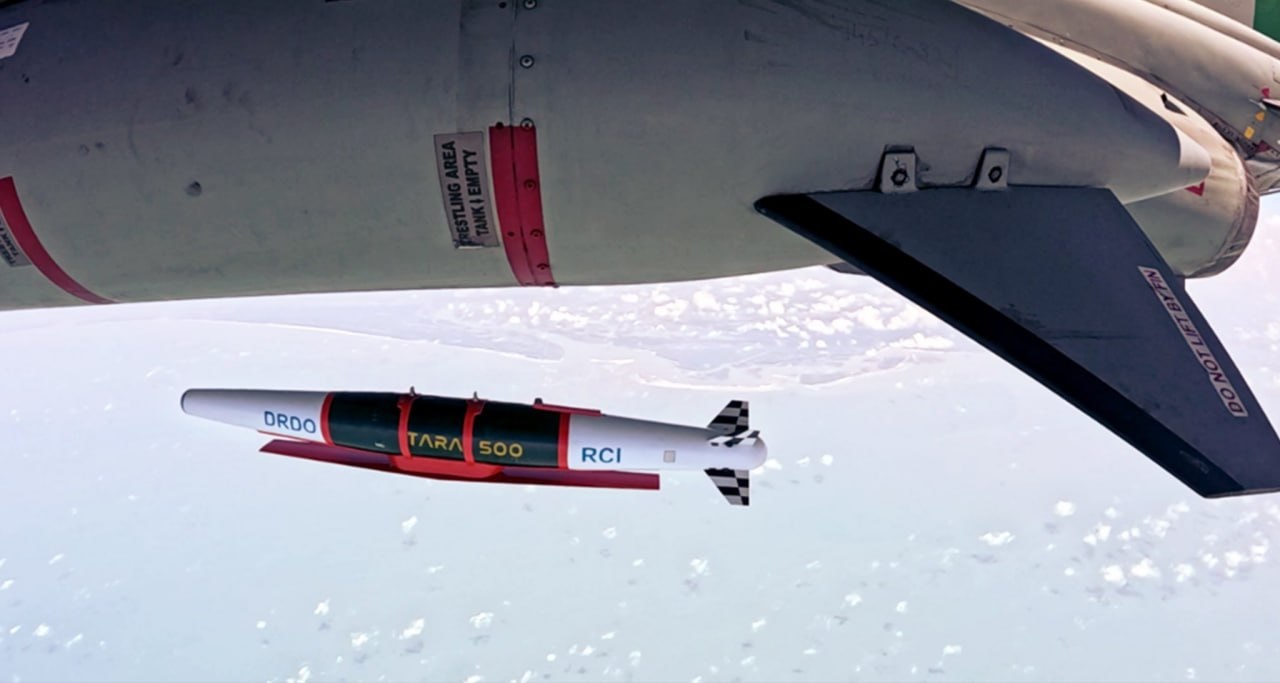
NEW DELHI — May 8, 2026 : The Defence Research and Development Organisation (DRDO) and the Indian Air Force (IAF) have successfully conducted the maiden flight-trial of the indigenous Tactical Advanced Range Augmentation (TARA) glide weapon system, marking a major milestone in India’s efforts to expand its domestically developed precision-strike capabilities.
The trial was carried out on May 7, 2026, off the coast of Odisha in the Bay of Bengal. During the test, the TARA long-range glide weapon was released from a Su-30 MKI fighter aircraft, validating the system’s range-extension, navigation, and precision-guidance capabilities under operational conditions.
TARA is India’s first indigenous glide weapon system and has been developed as a modular range-extension kit designed to convert conventional unguided bombs into precision-guided stand-off weapons. The programme is intended to significantly enhance the effectiveness of existing aerial munitions while reducing dependence on imported glide bomb systems.
The weapon system has been designed and developed by DRDO’s Research Centre Imarat (RCI), Hyderabad, in collaboration with other DRDO laboratories and domestic defence industry partners. Development-cum-Production Partners (DcPP) and Indian manufacturers associated with the programme have already initiated production activities for the system.
Indigenous Precision-Strike Capability
TARA is regarded as the indigenous equivalent of the Israeli SPICE ER series and is designed to provide the Indian Air Force with a low-cost precision-strike capability using existing conventional bomb inventories.
The modular kit can be integrated with 250 kg, 450 kg, and 500 kg general-purpose or high-speed low-drag bombs, resulting in multiple variants designated as TARA-250, TARA-450, and TARA-500.
Once released from an aircraft at altitude, the weapon uses aerodynamic lift and advanced navigation systems to travel extended distances toward its designated target. The stand-off capability enables combat aircraft to strike ground-based targets while remaining outside the effective range of hostile radar-guided air defence systems.
Officials stated that the system is intended to improve the lethality, flexibility, and survivability of IAF strike operations by transforming existing “dumb” bombs into precision-guided munitions without requiring entirely new weapon inventories.
Guidance and Navigation Systems
The TARA weapon system incorporates a fibre-optic gyro-based inertial navigation system (INS) combined with multi-GNSS satellite guidance for mid-course navigation and trajectory correction.
For terminal engagement, the weapon can be equipped with multiple seeker options, including electro-optical, imaging infrared, and semi-active laser (SAL) seekers, depending on operational requirements and target profiles.
According to defence officials, the semi-active laser seeker variant is capable of achieving a Circular Error Probable (CEP) of less than three metres during the terminal phase of engagement. The electro-optical and imaging infrared seekers are also designed to maintain target acquisition and engagement capability in contested environments where satellite navigation signals may be jammed, spoofed, or disrupted.
The guidance architecture allows the system to conduct precision attacks against fixed and semi-mobile ground targets while maintaining operational effectiveness in electronically contested battlespaces.
Platform Integration and Operational Role
The maiden trial involved the release of the glide weapon from a Su-30 MKI fighter aircraft. However, the TARA system has been designed for integration across multiple Indian Air Force combat platforms.
In addition to the Su-30 MKI, the weapon is planned for deployment on Jaguar strike aircraft, Mirage 2000 fighter jets, and the indigenous Light Combat Aircraft (LCA) Tejas.
Officials stated that the modular design allows the system to be adapted across different aircraft types and bomb classes, providing the Indian Air Force with a flexible stand-off strike capability using existing operational infrastructure.
The successful trial demonstrated the weapon’s ability to extend strike range while improving accuracy and mission survivability for frontline combat aircraft.
Production and Indigenous Development
The TARA programme forms part of India’s broader efforts to strengthen indigenous defence manufacturing and reduce reliance on imported precision-guided weapon systems.
DRDO officials stated that the programme was executed with extensive participation from domestic industry partners, including Development-cum-Production Partners responsible for manufacturing and supply-chain support.
Production-related activities for the system have already commenced, indicating progress toward future operational induction into the Indian Air Force inventory.
The programme also reflects ongoing efforts to expand India’s indigenous portfolio of precision-guided munitions, glide bombs, and stand-off strike systems developed under the country’s defence self-reliance initiatives.
Official Statements
Defence Minister Rajnath Singh congratulated the DRDO, the Indian Air Force, Development-cum-Production Partners, and industry teams associated with the programme following the successful maiden trial.
He described the achievement as an important step in advancing India’s indigenous defence manufacturing ecosystem and enhancing domestic aerospace and precision-strike capabilities.
Dr. Samir V. Kamat, Secretary of the Department of Defence Research and Development and Chairman of DRDO, also congratulated the scientific teams, military personnel, and industry partners involved in the successful development and testing of the TARA system.
Further Development
Additional developmental trials, platform integration activities, and operational evaluation exercises are expected in the coming months as the TARA glide weapon system progresses toward operational induction with the Indian Air Force.
The successful maiden flight-trial marks a significant development in India’s ongoing efforts to expand indigenous stand-off precision-strike capabilities using domestically developed technologies and existing conventional aerial munitions.
——— End of Article ———