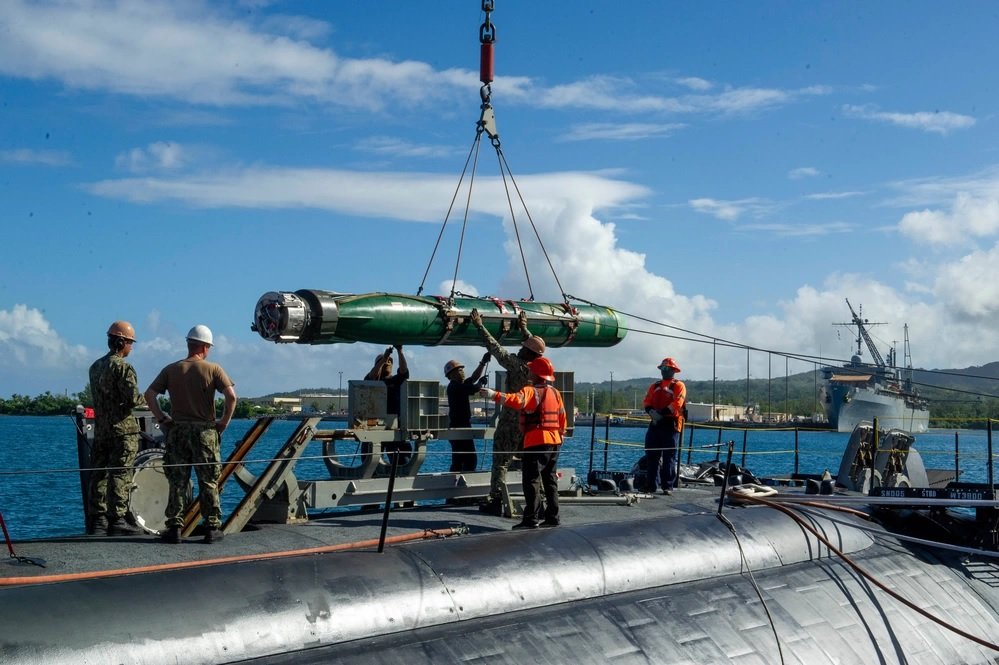
WASHINGTON — The U.S. Congress has directed the U.S. Navy to conduct a comprehensive review of its torpedo inventory, production capacity, testing infrastructure, and modernization plans under the National Defense Authorization Act (NDAA) for Fiscal Year 2027. The measure is intended to ensure the Navy maintains enough undersea weapons to support operations in two major regional conflicts at the same time.
The legislation requires Secretary of the Navy Hung Cao to begin the effort within 90 days after the NDAA becomes law. The review will cover torpedo inventory levels, industrial production, testing systems, supply chain resilience, and future modernization programs.
A key requirement of the legislation is the establishment of mandatory inventory floors for every class of U.S. Navy torpedoes and related undersea weapons. These minimum stockpile levels are intended to ensure the Navy maintains sufficient reserves for wartime requirements.
The inventory floors will apply to the MK-48 Advanced Capability (ADCAP) heavyweight torpedo, the MK-54 lightweight torpedo, advanced torpedo variants, training and testing rounds, and torpedo countermeasures. The required stockpile levels will be based on Navy assessments of projected torpedo expenditure during a conflict involving two peer or near-peer maritime adversaries.
In addition to setting inventory requirements, the NDAA directs the Navy to evaluate the current condition of the U.S. undersea weapons industrial base. The review will identify production bottlenecks affecting key areas, including energetic materials, propulsion systems, acoustic seekers, guidance electronics, specialty metals, undersea weapon integration, manufacturing facilities, and reliance on single-source suppliers.
The legislation also requires the Navy to develop a plan to increase production capacity to support both routine peacetime manufacturing and rapid wartime surge production. The plan will examine options such as establishing second-source suppliers for critical components, expanding government-owned and private manufacturing facilities, increasing cooperation between public and private industry, and making greater use of multi-year procurement authority to improve long-term production planning.
Congress has also instructed the Navy to strengthen supply chains for sensitive and difficult-to-source components that could become vulnerable during future conflicts.
The NDAA further calls for modernization of the Navy's undersea weapons testing infrastructure. Planned improvements include upgrades to target vessels, expansion of undersea test ranges, improvements to digital testing models, and enhanced environmental testing to verify weapon performance in deep-water and Arctic operating conditions.
The legislation also directs the Navy to improve resistance to advanced acoustic countermeasures and develop more efficient wartime transportation and logistics methods for undersea weapons.
Secretary Cao must submit a comprehensive report within 120 days after the NDAA is enacted. The report will outline the Navy's findings, recommended actions, wartime expenditure estimates, industrial base requirements, production expansion plans, testing improvements, and measures to reduce supply chain risks.
Following submission of the report, Secretary Cao is expected to present the findings during congressional hearings, where lawmakers will review production risks, inventory requirements, testing strategies, and investment plans needed to meet future operational demands.
The congressional review comes as the Navy continues work on several next-generation undersea warfare programs.
Among them is the MK-58 Compact Rapid Attack Weapon (CRAW), developed by Raytheon. The MK-58 is designed for both offensive anti-submarine operations and defensive use as a hard-kill anti-torpedo weapon capable of intercepting incoming torpedoes. According to previously released program information, the weapon uses an electric propulsion system for quiet operation and a stored chemical propulsion system for high-speed intercepts. Its compact size could also allow submarines to carry multiple MK-58 weapons in space typically occupied by a single larger torpedo. The MK-58 was selected over the RAPTOR low-cost heavyweight torpedo.
The Navy is also continuing development of improved defensive countermeasures. In February 2026, Ultra Maritime received a contract to develop the next-generation Acoustic Device Countermeasure (ADC) MK6. The system is designed to produce tailored acoustic signatures intended to confuse and divert advanced enemy torpedoes away from U.S. naval vessels.
According to the House version of the FY2027 NDAA, the torpedo-related provisions are included in Section 130 under Navy programs. The bill has passed the House of Representatives and, as of late July 2026, remains under consideration.
——— End of Article ———