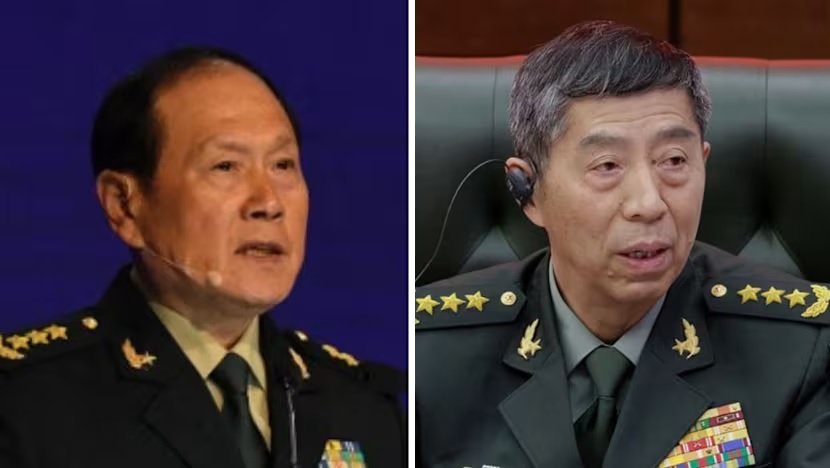
BEIJING — May 7, 2026 : Chinese authorities have sentenced former defense ministers Wei Fenghe and Li Shangfu to death with a two-year reprieve after both were convicted on corruption-related charges, according to rulings announced by Chinese state media on Wednesday.
The judgments, published by Xinhua News Agency, represent the most severe punishment imposed on senior military officials during President Xi Jinping’s ongoing anti-corruption campaign inside the People’s Liberation Army (PLA).
The military court found Wei guilty of accepting bribes and abusing his authority in military personnel promotions. Li was convicted of accepting and offering bribes, as well as facilitating appointments and promotions for specific individuals within the military structure.
Both men were stripped of political rights for life and had all personal property confiscated.
Under Chinese law, a death sentence with a two-year reprieve is typically reduced to life imprisonment if the convicted individual does not commit additional crimes during the suspension period. Chinese authorities stated that, following commutation, both Wei and Li will serve life sentences without the possibility of parole, sentence reduction, or further commutation.
Senior PLA Figures Brought Down
Wei Fenghe served as China’s defense minister from 2018 to 2023 and previously held senior leadership roles within the PLA Rocket Force, the branch responsible for China’s nuclear missile and strategic deterrence capabilities.
Li Shangfu succeeded Wei as defense minister in 2023 but remained in office for less than eight months before disappearing from public view amid corruption investigations. He later became the shortest-serving defense minister in the history of the People’s Republic of China.
Both former officials had also served as members of China’s powerful Central Military Commission (CMC), the top military command body chaired by Xi Jinping.
In 2024, the Communist Party of China expelled both men for what authorities described as “serious violations of discipline,” the standard phrase used in major corruption investigations involving senior officials.
Expansion of the Military Purge
The sentencing comes as China continues a broad anti-corruption campaign across the PLA that began intensifying in 2023 following major scandals within the PLA Rocket Force.
The Rocket Force was the first branch to face extensive restructuring after investigations uncovered corruption linked to procurement, promotions, and operational management. The campaign later expanded to the Central Military Commission, senior procurement departments, and top military leadership.
Analysts have described the current purge as the largest crackdown inside the Chinese military since the era of Mao Zedong.
According to reports cited by Bloomberg and international defense researchers, nearly a fifth of the PLA’s generals have been removed, investigated, or disappeared from public view since the campaign accelerated under Xi Jinping’s third term.
Of the 79 generals personally promoted by Xi, at least 14 have reportedly come under investigation or been removed from active leadership positions.
Research published by the Center for Strategic and International Studies indicated that the purge has affected a substantial portion of the PLA’s senior command structure, creating significant vacancies across several branches of the military.
Corruption Networks Inside the PLA
Investigations conducted during the anti-corruption campaign exposed widespread corruption throughout multiple levels of the PLA.
Reports indicated that cadets seeking admission to leading military academies allegedly paid bribes of up to $16,000 to secure passing examination scores or entry approvals. Officers were also accused of paying senior commanders and generals to obtain promotions and preferred assignments.
According to reports, some officers later recovered those costs through kickbacks connected to procurement contracts and internal military projects.
Authorities also uncovered corruption involving equipment procurement, weapons acquisition programs, and armaments production systems.
Separate reports citing U.S. intelligence assessments alleged that corruption within the Rocket Force contributed to operational failures, including defective missile silo construction and maintenance irregularities affecting parts of China’s strategic missile infrastructure.
Impact on China’s Military Leadership
The removal of Wei Fenghe and Li Shangfu has added to a period of major instability within China’s senior military leadership.
The anti-corruption campaign has resulted in rapid turnover across several PLA branches, including the Rocket Force and senior command structures linked to procurement and strategic operations.
Defense analysts say the campaign reflects Beijing’s efforts to strengthen internal discipline, reinforce political loyalty to the Communist Party, and tighten centralized control over the military during an ongoing modernization program.
At the same time, analysts note that the removal of experienced commanders and senior officials could create operational and institutional challenges as the PLA continues efforts to modernize its forces and expand military capabilities.
Following Li Shangfu’s removal, Dong Jun was appointed as China’s defense minister.
The sentencing of Wei Fenghe and Li Shangfu is expected to remain a significant development in China’s wider military restructuring efforts as investigations continue across senior PLA ranks and defense procurement systems.
——— End of Article ———