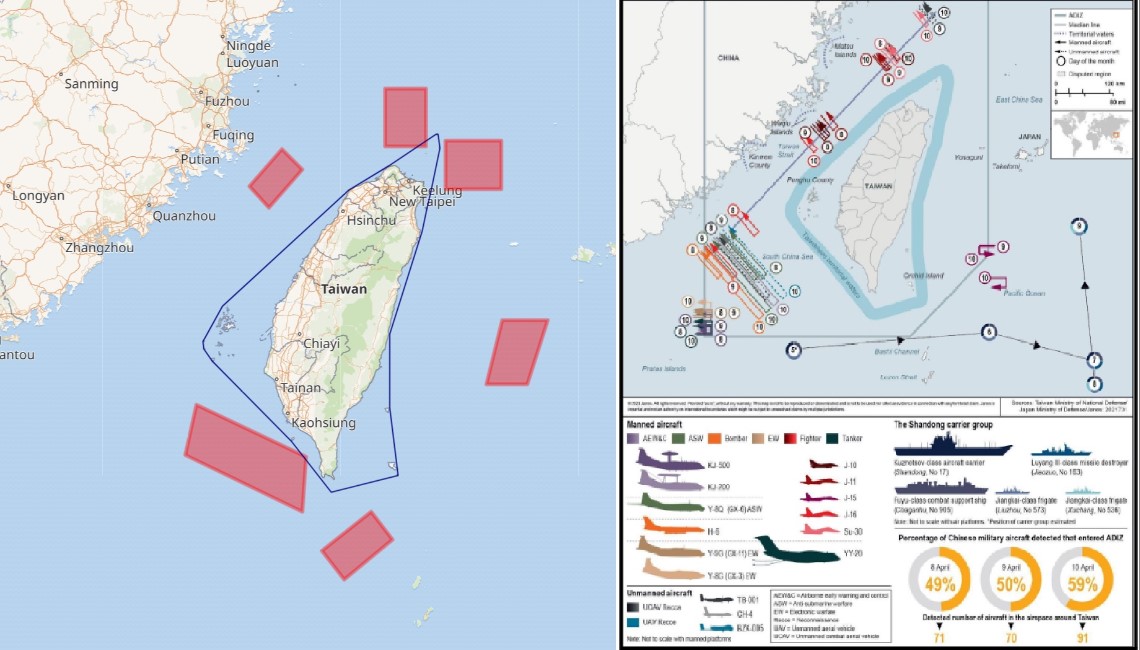
Beijing / Taipei / Washington — China has sharply escalated military pressure around Taiwan by initiating large-scale joint exercises under the code name “Justice Mission 2025,” a move that comes days after the United States approved the possibility of military procurements for Taiwan worth up to $11 billion. The drills, announced by the Eastern Theater Command of the Chinese Armed Forces, mark one of the most expansive and operationally realistic military demonstrations Beijing has conducted around the island in recent years.
The exercise follows a rapid sequence of escalation. After Washington’s arms decision, Beijing responded with strong diplomatic protests, explicit warnings to the United States, and sanctions on American defense companies. The launch of “Justice Mission 2025” now signals a transition from diplomatic and economic pressure to direct military coercion.
Joint Forces Encircle Taiwan
According to official Chinese statements, units from the Army, Navy, Air Force, and Rocket Force have been mobilized to conduct coordinated drills in the Taiwan Strait and in operational areas north, southwest, southeast, and east of Taiwan Island, effectively surrounding Taiwan.
Shi Yi, spokesperson for the Eastern Theater Command, said the exercises are focused on sea-air combat readiness patrols, joint seizure of comprehensive superiority, blockades of key ports and maritime approaches, and all-dimensional deterrence along Taiwan’s outer defensive lines. The breadth of participating services and directions underscores Beijing’s emphasis on joint, system-of-systems warfare.
Precision Strike Phase and Close-In Maneuvers
A critical phase of the drills began on December 29, when Chinese forces deployed fighter jets, strategic bombers, and unmanned aerial vehicles, coordinated with long-range rocket fire, to conduct exercises in the central waters and airspace of the Taiwan Strait. Chinese sources say the focus is on precision strikes against mobile ground targets, a capability essential for disabling air defenses, missile launchers, and command infrastructure in a real conflict.
From the same date, Chinese naval and air units were dispatched to carry out combat readiness patrols around the island, approaching Taiwan from multiple directions at close proximity. The stated aim is to test the ability of forces to maneuver rapidly, establish an all-directional operational posture, and enforce blockade and control operations under combat conditions.
China initially announced five blockade sectors around Taiwan, later expanding them to seven, a move that analysts say effectively simulates a complete encirclement of the island. Such a configuration would allow Beijing to sever maritime trade routes, energy imports, and critical supply lines if ordered.
Beijing’s Political Message
Chinese authorities describe “Justice Mission 2025” as a stern warning to “Taiwan independence” separatist forces and external interference, insisting the drills are a legitimate and necessary measure to safeguard sovereignty and national unity. The language closely mirrors long-standing positions that Taiwan remains a core national interest for Beijing, leaving little room for compromise.
Expert View: A Rehearsal, Not a Signal
Military analysts and regional security experts say the scale and structure of the exercises go well beyond routine signaling.
According to analysts at the International Institute for Strategic Studies, the drills resemble a textbook rehearsal of a pre-invasion campaign. “This is not simply about intimidation,” one senior analyst noted. “The combination of precision strikes, multi-axis naval maneuvers, and expanding blockade zones reflects how the People’s Liberation Army would seek to control escalation while strangling Taiwan economically.”
Experts from the Center for Strategic and International Studies assess that a blockade-first strategy remains Beijing’s most likely opening move in a Taiwan contingency. “A full amphibious invasion is risky and costly,” a CSIS report argues. “An enforced blockade allows China to apply maximum pressure while testing international resolve, especially that of the United States and its allies.”
Regional observers also point to the integration of the Rocket Force as particularly significant. “The emphasis on long-range fires coordinated with air and naval assets suggests China is refining its ability to neutralize targets without immediate ground landings,” said a former East Asian defense official now affiliated with the Lowy Institute.
Strategic Implications
The timing of “Justice Mission 2025,” so soon after the U.S. decision enabling $11 billion in potential arms support for Taiwan, highlights the increasingly volatile security environment in the Indo-Pacific. While Washington maintains that its actions are intended to preserve deterrence and stability, Beijing views them as direct challenges to its strategic red lines.
As the exercises continue, regional militaries and policymakers are watching closely for their duration, escalation pattern, and potential spillover effects. For now, experts agree on one point: “Justice Mission 2025” is less about symbolism and more about preparation, signaling that China is steadily refining the military options it could employ in one of the world’s most consequential flashpoints.
——— End of Article ———