Space News - On
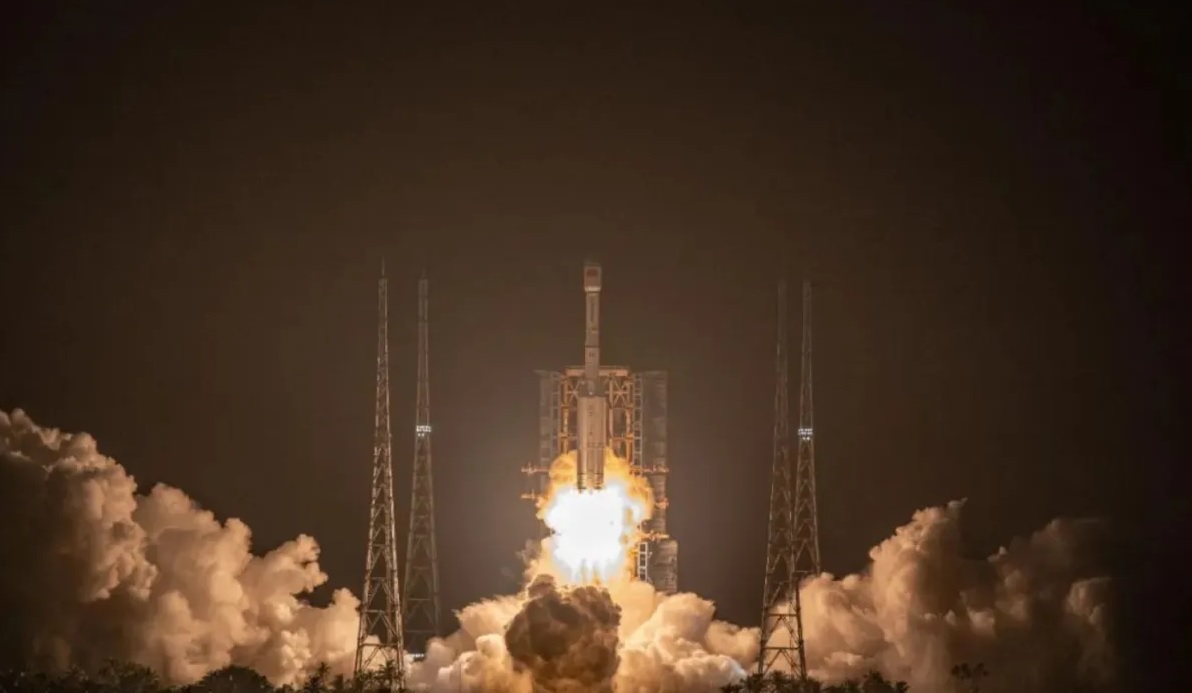
Friday, China successfully deployed the classified Yaogan-41 optical
satellite into the geostationary belt, utilizing the nation largest
launch vehicle, the sixth Long March 5 rocket. The launch took place at
8:41 a.m. Eastern (1341 UTC) from the Wenchang Satellite Launch Center
along the coast, with the China Aerospace Science and Technology Corp.
(CASC) confirming the mission success approximately an hour later.
The
Yaogan-41 satellite, developed by CASCs China Academy of Space
Technology (CAST) subsidiary, featured an elongated 18.5-meter-long,
5.2-meter-diameter payload fairing, a departure from the previous
12.3-meter fairings. Despite limited visual information provided by
CASC, state news agency Xinhua described the satellite as an optical
remote sensing satellite, emphasizing its applications in land survey,
crop yield estimation, environmental management, meteorological warning
and forecasting, and comprehensive disaster prevention and reduction.
However,
external assessments suggest a potential military application for the
Yaogan series, given the classified nature of the mission. The U.S.
Space Force space domain awareness cataloged the spacecraft in a 195 by
35,815-kilometer orbit inclined by 19.51 degrees.
This successful
launch contributes to China expanding capabilities in on-orbit remote
sensing. If Yaogan-41 assumes a position in geostationary orbit at
around 35,786 kilometers above the equator, it would provide continuous
observation of a fixed geographic area, covering about one-third of the
Earth surface. Geostationary optical data holds significance for
security, meteorology, climate studies, and environmental monitoring.
This
mission may be considered a potential military sequel to the civilian
Gaofen-4 satellite launched in 2015. Unlike the Gaofen-4, the Yaogan-41
is transported by the larger Long March 5, capable of carrying payloads
up to 14,000 kg to Geostationary Transfer Orbit (GTO).
The
Changchun Institute of Optics, Fine Mechanics and Physics (CIOMP) under
the Chinese Academy of Sciences (CAS) played a role in producing
critical components for space remote sensing. Additionally, CIOMP is
involved in the development of Xuntian, a Hubble-class space telescope
set to join the Tiangong space station in orbit in 2025.
This
launch follows China recent deployment of a geosynchronous orbit radar
satellite in August, bolstering its GEO observation capabilities. The
Long March 5, despite experiencing setbacks in its early flights, has
become a reliable workhorse for China space missions, including the
Tianwen-1 Mars mission and the Chang e-5 lunar sample return mission.
Furthermore,
China space exploration efforts continue, with the Long March 5 serving
as the foundation for the upcoming Long March 10, featuring upgraded
versions of the YF-100 kerosene-liquid engines and three
five-meter-diameter cores.
In a separate development, a day prior
to the Yaogan-41 launch, China successfully placed its experimental
reusable spacecraft into orbit for the third time. This spacecraft
achieved an orbit ranging from 333 to 348 kilometers in altitude,
inclined at 50 degrees.
As of this launch, China has conducted 61
missions in 2023, contributing to the global total of nearly 200
orbital launches. Notable achievements include crew and cargo missions
to Tiangong, satellite internet test satellites, and the initiation of
commercial liquid propellant launches. While CASC aimed for over 60
launches this year, it appears to be falling slightly short of this
target, although the organization has not experienced any launch
failures since 2020.
——— End of Article ———