BEIJING — May 8, 2026 : China has officially confirmed for the first time that Chinese technical personnel were deployed to support the Pakistan Air Force (PAF) during the four-day military conflict between Pakistan and India in May 2025, publicly acknowledging direct operational assistance provided during the clashes.
The confirmation was made through interviews aired by China’s state broadcaster CCTV featuring engineers from the Chengdu Aircraft Design and Research Institute, a division of the state-owned Aviation Industry Corporation of China (AVIC), which develops the J-10 fighter aircraft series.
The broadcast marks the first official Chinese acknowledgment that Chinese personnel were physically present in Pakistan during active combat operations involving India.
Chinese Engineers Confirm Deployment to Pakistan
During the televised interview, AVIC engineer Zhang Heng stated that he was deployed to a Pakistani operational support base during the conflict to assist with technical maintenance and combat support for Pakistan’s fleet of Chinese-built J-10CE fighter aircraft.
Zhang described the operational environment at the base, saying Chinese personnel regularly heard fighter jets taking off alongside air-raid sirens while conducting maintenance and support activities.
He said the working conditions were physically demanding, with temperatures at the base approaching 50 degrees Celsius during daytime operations.
According to Zhang, the Chinese team remained focused on ensuring that the aircraft and associated systems operated at their “full combat potential” throughout the conflict.
He added that the deployment reflected the close working relationship developed between Chinese technical teams and Pakistan Air Force personnel through continuous cooperation and operational coordination.
Another engineer from the same institute, Xu Da, also confirmed his involvement in the deployment.
Xu compared the J-10CE fighter aircraft to a “child” that the engineering team had developed and eventually transferred to the user after years of work and testing.
Speaking about the aircraft’s reported combat performance, Xu stated that the engineering team was not surprised by the outcome, saying the aircraft had simply been waiting for the opportunity to demonstrate its operational capabilities under combat conditions.
J-10CE Fighter and PL-15 Missile System
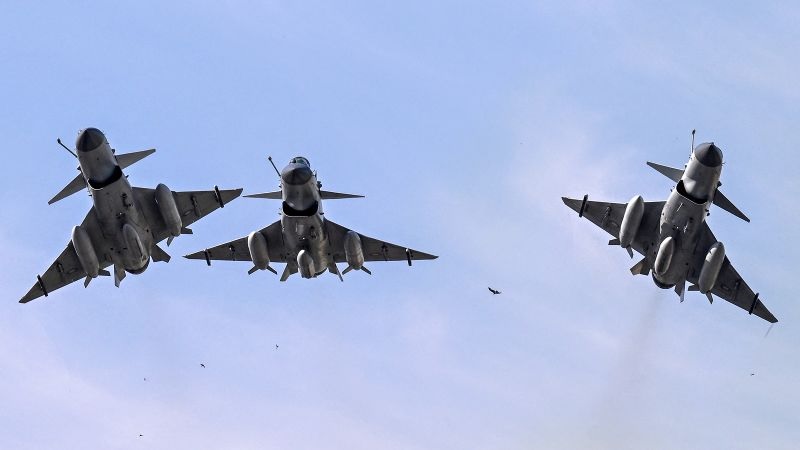
The J-10CE is the export version of China’s J-10C 4.5-generation multirole fighter aircraft.
The platform is equipped with an active electronically scanned array (AESA) radar and is compatible with advanced Chinese air-to-air weapons, including the PL-15 series beyond-visual-range air-to-air missile.
Pakistan remains the only confirmed foreign operator of the J-10CE fighter.
In 2020, Islamabad ordered 36 J-10CE aircraft along with approximately 250 PL-15 missiles as part of efforts to strengthen its air combat capabilities following India’s acquisition of French-built Rafale fighter jets.
The Pakistan Air Force also operates the JF-17 Thunder, a fighter aircraft jointly developed by China and Pakistan that serves as one of the PAF’s primary combat platforms.
According to data published by the Stockholm International Peace Research Institute (SIPRI), China accounted for nearly 80 percent of Pakistan’s total arms imports between 2021 and 2025, highlighting the depth of defence cooperation between the two countries.
Aerial Engagements During the 2025 Conflict
The May 2025 conflict marked the first reported combat deployment of the J-10CE platform.
Strategic and Defence Implications
Defence analysts have described the recovery of relatively intact PL-15E missile components as a significant intelligence opportunity for India because it potentially allows detailed examination of Chinese missile technology, including propulsion systems, radar seekers, guidance electronics, and internal architecture.
Chinese defence officials have largely avoided directly addressing reports regarding technical failures involving the recovered missiles.
Public comments from Chinese officials have instead emphasized the missile system’s operational capabilities and export presence while calling for regional stability and restraint.
The CCTV interviews with Chinese engineers are viewed as an important public acknowledgment of the extent of China’s operational and technical support relationship with Pakistan during the conflict.
The statements also underline the growing strategic defence partnership between Beijing and Islamabad, which has expanded over the past decade through joint aircraft development programmes, weapons transfers, training cooperation, and logistical support arrangements.
The J-10CE has attracted increased international attention following the 2025 conflict due to its reported operational use and the broader implications for Chinese military aviation exports in international defence markets.
AVIC and Chinese authorities have not released additional operational details regarding the deployment of Chinese technical personnel or the specific combat activities carried out during the conflict beyond the statements aired by CCTV.
——— End of Article ———