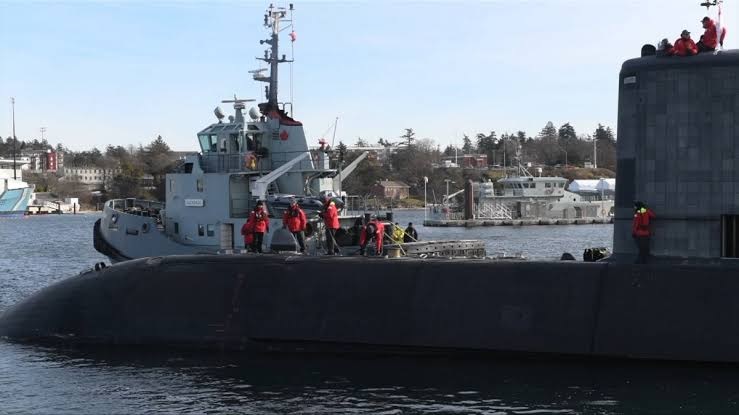
RIO DE JANEIRO / BRASÍLIA, — April 21, 2026 : The Brazilian Navy is scheduled to commission its first Tamandaré-class frigate, Tamandaré (F200), on April 24, marking a key milestone in the country’s Surface Fleet Renewal Programme (PROSUPER). The commissioning follows the vessel’s delivery to the Navy on March 9, 2026, and its subsequent arrival at its home port in Rio de Janeiro.
The development coincides with an announcement by President Luiz Inácio Lula da Silva during Brazil’s participation in the Hannover Industrial Fair in Germany this week, where he confirmed that negotiations have advanced for the acquisition of four additional frigates of the same class. A related agreement between Brazilian and German defence ministries supporting this expansion was signed on April 20, 2026. If finalized, the second batch would increase the planned fleet of Tamandaré-class vessels from four to eight.
Programme Structure and Industrial Framework
The Tamandaré-class programme, formally designated as the Programa Fragatas Classe Tamandaré (PFCT), is executed under PROSUPER and managed through the Águas Azuis Consortium. The consortium comprises thyssenkrupp Marine Systems, Embraer Defesa & Segurança, and Atech.
The initial contract, awarded in March 2020, covers the construction of four frigates at the Itajaí shipyard in Santa Catarina. The vessels are based on the MEKO A-100 modular design developed by thyssenkrupp Marine Systems. The programme incorporates technology transfer from Germany and includes workforce qualification measures, with local industrial participation estimated at 31.6 percent for the lead ship and increasing to approximately 41 percent for subsequent units.
Construction Timeline and Fleet Progress
The lead ship Tamandaré (F200) was launched on August 9, 2024. Construction of follow-on ships is progressing according to schedule. The second vessel, Jerônimo de Albuquerque (F201), was launched on August 8, 2025, and is currently undergoing outfitting. The keel of the third frigate, Cunha Moreira (F202), was laid in June 2025, while the fourth ship, Mariz e Barros (F203), remains under construction.
Deliveries of the initial four vessels are scheduled between 2026 and 2029.
Design Characteristics and Propulsion
The Tamandaré-class frigate has a full-load displacement of approximately 3,500 tonnes. It measures 107.2 metres in length, with a beam of about 16 metres and a draught of 5.2 metres. The vessel accommodates a crew of 130 personnel and features a flight deck and hangar capable of operating a medium helicopter.
Propulsion is provided by a combined diesel and diesel (CODAD) configuration consisting of four MAN 12V 28/33D STC engines, generating a total output of approximately 21,840 kW. Power is transmitted through two shafts equipped with five-bladed controllable-pitch propellers. Electrical power is supported by four Caterpillar C32 diesel generators.
The ship achieves a maximum speed of approximately 27 knots and has an operational range of around 5,200 kilometres.
Weapons and Combat Systems
The frigate is equipped with a Leonardo 76/62 mm Super Rapid main gun and a Rheinmetall Sea Snake 30 mm close-in weapon system. Additional close-range defence is provided by two Sea Defender 12.7 mm remote weapon stations.
Its missile armament includes the MBDA Sea Ceptor air-defence system housed in a 12-cell vertical launch system, along with eight MANSUP anti-ship missiles. Anti-submarine warfare capability is supported by the SEA TLS-TT torpedo launch system configured for Mk 54 lightweight torpedoes. Defensive countermeasures include the Terma C-Guard decoy launching system.
The combat management system is the Atlas-ANCS supplied by Atlas Elektronik, while the integrated platform management system is provided by L3Harris (L3 Mapps).
Sensors, Electronics and Navigation
The sensor suite includes the Hensoldt TRS-4D ROT active electronically scanned array volume search radar and the Thales STIR 1.2 fire-control radar. Additional systems include a Raytheon S-band surface-search radar, X-band navigation radars, and the Atlas Elektronik ASO 713 hull-mounted sonar.
Electronic warfare capabilities are provided by the MB/Omnisys Defensor MK3 electronic support measures system, complemented by Safran PASEO XLR optronic systems. Internal and external communications systems were designed and integrated by Rohde & Schwarz, while navigation is supported by the Anschütz SYNAPSIS integrated bridge system.
Trials and Certification Activities
Between April 9 and April 13, 2026, the Brazilian Navy conducted live-fire certification trials for the frigate’s combat and weapons systems in the Cabo Frio region of Rio de Janeiro state. The exercises included firing of the Leonardo 76 mm gun and deployment of Mk 54 lightweight torpedoes, with systems integrated through the combat management system alongside onboard sensors, radars, and electronic warfare components.
The trials involved participation from the Niterói-class frigate Defensora (F41) and an AH-11B Wild Lynx helicopter to support multi-unit operational integration. Deck-landing qualification training with the Super Lynx Mk21B helicopter was also completed during the evaluation phase.
Operational Role and Fleet Transition
Following commissioning, Tamandaré (F200) will replace ageing Niterói-class frigates and contribute to Brazil’s maritime security requirements. Its operational profile includes maritime surveillance, anti-surface warfare, anti-submarine warfare, and anti-air warfare missions in support of the country’s National Maritime Strategy.
The planned expansion to eight vessels, if concluded, would extend the programme timeline into the next decade while reinforcing Brazil’s domestic shipbuilding capabilities through continued industrial participation under the Águas Azuis Consortium.
——— End of Article ———